Showing posts with label fantasy. Show all posts

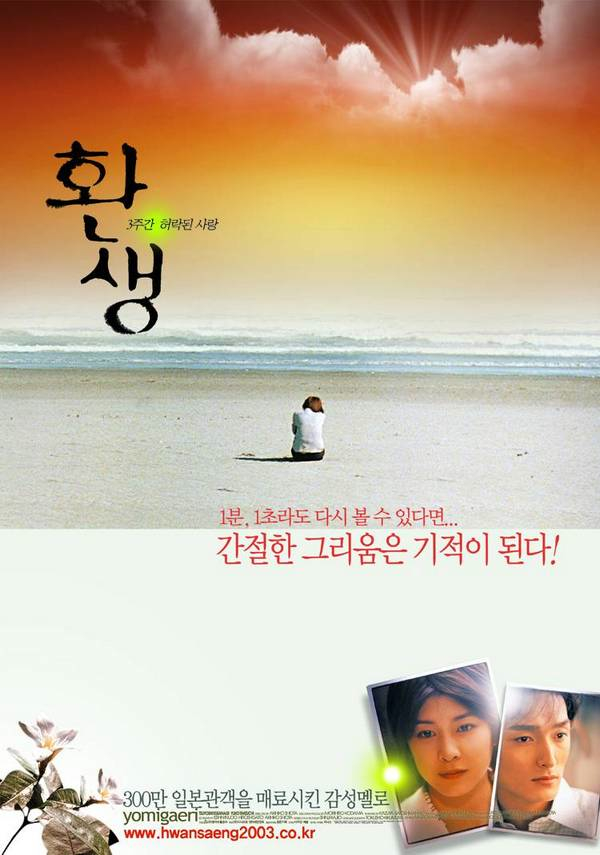
Resurrection 黄泉がえり (Yomigaeri) [2002] • Japan

It's hard to believe this is a Shiota Akihiko film; it's so mainstream sentimental. Compared to the two very independent flavored films about lost teenagers he made just before and after this one—the brutal Harmful Insect and the ennui filled Canary, not to mention his twisted psycho-sexual drama debut Moonlight Whispers—Resurrection is mall fodder. It's not bad as far as these things go. It just surprised me. The film stars adults instead of teenagers, but in the end it is very much a teen film.

People start returning from the dead. Children to parents, husbands to wives, wives to husbands, and so on. Each of these resurrections gets its own postcard-style short story and they are all meant to pull the heartstrings, nothing more. They have almost nothing to do with one another and they don't build to any big party for the dead. The film is a loosely knit series of vignettes held together by a government bureaucrat who returns to the little town where the events are happening, which also happens to be the town where he was born, to investigate the occurrences. Of course there is a girl there whom he pined for but lost contact with when he moved away. She serves as a love interest and sceptic. There's a twist and then you're supposed to cry.

It's all good. The film is so harmless it's hard to object to anything about it, except maybe the government bureaucrat's haircut. Tsuyoshi Kusanagi, as the bureaucrat, is an odd looking fellow. He'd been a member of the pop group SMAP, which lends more to the mall fodder aspect of the film, and he approaches the role with a sincere earnestness. He has a few well done moments of emotional outburst but is overall pretty flat, although not disagreeable, as an actor. Yuko Takeuchi is wonderful as the tomboyish love interest.

There is, actually, a big party for the dead at the end, but not really. It's a concert, which at first seems to serve only to highlight a couple songs, in their entirety, by pop singer Kou Shibasaki. Then you remember, "oh yeah, that's the girl from the beginning of the movie". It's not that this film is hard to follow, it's just structured in a way which favors feeling over narrative. The vignettes don't come together Altman style. They are all pretty much self-contained units.

This movie was a big hit in Japan when it came out, back when SMAP and Shibasaki were at the top of the charts, and was probably a lot more fun than it is now. What's interesting to me about it is seeing it in the context of Akihiko Shiota's other work. I haven't seen his two most recent films, Dororo and A Heartful of Love, but if this one is any indication, it suggests he is fully capable of making mainstream commercial films if he wants to. I don't know if that is good or bad.

★★★
Director: Akihiko Shiota
Starring: Tsuyoshi Kusanagi, Yuko Takeuchi, Yuriko Ishida, Sho Aikawa, Keiichi Yamamoto

IMDb
Asianmediawiki
Japan Times
Beyond Hollywood

Scott Pilgrim vs. the World [2010] • USA

A total blast. This film has about a dozen principle players and they are all great. Michael Cera does his Michael Cera thing but since I've only seen him do it once before I'm not sick of it. This is a good film for him. He gets to rock out on bass guitar and do a lot of ninja fighting. It's all way over the top and executed very well. Whoever edited this film deserves an Oscar for it. It's amazing. This is easily the most fun I've had watching a movie all year. But it's not trash fun. It's witty. I was smiling from start to finish and LOL'd many times. Not a weak or bad character in the bunch.

I understand that this film had a hard time defining its target audience. Who cares? It is sort of a middle school level cartoon with subtlety more mature humor. I don't care that many of the video game references are dated and I don't think the film is "I'm so smugly and ironically hip." I wasn't interested in seeing this film until I noticed it showing up on a few year end top tens. Yes, the film's marketing escaped me too. I was immediately hooked. Try it. If you aren't smiling and laughing in the first ten minutes unplug it and move on. It's at Netflix.

★★★★★
Director: Edgar Wright
Starring: Michael Cera, Mary Elizabeth Winstead, Kieran Culkin, Jason Schwartzman, Chris Evans, Anna Kendrick, Ellen Wong

IMDb
Wikipedia
Twitchfilm (Todd Brown)
Twitchfilm (Jim Tudor)

Secret (Himitsu) [1999] • Japan ... & ... The Secret (Si j'etais toi) If I Were You (2007) • France

I saw the 2007 French/American version of this film first without knowing it was a remake. I liked it, especially the performance by Olivia Thirlby, but when I discovered the 1999 Japanese version, which I liked even more, it highlighted for me a little of why I like Japanese films in particular, and East Asian films in general. It's a lot sweeter and more subtle. More sad too, casts a wider emotional net. As a matter of disclosure I'll point out that I am not a remake basher, on principle, at all.

The basic story centers on a seventeen year old girl whose body is inhabited by her mother's soul. The two of them were in a terrible accident, and while in the hospital, just as the mother is about to die she reaches over, all ceiling of the Sistine Chapel like, and transfers her soul into the body of her daughter. The daughter keeps her body but becomes her mother in personality and memories. When she goes to school and hangs out with her friends she doesn't really know what's going on, who the people are or what her homework assignments are, because ... well, she's her mother now, for all practical purposes. It takes her a while to come to terms with what's happened and even longer to convince her father/husband.

Now, to cut right to the chase in case you can't see the 400 pound gorilla in the room, once the father is convinced that his wife is living in the body of his daughter and they, well, ya know, they're all in love and stuff ... so what about sex?

Things get a little creepy but I give both films high marks for how delicately the sex question is handled. I'll leave it at that and say it's not the main theme of either film, just one of many issues that come up.

The English version is loud and antagonistic. It's not a horror movie (not sure how it got marketed as such) unless you consider David Duchovny spooning with a seventeen year old girl to be horror. The daughter is in rebellion mode against the mother before the accident and their relationship takes center stage—the mother discovering her daughter’s world of sex, drugs, and rock and roll while the daughter comes to recognize the love that her mother has always had for her. The Japanese version is much quieter in comparison. The mother and daughter love each other very much and the antagonism angle focuses on the husband/wife relationship. The husband becomes sad and wimpy, feeling oppressed by having his wife around only as a roadblock to his moving on. The diet of sadness is served in small introspective doses, though, and changes how the film resolves. In the English version the resolution occurs between the mother and daughter. In the Japanese version it is between the husband and wife and involves a big twist that should serve to remind viewers that this has been a fantasy film, after all. As mentioned, I saw the English remake first and it didn’t do the twist, and when I watched the original (with the twist) I thought to myself “This is why I like Asian cinema.” It is so Japanese. Just when the limits of despair seem to have been reached, another complex layer of sadness is revealed for your weeping pleasure. (I wonder how the book they're both based upon ends.)

I’m not a remake basher but I think if I had seen the Japanese version first I might have railed against the remake for changing focus and tone. Having seen the English version first allowed me to enjoy it for what it was, and it didn’t in any way impinge upon my enjoyment of the original. I recommend both films but suggest, oddly, seeing the remake first. Both films explore, and handle, the creepy dilemma of “Would you have sex with your wife if she was living in your daughter’s body?” quite well. They’re both sweet and touching ... except for some of the touching.

★★★★ 
(Japanese version)
Director:  Yojiro Takita
Starring: Ryoko Hirosue, Kaoru Kobayashi

IMDb
Asianmediawiki


★★★★ 
(English version)
Director: Vincent Perez  
Starring: David Duchovny, Olivia Thirlby, Lili Taylor

IMDb
Wikipedia

Duelist (Hyeongsa) [2005] • South Korea

I'm a big fan of of director Lee Myung-se's M, consider it a top ten favorite film of all time. It's an audio visual masterpiece. The man has undeniable multimedia chops with an unconventional approach to storytelling.

Duelist shares M's visual beauty along with its fragmented narrative style. It's not hard to get the basic story in either film but you do need to step back and just go with the flow rather than keeping notes on how A leads to B leads to C, and so on. Set in the Joseon Dynasty, the story here is your basic good (in this case) girl cop falling for the bad guy she's supposed to capture and put behind bars, with the romantic angle competing with, and coloring, the chase. There's a mystical twist to it too, wherein the would be lovers don't do a lot of talking to one another, instead, they fight. With swords. This allows director Lee to stage some dramatic and very elegant battle scenes, but the motivation here is romance so the dueling is presented as dance rather than combat, and probably won't satisfy fans of traditional action movies. There's a lot of killing but very little blood. The battles are emotional, internalized and stylized without all the grunting and macho posturing that usually accompanies this kind of action.

One of the many dualities of the film is the unrefined, gut level nature of the cops versus the refined ways of aristocratic bad guys. Another is the way the cat and mouse game shifts back and forth between sleuthing and the romance. The Duelist knows the young lady cop is infatuated with him, that his capable mysteriousness in matters of crime and conflict occupies her heart as well as her head. So he toys with her. She is his equal in combat but not in love and he uses this to his advantage.


Ha Ji-won shines in her role as the young police officer who plays the mouse to the Duelist cat. She gets to be goofy, girly, and kick ass all at once. You can tell she is doing most of her own stunts and she's got surprisingly good comic timing. This film is also quite funny at times. A lot of the humor is of the bumbling kind but it's not cheap slapstick. It's more good natured (unfair to characterize it as) loser type struggle. Veteran actor Ahn Sung-Kee, who elevates every film he is in, plays mentor to Ha Ji-won, and he's just great. Supermodel Kang Dong-Won plays the Duelist, named "Sad Eyes", and does a respectable job of playing a hairstyle with depth.

Duelist is a beautiful, if loosely constructed film that won't satisfy hardcore action fans. For me, even though the fighting scenes were mostly stylized dance pieces, and the film wouldn't work without them, there were just too many of them for me to want to watch the film again and enjoy all the other good stuff about it. Take a look at the clip below to see how awesome this guy is at shooting film and marrying music to it.

★★★

Director: Lee Myung-se
Starring: Ha Ji-won, Ahn Sung-Kee, Kang Dong-Won

IMDb
Wikipedia

Avatar: An IMAX 3D Experience [2009] • USA

I've finally seen Avatar in all its glorious 3D IMAXness. I applaud the commitment and the massive amount of work that went into making it, which is just a different way of saying I give it an A for effort, but I'm not sure I'm ready to respond to it as merely an experience and set aside thoughts on how it fares as a film.

The problem with, like, solidly professional filmmakers who make big ass films like this is that they often rely on cardboard cutout stereotypes for character development. For every beautiful set piece, every touching ritual or philosophical bit of soul candy in Avatar, and there are lots of them, there are moments of groan out loud, eye-rolling plot points and dialog. I understand the need for expediency when creating a brand new world and trying to tell a story within it (within the running time of a movie) but that doesn't mean it's exempt from taking hits for it. If you are the type to overlook things like this, like so many seeds in a watermelon, then you will probably enjoy this movie, a lot. And by 'things like this' I mean almost all the moments and characters in the film that are negative in some way. The Colonel, why is he so shiny? Maybe there are tools like him in real life but he seems more irratating than badass. As good as Giovanni Ribisi is, he really goes dumpster diving for this role. Sigourney Weaver plays an ultimately good character, and it's actually developed pretty well, but every time she has to act tough, or act like a bitch, I sighed silently in protest of the script. The same is true of Tsu'tey, the jilted heir.

Creating conflict and character development in films is tough. At almost three hours, the film didn't feel long to me at all. I was never bored and if some of the blunt shallowness could have been presented in a more ripened form by extending the running time I would have been happier, overall.

I don't mind one bit that Avatar is a story that we've heard before and will hear again. That's the nature of good stories, educational fables. They keep getting retold. All in all, Avatar has some incredibly beautiful scenes and some very uplifting and touching moments and if you're not a film creep like me who prefers character studies to fantasy and action, you will love this movie.

★★★★

Director: James Cameron
Starring: Sam Worthington, Zoe Saldana, Stephen Lang, Sigourney Weaver, Michelle Rodriguez

IMDb
Wikipedia

A Blind River (Kwihyang) [2009] • South Korea

Everything about this film is perfect ... except that it doesn't lend itself to slick and easy summation. It's beautifully shot, powerfully acted, skillfully directed, and the soundtrack, while used very sparingly, when called upon to augment the emotion of a scene, is executed with flair.

OK. That's some hyperbolic praise. This film blew me away. The funny thing is, though, I'm not sure I really got it, or got all of it. In a nutshell the film is about a thirty years young Korean man in search of his biological mother. With extras.

This film touches on many of the related topics of child abandonment, identity, adoption, loss, and being young and pregnant and alone (not to mention some very pointed exposition on Korean nurseries and clinics) in very powerful ways but it's not a message film nor an after-school special level catharsis. It's way weirder, and more literary, and much more poetic. The film is more like a visual narrative than a story. The second act is pretty much a riff on Albert Camus' Le Malentendu. And what a second act it is. It reaches Shakespearean levels of emotional intensity that are downright scary, getting jiggy with some twisted Oedipal sidewinder concoction. I wouldn't call this an art-house film, though. It doesn't come off as pretentious or intentionally vague even though parts of it might seem random and inexplicable.

So what is it I didn't get? The film opens abruptly with a scene, likely to cause you to recoil in your seat, of young girl in somewhat primitive circumstances having an abortion. It's not explicit, more fly-on-the-wall view, but it's potent. And I think it's an abortion. Could be she is going to deliver the baby and sell it. Given the stage of her pregnancy the latter is more likely, and the film seems to want to ask if there is a difference. [UPDATE: upon a second viewing, it's clearly option #2, but I'm leaving my error because I'm in favor of letting this represent my initial reaction] Either way, she is in full traumatized mode. The confusing part is that this girl continues to appear in the film, pregnant, with ambiguous results in a parallel storyline. I'm not sure if she is to represent the boy's mother or simply another scenario. I'm not sure at what level this film plays with time, reality, representation, or dreams but only my left brain wants to know. There's nothing frustrating or loose-endy about it if you just let it be.

After the first scene the film settles into more standard drama for a bit, with a little cultural essaying and identity politics as it introduces us to the young man who will be our protagonist. He is with his girlfriend who wants to support him but also proposes to him and suggests it might be better if the two of them start their own family instead. The young man says he's not ready for that and abandons her to go find his mother.

The young man was raised in Australia and speaks English. His Korean is broken at best and this adds to the difficult dreamlike second act when he returns to Korea and ends up at a broken down hotel run by two widows, one of whom may or may not be his mother. I'm not even going to begin to try and dissect the second act. Suffice to say, the ambiguity of this film is precise and remarkable. As is the performance of Park Ji-a as the younger of the two women inn-keepers.

Park Ji-a, apparently going by simply ZIA now, is the only person associated with this film that I know anything about. She's been in a few Kim ki-duk films, most notably the lead in Breath (Soom), and I've always liked her peculiar beauty and thin but extremely muscular frame. It's not surprising to see her here as she has always seemed at home in Kim's dreamy structures. A Kim ki-duk directorial comparison is apt here but I can't tell you a thing about the person who directed this movie, Ahn Seon-kyeong.

Park Sang-hun is very good as the young Korean man, and I guess I do know about Park Ji-Yeon who plays his girlfriend. Her role is minimal but she does a fine job. I'm not sure who plays the young pregnant girl (Kim Ye-ri?) but her performance is amazing. She practically steals the show and you will feel very strongly for her.

Things wrap up with a mildly melodramatic resolve but I didn't really care one way or the other about it. The film had to stop at some point. I can't imagine that even if you hate the ending that it would spoil the preceding journey. This is a film that should be seen by anyone interested in good and/or powerful film making. It's not about the story or the message. It's about the colors and the brush strokes. And the meter.

★★★★★ 

The Most Beautiful Night in the World (Sekai de ichiban utsukushii yoru) [2008] • Japan

It's all here. The reason for wars and other bad things is that people are not sexually satisfied. So, create a potion that will make everyone want to have sex all the time, all the unhealthy people will die from exhaustion, and then the world will be overrun with children. The march of civilization will stop but at least so will the wars and corruption. Interesting idea, but the acting and the storytelling in this nearly three hour film are so bad it can only work by virtue of a train wreck curiosity. It may become a cult classic. It's got full frontal nudity and a fifty persons naked orgy at the end. You can't take this film seriously but it does make a case for taking pity on it. It's bad, frighteningly bad, but it's shooting for being so bad it's good, hoping to create a pathetic charm. And it succeeds, to a degree. I admit to sorta liking this film after it was over but sitting through it had many difficult moments.

Michie Itô is great as the genius girl who breaks out in an allergic rash when she gets near stupid people, and who gives birth to a girl who has no bellybutton because she was born in an egg.

It's definitely not a pink film and I even hesitate to call it weird. It's more just earnestly underachieving. There's a wholesome quality to it too. It's strangeness isn't typical of Japanese weirdness, it's more like midnight-movie camp. It's structure is that of a fifteen year old girl (the one without a belly-button) narrating the secret of why her small community has such a high fertility rate: "It all started fourteen years ago when 'that man' came to our village", and then it takes its sweet time getting to the present. There isn't really an allure that something erotic might happen, although Michie Itô's character has a way of leading you to the edge every time she shows up, but there is a continuing implication that the story might unfold in an interesting and fulfilling way.

It's not Christopher Guest weird, where everyone seems to exist in their own orbit, and it's not Satoshi Miki witty weird, it's more like Godzilla ... with animated sequences from a third-grader thrown in. NYAFF Trailer @ YouTube

★★★

Re-cycle (Gwai wik) (2006) • Thailand • Pang Bros.

One of the reasons the Pang Brothers' films are so engaging is they have an excellent grasp of sound design and good taste in music. Both this film and Diary (an Oxide solo effort) reach operatic proportions at times. They are not content to hire up a few jingles and play them over and over throughout the film in some sort of branding effort. Each scene has its own soundtrack. Oftentimes the soundtrack seems to lead the scene. I hesitate to call it music video-like because that smacks of demotion, but it is like a music video in the sense that the music is as important as the video.

Re-cycle reminded me of Terry Gilliam's work, but it's not as desolate or oppressive. It's a beautiful film made edgy by the Pang Brothers tendency to genre hop, mixing in horror and melodrama. I think most would agree the Pangs are quite skilled and creative in the visual department but seem to lack a command of the story telling part. I say, so what. I'm happy to be fully engaged while the film is playing, with my only after thoughts fond memories of the ride. I don't always need a deep philosophical discussion of what a film is trying to say.

There may be better ruminations on the basic idea of this film, and it's a good one--exploring a place where all that's forgotten or abandoned congregates--(Spider Forest comes to mind), but few will be as engaging as this multimedia masterpiece. I had no idea this film was going to take off into fantasy land and stay there for the duration of the film. It came as quite the surprise, and kept surprising me.

I loved Angelica Lee's man-shoes, and ... is there anything more adorable on this planet than an eight year old Chinese girl? Big round of applause for Yaqi Zeng!

★★★★

Last Quarter (Kagen no tsuki) (2004) • Japan

A good movie, maybe, to those it's meant for, but not me. I could barely sit through it. I don't think it is necessarily a poorly made film. It's a film clearly targeted at Asian early- and pre-teens with its inclusion of super-secretive Japanese rock star Hyde in a prominent, though not leading, role. Every time he appears on screen I roll my eyes and groan because he looks like a Keith Partridge wannabe trying to appear tough by smoking cigarettes. He might be a talented musician but he's a terrible actor, at least in this film.

The rest of the cast does a credible job. Model, actress and hair-do, Chiaki Kuriyama is always refreshing on screen. Western audiences may recognize her as Gogo from Quentin Tarentino's Kill Bill Vol 1. She appears to play the piano quite well, vamping on the film's musical theme a couple times. I like the theme a lot, but in the end this modern fairy-tale is just too sugar-coated and precious for my aged sensibility.

★★