Showing posts with label ★★★. Show all posts

Resurrection 黄泉がえり (Yomigaeri) [2002] • Japan

It's hard to believe this is a Shiota Akihiko film; it's so mainstream sentimental. Compared to the two very independent flavored films about lost teenagers he made just before and after this one—the brutal Harmful Insect and the ennui filled Canary, not to mention his twisted psycho-sexual drama debut Moonlight WhispersResurrection is mall fodder. It's not bad as far as these things go. It just surprised me. The film stars adults instead of teenagers, but in the end it is very much a teen film.

People start returning from the dead. Children to parents, husbands to wives, wives to husbands, and so on. Each of these resurrections gets its own postcard-style short story and they are all meant to pull the heartstrings, nothing more. They have almost nothing to do with one another and they don't build to any big party for the dead. The film is a loosely knit series of vignettes held together by a government bureaucrat who returns to the little town where the events are happening, which also happens to be the town where he was born, to investigate the occurrences. Of course there is a girl there whom he pined for but lost contact with when he moved away. She serves as a love interest and sceptic. There's a twist and then you're supposed to cry.

It's all good. The film is so harmless it's hard to object to anything about it, except maybe the government bureaucrat's haircut. Tsuyoshi Kusanagi, as the bureaucrat, is an odd looking fellow. He'd been a member of the pop group SMAP, which lends more to the mall fodder aspect of the film, and he approaches the role with a sincere earnestness. He has a few well done moments of emotional outburst but is overall pretty flat, although not disagreeable, as an actor. Yuko Takeuchi is wonderful as the tomboyish love interest.

There is, actually, a big party for the dead at the end, but not really. It's a concert, which at first seems to serve only to highlight a couple songs, in their entirety, by pop singer Kou Shibasaki. Then you remember, "oh yeah, that's the girl from the beginning of the movie". It's not that this film is hard to follow, it's just structured in a way which favors feeling over narrative. The vignettes don't come together Altman style. They are all pretty much self-contained units.

This movie was a big hit in Japan when it came out, back when SMAP and Shibasaki were at the top of the charts, and was probably a lot more fun than it is now. What's interesting to me about it is seeing it in the context of Akihiko Shiota's other work. I haven't seen his two most recent films, Dororo and A Heartful of Love, but if this one is any indication, it suggests he is fully capable of making mainstream commercial films if he wants to. I don't know if that is good or bad.

★★★
Director: Akihiko Shiota
Starring: Tsuyoshi Kusanagi, Yuko Takeuchi, Yuriko Ishida, Sho Aikawa, Keiichi Yamamoto

IMDb
Asianmediawiki
Japan Times
Beyond Hollywood

A Blue Automobile (Aoi kuruma) [2004] • Japan

This film has three things going for it: Aoi Miyazaki, Kumiko Aso, and a great soundtrack. Miyazaki and Aso are two of Japan's most talented and popular young actresses, and I'm always happy when a director shows good taste in music and uses it well—although the hip and evocative soundtrack used here sometimes seems a bit at odds with the slow paced art-house stylings of the film.

A Blue Automobile is a good looking film, very bleak, all stark and concrete, and there are a number of creative and interesting directorial choices made by Okuhara but the overall vision of the film left me wanting. That isn't always a problem but this film plays like it wants to be a film with a vision to talk about, an exploration of a heavy theme: pain, as a game changer. Indie actor cool dude Arata does a fine job as a young man who doesn't think much of living because of an accident as a child that has left him scarred around the eyes. He plays an introverted danger-punk guy, and we all know that fetching, young, good-hearted women are attracted to the type, so that's what plays out.

I was intrigued, fascinated even, by the characters as discreet units but wasn't able to engage or be moved by the exposition of the characters' motivations toward one another. It's basically another story about a guy who gets two women. And this time they are sisters, which adds to the oh-so-intense nature of the angst. That there's a big theme of immense suffering lurking in the background all the time doesn't make it much more than that, except it does make it "alternative".

The film has many bright moments and solid acting. It's not mainstream fare by a long shot, but fans of any of the three leads should enjoy watching them do their stuff. The film wants to be more than it is but it really doesn't matter. I enjoyed the experience of the film. It's one of those where you give more points to journey than goal.

★★★
Director: Hiroshi Okuhara
Starring: Arata, Aoi Miyazaki, Kumiko Aso, Tomorowo Taguchi, Kenji Mizuhashi

IMDb
Asianmediawiki
Japan Times

Norwegian Wood ノルウェイの森 (Noruwei no mori) [2010] • Japan

I let myself get over-hyped about this one: Director Anh Hung Tran's The Vertical Ray of the Sun is one of the most beautiful films I've ever seen; Cinematographer Ping Bin Lee, one of my favorites; Jonny Greenwood doing the soundtrack. Almost every publicity blurb about this movie starts off with "Upon hearing the song "Norwegian Wood," Toru remembers back to his life in the 1960s ..."

Well ... that blurb may describe the book but it has nothing to do with this film. I'm not a Beatles fan but I do carry a bunch of love for that song and it does bring with it a great sense of nostalgia. Somebody paid somebody a bunch of money to play that song over the end credits, all for naught. There isn't any real sense of nostalgia in the film except for some of the fashion and the big telephones. I let myself be mislead.

Greenwood's soundtrack might be interesting to listen to by itself but in the film all the lilting strings manage to seem bombastic. I literally muted the film several times it annoyed me so much. I don't think this is Greenwood's issue, though. Tran has been known to over-saturate a film or two with torturing soundtracks (The Scent of Green Papaya). Ping Bin Lee did come through. There are many breathtakingly beautiful scenes in the film, a few of which played silently for me because of the aforementioned soundtrack's habit of shitting all over the film.

I do not like Rinko Kikuchi's acting. I've seen her in a handful of films and while she gets some moments right, she often brings too much of her blonding international star self to roles (even before she had it) and I struggle to see a character beyond her personality. She whispers a lot which is a phony way to be dramatic done by people, strangely, desirous of attention. If they have your attention a little bit they can force you to double it by whispering. Fortunately she is only half the focus of the film. Texas born Kiko Mizuhara is awesome as the main "other" girl, Midori, in Toru's life. She's cute, spunky, forward, sexually confident, and blunt, but comes off as merely an outline of a character. I wish the whole film were about her. Ken'ichi Matsuyama, as Toru, is serviceable as the supposedly nostalgic one but hardly awesome enough to be a guy that three different girls just have to fuck. Gorgeous Eriko Hatsune has a nearly film-stealing scene but that's about all we see of her.

The film contains some rather bold, and funny at the same time, sexual dialog, although it's a little sore-thumbish because the film is only punctuated with it. I loved it, and laughed, when Midori calls up Toru and says "My dad died. Will you take me to a porno film? The most perverse one." She also has a few moments describing to Toru how she'd like to be bedded by him which are entertaining. Kikuchi's Naoko, after letting Toru know that she's too crazy with despair to sleep with him asks him if it's torture to have an unserviced erection: "I can help with that", she then offers. There is a good bit of sadness and mixed up desire in the film but the characters and the story aren't developed enough to see it as more than immature angst.

I think this film will appeal to teenagers and twenty-somethings who've read the Haruki Murakami novel it's based upon because most of the holes in the film will be filled in and the sense of nostalgia might be there. Not that teenagers have a lot of nostalgia for the sixties but the film is about loss, and it is fairly good at presenting that—except the adolescent level of it is pretty thin. The film is NOT about the way things were—the last few wonderful lines of the film and a Beatles tune can't save it. It's just a young-love story which lacks the depth to appeal to those not feeling the same way, i.e., older folks. Young people experiencing the whirlwind of sexual awakening, and or those who've had a friend commit suicide, might love it.

Norwegian Wood is a great looking film but not well written or acted, and since it is also quite slow moving I don't think it will engage general audiences who haven't read the book. It's not sexy enough nor smart enough.

★★★
Director: Anh Hung Tran
Starring: Rinko Kikuchi, Ken'ichi Matsuyama, Tetsuji Tamayama, Kiko Mizuhara, Reika Kirishima, Eriko Hatsune

IMDb
Wikipedia
Asianmediawiki

Dream Home 维多利亚一号 (Wai dor lei ah yut ho) [2010] • Hong Kong

Gore-hounds and violence enthusiasts should enjoy this one a lot, except that all the horror plot points are interrupted by a lot of story and social commentary about rising home prices in Hong Kong. Dream Home is a serious and thoughtful drama with a lot of blood.

The flashback narrative technique doesn't serve the film very well except for the fact that it lets the blood start flowing from the opening scene. It feels like a cop out to me when a director doesn't have the confidence to let a film build to its climax, and feels the need to begin with the climax and then retrace the steps that lead up to it.

A few of the kills in this film are fantastic, in a "Really?!?! Holy Shit!" sort of way, especially the coitus interruptus one. The fact that mild-mannered Josie Ho is performing them adds to the effect. The only problem I had is that many of them start off as failures, to build phony tension the wrong way, become successes, and then someone who should have been dead dead dead pops up for another go at it. This produces more bang for the buck by getting, say, a dozen kills out of only seven characters.

There's plenty of nudity and some graphic fucking to round things out but the cognitive dissonance created by mixing deep dramatic story lines with over-the-top bloodletting is likely to leave most viewers sitting on the fence verdict-wise. I recommend the film more to gore hounds than to connoisseurs of fine Hong Kong cinema. The film looks great and the production values are top notch, so ....

★★★
Director: Ho-Cheung Pang
Starring: Josie Ho, Anthony Wong Chau-Sang, Eason Chan, Michelle Ye, Hee Ching Paw, Kwok Cheung Tsang

IMDb
Wikipedia
Asianmediawiki
LoveHK Film

Under the Hawthorn Tree 山楂树之恋 (Shan zha shu zhi lian) The Love of the Hawthorn Tree [2010] • China

Zhang Yimou reportedly auditioned 10,000 girls in search of untarnished, innocent (old school Chinese) beauty when looking to cast the lead in this film.
"These young folks are looking worse and worse with each generation. Pretty girls obviously aren't marrying handsome guys these days. They're hooking up with this sugar daddy and that old lonely bachelor with money. No wonder the kids are lacking in the looks department.

When you look at any picture of young Chinese women from the 60s and 70s period, you'll almost always have an eager face that radiates innocent beauty looking back at you. This is now a thing of the past, young folks rarely have that innocence about them any more."
I read that before seeing this film and it put an awful lot of pressure on the young actress who passed the audition. She's cute, but she's no Gong Li. She's hardly a Zhang Ziyi either, but that may have more to do with the way the film is assembled than anything else.

I'm a BIG fan of Zhang Yimou's common people films. I love his nostalgic looks at the past and his thinly veiled commentaries on the Cultural Revolution and cultural change in general, in China. But Zhang seems to have tossed this one off before finishing a proper script. Title cards are used to fill in narrative gaps (red flag) and to allow for fade-to-black wistful shots of the girl biting her lower lip, pouting, and looking like the innocent beauty Zhang craves. I think the need for fade-to-black wistful shots of the girl biting her lower lip and pouting suggests he didn't find it.

The film is adapted from a popular mainland novel which was based on a true story set during the Cultural Revolution. There's lots of good stuff and great attention to detail concerning the period, and it satisfied my desire for that. There's a pretty standard love story plopped on top of it all, complete with a terminal disease tuggin at your heart strings. But not just any old love story, it's a Japanese styled "pure love" love story. That part is fine as well. A little Korean style melodrama mixed with Japanese pure love stylings works for me most of the time. So why didn't I love this movie?

Honestly, the title cards bothered me. Not just because the girl bit her lip and pouted going into many of them (which got on my nerves as well), but because they gave the film an unfinished quality. It's difficult to remain completely faithful to a novel when adapting it for the big screen, and just as voiceover narration can be used successfully to fill in narrative gaps or it can stick out like a sore thumb, so go the title cards.

"Sun told Jing that he would be waiting for her upon her return"

Sticks out like a sore thumb.

To be fair, dancer and senior high school girl, Zhou Dongyu, from Shijiazhuang in Hebei Province, with “eyes that are clear like the mountain springs”, is pretty fetching as the young girl who is sent to re-education camp and falls in love with an upwardly mobile land prospector. The film's theme of with whom and when one falls in love being up to the discretion of Communist Party leaders is far more tragic than the terminal disease. Shawn Dou Xiao is outrageously handsome and appealing as the young man who falls in love with her.
 
Under the Hawthorn Tree is delicately shot and filled with wonderful period detail. My final waffling verdict is: It's a beautiful and tragic love story with some distracting blemishes. If Zhang Yimou had spent as much time fleshing out a proper screenplay as he did finding a girl to play the lead character he might have produced another masterpiece. I recommend the film to those who like pure love stories.

★★★
Director: Yimou Zhang
Starring: Dongyu Zhou, Shawn Dou, Taisheng Chen, Rina Sa, Xuejian Li

IMDb
Wikipedia
Asianmediawiki

She, a Chinese [2009] • UK, France, Germany, China

Frustrated with life in a rural village, she's slapped by her mom, groped by her boyfriend, raped by a truck driver, moves to Shenzhen. Fired from a factory job on her first day, she volunteers to work at a Love Salon. Her lover gets killed (good thing he had a pile of money underneath his mattress). She moves to London and gets a job but her first paycheck is taken back because she has no bank account. She goes to work in a massage parlor and marries a wrinkly old white guy with a bank account who reads the newspaper too often and his cat dies. She gets pregnant by an Indian whose cultural identity is calling him home rather than pushing him away, so he leaves her. The quantity of bummers in this film is so thick it skips along too rapidly and loses credibility.

Lu Huang as Mei (The 'She' of the title) does a fine job plowing her way through the endless misfortune (she did the same thing in Blind Mountain—a great film), so props to her. The story, however, which has a heart and good intentions, asks so much of its characters it stretches the limits of credulity creating distance instead of empathy. It begins to suggest that the circumstances "She" gets into are a result of personal selfishness, or stupidity, rather than exposing or exploring the difficult climb from rural Chinese village to downtown London.

I recommend this film because many of the realities and situations it points at are worth considering. I just wish it would have pointed at a few less and explored them more deeply, or with a whisper of hope. I've got nothing against bleak films, but She, A Chinese gives the impression that once the desire to break free of tradition and hopeless circumstances begins, a stream of unrelenting nausea is likely to follow. Which in turn begs the question of whether the scenarios depicted in the film are the result of the personal characteristics of this particular She, in a sense becoming a character study, or if they are some sort of warning siren or social commentary on what a bitch life is if you begin from a certain place, look a certain way, and have unrealistic expectations concerning what can be done about it.

Broken into discreet elements—the film is broken into discreet parts with the use of title cards that offer sometimes whimsical commentary on various events—the execution is pretty good, but the overall impact is diluted. The performances are solid and the director does a good job making things appear realistic so it might just be a case of truth being harder to get on board with than fiction.

★★★
Director: Xiaolu Guo
Starring: Huang Lu, Wei Yi Bo, Geoffrey Hutchings, Chris Ryman, Hsinyi Liu

IMDb
Asianmediawiki

Girlfriend • Someone Please Stop the World [2004] • Japan

More Ryuichi Hiroki. This one is love story between a young woman photographer, Kyoko, who gets an assignment to pick a woman off the street and take nude photos of her for a men's magazine, and the woman who turns up as the subject of that assignment, Miho. Kiyoko's professional ethos is one of getting to know her subject deeply, be it a fruit plate or a human being, and as she does this she finds her interest in this particular subject, Miho, turning into fondness. The feeling is mutual, but this isn't a gay-themed film per se. There are just no barriers in the way that might prevent these two wandering souls from exploring each other, trying to find a positive relationship in a world they feel disconnected from, saddened by. The two performances are good enough, but not great, while the underlying drama and psychological trauma seem less satisfying.

I'm never quite happy with films that explore a lesbian liaison by setting up one of the participants as frustrated by bad relationships with jerkball men. It doesn't have to be that way. In this case it's Kyoko, but she has the personality of being frustrated by more than her bad boyfriends. She's a bit frustrated with herself and is trying to find a comfortable compromise between photography as art and photography as commerce. She's idealistic and a bit peculiar. When she meets Miho, who is angry about her father who left her family years ago and hasn't been in contact since, she meets someone who's more bummed out with life than she is so she's able to feel a little bit better about herself, and seems genuinely interested in, listening to Miho's stories. It's not unusual to become attracted to someone that makes you feel better about yourself.

Miho agrees to pose nude for Kyoko partly, well, mostly, as a means of getting back at, and getting the attention of, her father. I'm not sure about that as a method or as a solution but she's hurt and angry and she wants her father's attention. Kyoko and Miho are both presented as empathetic outsiders. Following them is a reasonably enjoyable romp in indie ennui but it doesn't wrap itself up into a grand story.

Girlfriend is part of the Love Collection, a loose series of DV shot features from 2004 with the common theme of love. Other entries include Kihatsusei no onna (A Volatile Woman) by Kazuyoshi Kumakiri, OLDK by Masahiro Hara, Nejirin bou by Tadashi Tomioka, Moon and Cherry by Yuki Tanada and Kokoro to karada by Hiroshi Ando.

★★★

Director: Ryuichi Hiroki
Starring: Aoba Kawai, Tomorowo Taguchi, Kinuwo Yamada, Kazuhiro Suzuki, Jason Gray, Aya Sugimoto
IMDb
Asianmediawiki
cinephilia101

Ex 前度 (Chin do) [2010] • Hong Kong

This film is just way too over-directed for my taste. Young director Heiward Mak seems to possess an intelligent and observant mind, can write insightful snippets of dialog and show us that she gets a certain segment of contemporary Hong Kong youth culture, but those skills and ingredients don't mean a good film is going to emerge. She co-scripted last year's wonderfully biting Love in a Puff but that film was assembled by an experienced director, Pang Ho-Cheung.

I don't want to rain on this young director's parade too much. She's obviously smart, and a major talent (more so in some areas than others), and she's going to be a major player in Hong Kong's film industry. I like what I took to be the main theme of this film, we are our histories, but the story is interrupted by an over zealous directorial hand. I wanted to settle into the hearts and minds of the characters but the MTV generation style camerawork and editing (and I don't mean that as insult or insinuation, necessarily) wouldn't let me.

Gillian Chung does a fine job as the film's protagonist, Zhou Yi, a young woman who has just broken up with her boyfriend, or is about to break up with him as the film begins. An ex, Ping, is at the next table with his current girlfriend, Cee, and witnesses said breakup. A whole bunch of coincidental circumstances are packed together in the film's opening scenes so that we can get to the scenario where Zhou Yi moves in with Ping and Cee. Flashbacks and memories abound, infuse, and confuse, as a portrait of a young woman in the throes of a recent break-up collides with a portrait of a young man who happens to be an ex and whose life may or may not be anything more than his next break-up waiting to happen. It's got the makings of some juicy plot opportunities, some of which are realized, but it never relaxes enough into the story for an inviting overall picture to come to the surface and take over. Also, antagonism is too often demonstrated through volume in the film. I understand that this is a twenty-something reality but listening to a lot of fighting and whining in high decibel Cantonese isn't the most pleasant experience. I knew from the opening scene's musical soundtrack that my audible wavelength was not in tune with the director's. And things didn't change. The whole soundtrack sucks.

Honestly, if I had seen this film in a theater full of like-generational people to the film's players—in Hong Kong, no less—my watching energy might have ramped up to the director's style and I might have found myself swimming along joyously, but such was not the case. I'm going to keep an eye on Heiward Mak but Ex was not a fulfilling film experience. The director has brains and chops but maturity hasn't kicked in yet.

Director: Heiward Mak
Starring: Gillian Chung, William Chan Wai-Ting, Michelle Wai, Lawrence Chou, Jacky Heung

IMDb
Asianmediawiki
Timeout
LoveHKfilm

No Mercy 용서는 없다 (Yongseoneun Eupda) [2010] • South Korea

Pretty standard cop versus killer thriller which is elevated quite a bit by a few good performances and a spectacular ending. It would be a tosser if it weren't for the ending. I didn't see it coming and it is SPECTACULAR (except for the missed opportunity of showing the girl sit there and not do anything when she could have been used to great effect instead of looking like an error).

This film plays out more like a pitch for a movie than a movie. Everything about it and all the characters are formulaic been there, done thats. The script is an eye-roller a lot of time. Bumbling cops and a rouge character on a singular mission who constantly does the impossible because his daughter is in danger. How many times has that been pitched to, and made, by a studio?

However, No Mercy is redeemed by some good performances. Kyung-gu Sol is a very fine actor. The guy who plays the funny pain-in-the-ass cop cliche is also good. Very appealing is Han Hye-Jin. She's one of those spunky young adorable Korean starlets, for sure. Reminded me of Gyu-ri Kim (aka Min-Sun Kim) in Rainbow Eyes.

So if you don't mind run of the mill cop versus killer thrillers, this one is totally worth it for the ending. There is a comparison to be made, to a very famous film with a very famous ending, but it would spoil this film to make that comparison. No Mercy also has some of the more graphic autopsy scenes I've seen in a film. If this is your genre give it a watch. I'm sure you will like it more than I did.

★★★
Director: Kim Hyeong-Jun
Starring: Hye-jin Han, Seung-beom Ryu, Kyung-gu Sol, Ji-ru Sung, Woo-hyung Kim

Asianmediawiki
HanCinema

May Story 순지 (Soon-ji) [2010] • South Korea

This one is odd. Something of a cross between Kim Ki-duk's Seom (The Isle) and Lou Ye's Summer Palace, though not the caliber of either of those films, it's got several art-house styled sequences which are executed very well but they're undercut by exposition, character development, regular drama, and some poor acting while ambiguous, or unclear political essaying goes on in the background. It's a dense package.

In 2008, the city of Gwangju staged a re-enactment of the events of May 18, 1980 known as the Gwangju Uprising, a demonstration against South Korea's military dictatorship which is seen as a pivotal moment in the country's march to democracy. The re-enactment is used as a backdrop to a character study of a young woman, Soon-ji, and a twisted romance she gets involved in. At first I thought the title of the film referred to the May uprising but in a nice duality move it simply refers to the title character.

Ambiguous duality is a prime plot mover in the film. Soon-ji's object of affection has come to participate in the re-enactment but has a few screws loose and thinks it's the real thing. I think the guy is just supposed to be good looking but it's his passion for the cause that's attractive to Soon-ji who lost her father during the real uprising. Soon-ji is being courted by a police officer whom she uses to help her lover get some real weapons for the re-enactment. The director seems to be illuminating an essay on the different meanings and memories the uprising, and its re-enactment, might have for different people. I like that he simply explores the idea without insisting on making any definitive political or social declarations.

The film starts out developing Soon-ji's character as a loner, someone who was ridiculed and ostracized when she was younger. That part, and some of the standard drama of the ensuing romance are the weaker parts of the film from most angles—acting, storytelling, direction. I may give this film another chance. My initial reaction was that overall the film is weak. The vision is not fully realized or consistent. There's some standard drama, reaching almost melodramatic levels, and some standard storytelling that seem at odds with the more surreal elements that are introduced throughout. The latter are quite effective and a second viewing might flesh them out a little more. I'm happy to enjoy a film for it's stylistic methods as much as its content but the two things seem to fight one another here.

I can't begin to pronounce on how this film plays to a Korean audience, how much more would be gleaned from it. For example a couple characters in the film are wearing period costumes from 1980. I'm not sure many western audiences would recognize that. But for non-Koreans interested in Korean history and culture I do recommend this film, both for it's content and its style, though not as an introduction to Korean cinema. I also recommend a brief review of the events of the Gwangju Uprising before watching this if you are not familiar with them.

★★★
Director: Kwang-man Park
Starring: Se-yoon Jang, Yoon-seong Kim, Im-ho Yang, Dae-sung Choi, jeong-ho Yoo, Seol-goo Lee

Asianmediawiki
HanCinema
Mondo70 

Island of Light ゴーヤーちゃんぷるー (Goya-champuru) [2006] • Japan

The least one can say about this film is that it won't hurt you. It's a bit thin, borderline trite, in it's I love the magic that is Okinawa message, but it's not offensive. There's this sixteen year old Tokyo girl whose mother abandoned her when she was two; her photographer father died mysteriously a month ago ("No body, so we prayed to his camera instead. That was quite weird to see"); she's bullied at school but jumps at the first chance to join the gang by targeting her best friend as the new scapegoat (she slaps her for no reason as an initiation rite); she quits school and secludes herself in her room because she can't relate to her guardian grandparents; she joins an online sort of hikikomori group, starts texting some guy (who befriends kids in the group because he feels superior to them) and tells him she wants to die. He says "might as well, it beats living ... but why don't you come visit me in Okinawa instead". All that's in the first ten minutes or so.

The girl isn't even off the ferry to the Island of Light before she is taken under the wing of a sweet old lady, the first of the fabulous Okinawans we'll meet as the film progresses. The old lady is a delivery driver which makes it convenient for quickly introducing the young girl to the community of wonderful people who will change her life. On one of their stops a man with terminal cancer has collapsed on his front porch so the girl gets a chance to be a hero by running to the clinic to fetch a doctor (on the way there she stops to ask directions of someone who is gardening and just happens to be the collapsed man's wife). She makes it to the clinic and delivers the message but collapses herself from all the running, and it just so happens that she collapses into the arms of a woman who, well ... if you haven't figured it out by now I won't spoil it.

Ordinarily a film like this would gross me out but this one gets a pass because it never gets melodramatic or histrionic. Most of the performers come off as non-actors (but most aren't) so maybe they lacked the chops to take it to that level. Even the coincidence heavy plot didn't roll my eyes too much because it unfolds in a "country" way, just like you'd expect on the Island of Light, not by building each scene to a crescendo, which is the "city" way. The scenery of Okinawa is soothing, too. In the end just remember: the film won't hurt you.

★★★
Director: Tetsuya Matsushima
Starring: Mikako Tabe, Jun Fubuki, Kôhei Takeda, Misako Ôshiro

IMDb
Asianmediawiki

Wanee and Junah 와니와 준하 (Wanee wa Junah) [2001] • Korea

In an angsty romance there's got to be something in the way. Koreans usually toss in a terminal disease as roadblock. Wanee and Junah employs something different. Let me get the accolades out of the way before I spoil the hell out of the movie so you can stop reading when it's appropriate for your needs.

Hee-seon Kim, as Wanee, is fabulous. I'm not familiar with her work outside Wanee and Junah but apparently this "first beauty of South Korea" hadn't received many high marks in the thespian department before this. She is a natural and simple beauty but that's not important. She brings an incredible amount of restraint and depth to the role here, and when it comes time to cry she does it just right. Jin-mo Ju, also a looker, as Junah, is very sympathetic and brings more to his role than just being a kind and supportive puppy dog.

These two very genuine performances allow for Wanee and Junah to reach some peaks of emotional sadness on the level of One Fine Spring Day—one of the best films ever made about love evaporating for no reason (or for so many reasons it's too complicated to parse), just like it does in real life. This is the kind of sadness that doesn't make you cry, it makes you mad. It makes you want to rebel against it because it seems so unfair, so not right. So with all this goodness going for it why don't I love this film? Maybe I do. Maybe I'll come around to accepting it, warts and all. One thing I love about it is that it has stayed with me and scrambled my brain for days after watching it.

The director uses a handful of jump edits in the first act of the film. This technique is often utilized to let ten seconds of screen time signify a much greater span of real time. I thought they were unnecessary and gave it an amateurish feel. The film jumps back and forth in time, from the present day to Wanee's high school days, so there is an inherent non-linearity to it. Since the film is about Wanee coming to terms with her past, and Junah discovering it, this is necessary. All of the transitions between time zones are expertly and creatively done but the substance of them often feels oblique, like the director is toying with the viewer's ability to file each of them away for later explanation. This is the kind of thing film snobs champion, saying "The film makes you think!". But good films should make you think about their content not their structural deployment.

Here come the ***SPOILERS***

It ends happily. In a way it comes as relief because ten minutes before it ends you're likely to be coiled up in disbelief at the level of sadness. But something about a happy ending makes for a less powerful film. It becomes just a movie at that point. Wanee and Junah is not just another movie, though. The roadblock to romance is Wanee's first love. A love left unconsummated and full of prickly details, one of which is that it kills her mother's husband, who is the father of said first love, which makes the guy her half-brother, not to mention also her best friend's first true love. At first, all of this thorniness seemed cheap to me, especially the way it is not made clear from the beginning. I felt deliberately mislead even though I knew from the overall wholesome tone of the film it wasn't going to go very far into dark places. It could have. And it could have chopped off the happy ending and it would have been killer. And I would have criticized the film for being unrealistic and exploiting taboos for the sake of making me unnecessarily unhappy. End ***SPOILERS***

Wanee and Junah is a pretty remarkable film. Good performances, good cinematography and score compliment the ambitious, if not always successful, directorial choices in both structure and content. I was frustrated many times along the way but not too many films can tie your guts up into a knot the way this one does. Color me impressed with that.


I'm posting this one with four stars, which is a compromise between Your Mileage May Vary and A Great Success. I've given it three, four, and five stars in the tags because I really can't decide. Wanee and Junah, like the aforementioned One Fine Spring Day, is a film that depends a lot on what you bring to it, what your own experiences are, and where you sit with regards to some of the delicate circumstances it operates in.
★★
Director: Yong-gyun Kim
Starring: Hee-seon Kim, Jin-mo Ju, Seung-woo Cho, Kang-hee Choi

IMDb
Asianmediawiki
HanCinema
Love HK Film
Koreanfilm.org

Fine, Totally Fine 全然大丈夫 (完全没问题) (Zenzen daijobu) [2008] • Japan

This is a subtle, almost surreal comedy that wanders along at a slow pace, punctuated with bits of low-brow humor to keep it alive. It's also an odd little romance and a root-for-the-losers character drama, but there's never any high drama, as the film never gets out of lazy Sunday afternoon mode. The comedy and romance are spices in the mix of everyday people turning thirty, going nowhere fast, who end up going from not so good to not so bad after all. When the humor is subtle or sad it's great, but not so good when it resorts to the juvenile, like when a booger flies across the room and lands in someone's eye. Comedy is tough and everyone has a style that suits them. I could have done without the more broad-based physical bits but they do serve a purpose as little alarms for those who don't appreciate two hours of deadpan, no matter how funny it is. The director demonstrates a good amount of skill in using editing for comic timing, and he was wise to cast YosiYosi Arakawa as the guy to do the heavy lifting when it comes to the “Life’s more fun when you’re an idiot” bits.

I recommend this film to those who like slow comedies, but also to those who like whatever you call these uplifting films about everyday people who don't become rock stars or win the Olympics but just get along and find happiness in everyday life. I love the way the film ends and anti-resolves a love triangle we weren't sure was going to turn out to be much of a plot point. I wanted to reach through my screen and hug the crap out of Yoshino Kimura. Her performance really surprised me. What a pleasure to see her do comedy, albeit of the low-key and clumsy kind.

And even though her part is very small, any film with Noriko Eguchi gets points just for having her.

★★
Director: Yosuke Fujita
Starring: YosiYosi Arakawa, Yoshino Kimura, Yoshinori Okada, Noriko Eguchi, Shima Ise

IMDb
Asianmediawiki

Nowhere to Turn 여기보다 어딘가에 (Yeogiboda Eodingae) Somewhere Over Here [2007] • South Korea

This is a film that went nowhere beyond a couple festival screenings. There's nothing earth shattering about it but it's not bad. Typical slacker-with-dream storyline about a girl who wants to go abroad and study music. What drew my attention to it was the lead actress Su-yeon Cha.

Cha made three films in 2007: Beautiful, For Eternal Hearts, and Nowhere to Turn. I had seen Beautiful, a film about a woman whose life is hell because of her incredible beauty. That's quite a role to fill. Cha is attractive in a sleepy, natural sort of way, but not typical of today's Korean starlets. Her performance in Beautiful showed promise, exuding poise and confidence, but the film was so scrambled script-wise it was hard to make much of her acting ability. Then I saw For Eternal Hearts, a supernatural thriller, and Cha performed reasonably well in a supporting role, so I took a chance on this one.

Nowhere to Turn follows Su-yeon (that's also her character's name) as she tries to earn enough money to go to England and study music. She has no support from her parents so she runs away from home in protest. She ends up at the flat of a male friend who has a big crush on her but she keeps the relationship platonic. She tries giving piano lessons to earn money but doesn't have the patience. She meets a successful musician and thinks he might be able to help her but all he wants to do is sleep with her. She returns to the puppy dog boyfriend and does something creepy. She discovers another woman is interested in her friend so she tells the woman that he has AIDS. One thing leads to another and she and her boy friend form a musical duo to perform in a contest that offers a cash prize big enough to send her to England. Bummer she didn't sleep with that other musician guy, as he turns up as one of the judges for the contest.

Cha's performance in the film is OK but, as mentioned she has a sleepy sort of beauty, and judging from this film she appears to also have a sleepy sort of acting style. Her role as a drifter we are supposed to root for requires a little more spunk than she brings to it. She does do a very good job of fitting in as a member of the local indie music scene, so there's that going for her. She seems quirky hip, if a little low-key.

All in all there's not a lot to recommend about Nowhere to Turn. It's not a bad film but it doesn't offer much that's new and the performances are only adequate. I liked it a bit more than I think most people will because I find Cha to be an intriguing young actress and I like films about people pursuing a musical dream. It's worth a rental if either of those things appeal to you.

★★★
Director: Seung-yeong Lee
Starring: Su-yeon Cha, Ha-joon Yoo, Jun-suk Bang, Oei Lee, Won-sang Park

IMDb
Asianmediawiki
HanCinema
Soompi
LunaPark6

Trailer:

The Eel うなぎ (Unagi) [1997] • Japan

I like films with a relaxed pace but this one is slow to the point of boring and its poetic undertones are silly. The story is trite: jealous man kills his wife, goes to prison, opens a barber shop in a small village when he gets out, saves a woman from suicide, she falls in love with him, people gossip, his affection remains towards his pet eel, her baggage causes him to defend her, he goes back to jail. We've seen it all before. Nothing wrong with that, per se. There are a handful of cinematically attractive moments but not enough to make the film worthwhile.

Misa Shimizu is fetching in her high-wasted slacks but never shines. Kôji Yakusho isn't given enough script or the proper direction to make his signature introspective style come alive. All of the acting seems very stilted, about the level of Tomorowo Taguchi.

And there's something very excuse-making and just plain wrong with a film that ends several times for about a half hour. Geez.


★★★
Director: Shohei Imamura
Starring: Kôji Yakusho, Misa Shimizu, Mitsuko Baisho, Akira Emoto, Fujio Tsuneta, Tomorowo Taguchi

IMDb
Wikipedia
Asianmediawiki

M [2006] • Japan

A whole lot of twisted psycho-sexual drama going on here. A young woman has this made up story in her head about when she was a kid and her neighbor's father shagged her mom inducing her to start dating the boy next door as an excuse to be close to the father, but when the boy finds out the truth of her motivation he kills his mom and dad and she feels complicit. To atone for this Freudian guilt over something that didn't happen she takes on a Yakuza pimp, in that fucked up way that people do, to mistreat and abuse her, in that fucked up way that people do. We are given the possibility that all of these things are just fantasies of the young woman's impotent but well-meaning husband, but so what? What if? Doesn't change much of the experience for the viewer.

Meanwhile, a young man who really did kill his own father, and participated in a gang rape of his mother, wants to save the young woman from the Yakuza pimp so a bunch of drama takes place amongst the three of them. The whole thing comes off less like an exploration of psycho-sexual weirdness or repressed and imagined memories, and more like a director's fantasy of seeing how far he can go in abusing a young actress. Kinda creepy, imo.

Single-name actress Miwon, undoubtedly a pseudonym, is quite fetching as the protagonist, exuding a screen presence that's both strong and vulnerable. This is her only screen credit so I'll wonder out loud if she has acted, or is acting, under a different name, or if the experience of making this film put a great big damper on any hopes she had of making it a career.

Director Ryuichi Hiroki's extensive filmography is all over the place. From soft-core pink films to highly regarded film festival winners like Vibrator and It's Only Talk to innocent young love stories like April Bride and the Love on Sunday films. He's pretty good at what he does but I think he goes a little far here in heaping on the abuse without enough consideration of real reasons for why it's happening.

★★★
Director: Ryuichi Hiroki
Starring:
IMDb
Asianmediawiki

The Human Centipede (First Sequence) [2009] • Netherlands, UK

My take on this beast. Kudos for the attempt to take horror to a place horror hasn't been before; props to Dieter Laser for being one of the creepier bad guys we've seen in a while; respect to director Tom six for employing some restraint, after the initial premise of course, in what he shows and how he shows it.

For those who don't already know, this is a film about a surgeon who stitches three human victims, a man and two women, together anus to mouth creating a human centipede, with a marketing kicker that this procedure is 100% medically accurate and possible. The film is fairly clean, not too explicit in its horror. Six could have had the three victims be naked instead of wearing diapers, and had the last one shit all over the place and have them wallow in it, but he didn't. The two women are topless but through the use of controlled camera angles there is very little boobage on display. One of the women is flat-chested, which says a lot about what Six wants to give his audience.

Dieter Laser is pretty menacing and spooky as the surgeon but he doesn't have a very good script to work with so half the time he comes off as over-acting and kind of dumb. The rest of the cast, including the centipede people (two of them with variations on the name Ashley, for crying out loud), is pretty weak. The cinematography is crisp but the rest of the mechanics of film making aren't that great, mostly having to do with weaknesses in the script and direction. Little things, like when the two girls show up soaking wet in a rain storm at the surgeon's big, beautiful, immaculately clean house they just traipse in with their muddy feet and plop down on his big, beautiful, immaculately clean sofa. How does the centipede get up and down from a table so easily some times and with extreme difficulty in others? And of course there are many standard B-movie bad decisions by the victims sprinkled throughout.

The Human Centipede (First Sequence) isn't a complete flop by any means but it's not a very good film as far as films go. I don't think it will really disgust anybody who knows what it's about and willingly goes to see it, but I also don't think it will satisfy many people who go in wanting a lot more than it delivers unless they are so hung up and in love with the concept of the film they forget to actually watch it. Most important, I don't think the film leaves a lasting impression ... any more than just the thought of the film initially does.

★★★
Director:Tom Six
Starring: Akihiro Kitamura, Dieter Laser, Andreas Leupold, Ashley C. Williams, Ashlynn Yennie
IMDb
Wikipedia
Twitchfilm
Beyond Hollywood

Sakuran さくらん [2006] • Japan

Sure is colorful. There's a lot to write about when discussing this film but very little of it has to do with the story: In eighteenth-century Japan, a young girl is sold to a brothel by her mother; she's rebellious and tries to escape all the time; she's more talented and beautiful than all the other girls (suspension of disbelief required); she becomes an oiran (in the hierarchy of prostitutes, sort of like a four-star general in the army).

It's not that the story is bad or unimportant, it's that everything else about the film screams "Look at me! Look at me!" The sets and costuming, the soundtrack, and the casting of a mixed-race Polish/Japanese version of Courtney Love in the lead role all go against type. And one cannot help but notice that this is not Memoirs of a Geisha. Insight from the nearly sixty second montage of naked female breasts near the beginning of the film might be missed if one doesn't notice that the director Mika Ninagawa, the art director Namiko Iwashiro, the music director Ringo Shiina, the producer Chikako Nakabayashi, the scriptwriter Yuki Tanada, and the artist of the original manga Moyoco Anno are all women.

The film is beautiful to look at, if a little over-indulgent at times. No attempt is made to be true to the period. I don't speak Japanese, and subtitles are always deficient in nuance, but I'm sure the dialog is straight off the streets of contemporary Tokyo and not in any Edo period parlance. I'm not generally a fan of costume dramas or period pieces so on the one hand I was interested in seeing this modernized production, but on the other hand I felt a sense of incongruity while watching it. The bold colors of the sets and costumes didn't bother me but the soundtrack is a little odd. Not so much in the style—which swims through many modern genres of pop, rock, and jazz—as in the reverb. The music often doesn't sound like it is in the same size room as the action that is taking place. I like Ringo Shiina's music, have a few of her solo CDs and those of Tokyo Jihen, the band she also plays in. It's not that I think the music is bad, or that it is too terribly out of place. I think the sound design could have been better, and I think that some of the folks who find the soundtrack a little jarring would be less put off by it if more attention had been paid to the overall sound design.

Finally, I was not won over by Anna Tsuchiya in the lead role. I'm sure casting her was a well-thought out conscious decision by the director and I also, in theory, think she fits the package the director was trying to deliver. It's not that she doesn't look 'traditionally' Japanese, whatever that is. And it's not that she lacks a certain elegance I've come to expect of these types of characters, although I'm not surprised by the omission of her doing any of the arty things these pre-geisha geisha types were supposed to be fluent in like music, poetry, dancing, or witty conversation. It might be that she just isn't a very good actress. These rock star cum actress types often possess great charisma that passes itself off as good acting in the right context. I'm not sure this is one of them. I hope I haven't spoiled it for potential viewers by bringing up Courtney Love, but that's what it felt like to me, a little vulgar and somewhere between disappointing and distracting. Tsuchiya is a lot more attractive in her own musical environment than she is in this film. I just didn't buy her as a sophisticated beauty who rises to the top. Maybe I'm just upset that Yoshino Kimura is given short-shrift in the fake eyelash department or that the truly beautiful and engaging Miho Kanno is dispatched with too early in the film.

★★★
Director: Mika Ninagawa
Starring: Anna Tsuchiya, Yoshino Kimura, Miho Kanno, Kippei Shiina, Hiroki Narimiya, Masanobu Ando, Renji Ishibashi
IMDb
Asianmediawiki

The Clone Returns Home クローンは故郷をめざす [2009] • Japan

I'll start right off saying I'm not equipped to properly review this film but since my modus operandi here is not to review films as much as react to them, I'll indulge myself. I'm not much of a science fiction fan but I love Hiromi Nagasaku so I checked this one out. The Clone Returns Home (aka The Clone Returns to the Homeland) is a heady, metaphorical, poetic, extremely slow and beautiful film. There aren't a bunch of fancy gadgets or spaceships, nor aliens running around. The only reason to call this "sci-fi" is the photographic tweak to things that makes it feel like it's in the future (it is), and the fact that the main protagonist is an astronaut and his spacesuit plays a big role in the film. And, well ... there's the science.

The Clone Returns Home explores the notion of identity by way of cloning and it spends a good deal of expositional time discussing it and the ethical milieu it exists in. It also spends a good deal of non-expositional time observing some guy carry around a spacesuit.

Kohei is an astronaut who dies while on a mission in outer space. His company can legally clone him, complete with all his memories and feelings, as a sort of insurance reimbursement. His wife (Nagasaku) is a little freaked out by this notion, and thus begins the exploration of identity. Things get complicated when Kohei's memory bank seems to get filled back up only to a point in his childhood when his identical twin brother died while trying to rescue him from drowning at a fishing hole. At first I thought it was kind of cheap to use identical twins who, we learn through flashbacks, as children often tried to pass themselves off for one another, as the starting point in an exploration of identity. Even more so when this developmentally stunted clone goes missing and the company decides to clone him again, essentially making an identical twin clone. But then I realized the director wasn't trying to make a solid argument or theory about identity (or cloning) as much as trying to cook up a complex stew of ideas and invite the viewers in to sample all the spices. Just as it takes a connoisseur to fully appreciate the complexities of a fine wine, it will take a hardcore sci-fi fan to get her head around all that's being explored in this film. It's not for casual viewers. I couldn't begin to tell you who is in the spacesuit (which appears to be empty half the time), or who is carrying around whom. The film's glacially slow pace, meant to give the viewer time to savor the ingredients of the film as a whole and the spacesuit in particular, will not play well at the mall.

If I were a sci-fi junkie, especially one who enjoyed the heady and intellectual, I might give The Clone Returns Home five stars. But I'm not, so I give it three ... which means your mileage may vary.

★★★
Director:
Starring: Mitsuhiro Oikawa, Eri Ishida, Hiromi Nagasaku, Kyusaku Shimada, Ryô Tsukamoto
IMDb
Asianmediawiki

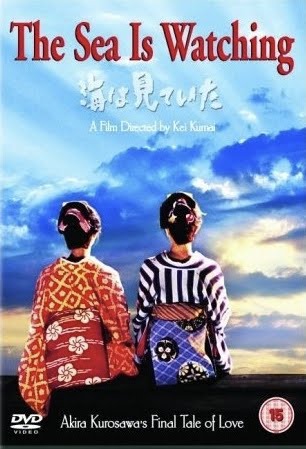
The Sea is Watching 海は見ていた (Umi wa miteita) [2002] • Japan


The Sea is Watching starts off as an attractive film; rich colors, effective photography, nice framing, fetching prostitutes. Then it goes melodrama, followed by silly, culminating in corny which brought a smile to my face before the surreal kicked in. It never stops looking good, though. I give it high marks for that.

There's nothing particularly new or groundbreaking story-wise, but it is a charming, sometimes funny, bittersweet tale of the inhabitants of a samurai-era brothel whose entire district ends up under water. Plot-wise it focuses on the love lives of two of the working girls: Kikuno (Misa Shimizu) plays an elder to the younger girls and enjoys being the object of pursuit, never giving in to the suitors who want to take care of her and take her for their very own; and Oshin (Nagiko Tono) who, against the advice of those around her, seems to fall in love with every one of her clients. One of them, a sweet samurai type, visits her often and convinces her that her "fallen soul" and "soiled body" can become pure again—just like a person's hair, nails, and teeth fall out and grow back. "A body can become pure again ... it would be too horrible for words if it weren't true".

Oshin is the main protagonist of the film and is meant to give it an emotional center as her heart breaks and yearns, but it never quite happens. Although Shimizu and Tono give good performances, overall the acting is not one of the film's high points. I recommend the film to those wanting a taste of historical Japanese culture and who enjoy quiet films about love, loss, and friendship. Yes, the ladies are prostitutes but they have feelings too.

★★★
Director: Kei Kumai
Starring: Misa Shimizu, Nagiko Tôno, Masatoshi Nagase, Hidetaka Yoshioka, Miho Tsumiki
IMDb
Asianmediawiki