Showing posts with label romance. Show all posts

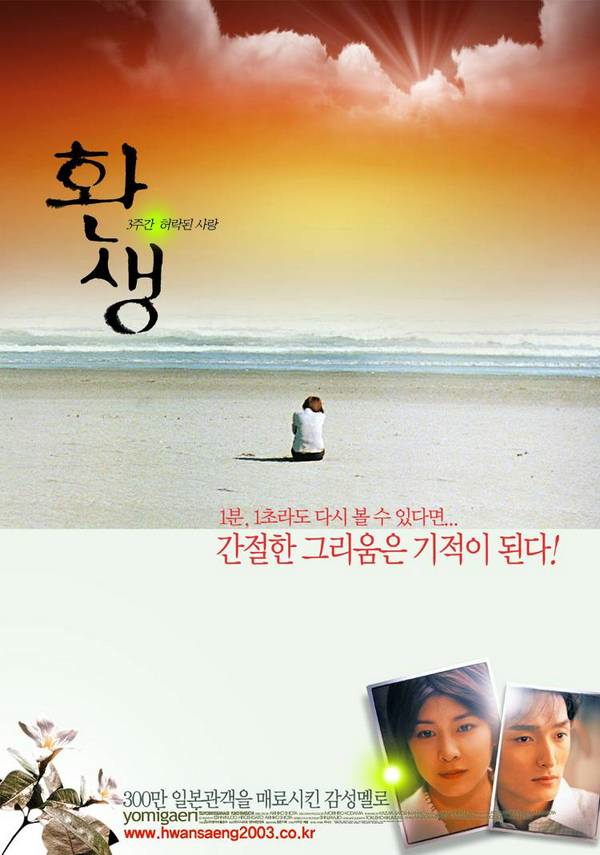
Resurrection 黄泉がえり (Yomigaeri) [2002] • Japan

It's hard to believe this is a Shiota Akihiko film; it's so mainstream sentimental. Compared to the two very independent flavored films about lost teenagers he made just before and after this one—the brutal Harmful Insect and the ennui filled Canary, not to mention his twisted psycho-sexual drama debut Moonlight WhispersResurrection is mall fodder. It's not bad as far as these things go. It just surprised me. The film stars adults instead of teenagers, but in the end it is very much a teen film.

People start returning from the dead. Children to parents, husbands to wives, wives to husbands, and so on. Each of these resurrections gets its own postcard-style short story and they are all meant to pull the heartstrings, nothing more. They have almost nothing to do with one another and they don't build to any big party for the dead. The film is a loosely knit series of vignettes held together by a government bureaucrat who returns to the little town where the events are happening, which also happens to be the town where he was born, to investigate the occurrences. Of course there is a girl there whom he pined for but lost contact with when he moved away. She serves as a love interest and sceptic. There's a twist and then you're supposed to cry.

It's all good. The film is so harmless it's hard to object to anything about it, except maybe the government bureaucrat's haircut. Tsuyoshi Kusanagi, as the bureaucrat, is an odd looking fellow. He'd been a member of the pop group SMAP, which lends more to the mall fodder aspect of the film, and he approaches the role with a sincere earnestness. He has a few well done moments of emotional outburst but is overall pretty flat, although not disagreeable, as an actor. Yuko Takeuchi is wonderful as the tomboyish love interest.

There is, actually, a big party for the dead at the end, but not really. It's a concert, which at first seems to serve only to highlight a couple songs, in their entirety, by pop singer Kou Shibasaki. Then you remember, "oh yeah, that's the girl from the beginning of the movie". It's not that this film is hard to follow, it's just structured in a way which favors feeling over narrative. The vignettes don't come together Altman style. They are all pretty much self-contained units.

This movie was a big hit in Japan when it came out, back when SMAP and Shibasaki were at the top of the charts, and was probably a lot more fun than it is now. What's interesting to me about it is seeing it in the context of Akihiko Shiota's other work. I haven't seen his two most recent films, Dororo and A Heartful of Love, but if this one is any indication, it suggests he is fully capable of making mainstream commercial films if he wants to. I don't know if that is good or bad.

★★★
Director: Akihiko Shiota
Starring: Tsuyoshi Kusanagi, Yuko Takeuchi, Yuriko Ishida, Sho Aikawa, Keiichi Yamamoto

IMDb
Asianmediawiki
Japan Times
Beyond Hollywood

Hot Summer Days 全城熱戀 (Chuen sing yit luen - yit lat lat) [2010] • Hong Kong, China

I laughed, I cried. This is a very fun, good looking, popcorn/date flick. Beneath its light-hearted surface there are some teary eyed love happenings. If you like star-studded Hong Kong romantic comedies and sugar-coated sentimentality, look no further.

Hot Summer Days tries to be cross-cultural by setting two of its four main story lines on the mainland but it's more in the tradition of Hong Kong rom-coms than mainland fare. Most of the actors are native Cantonese speakers. I watched this twice, once with the Mandarin audio and once with the Cantonese audio. There is some dubbing in both versions but the Cantonese version has less of it.

The eye candy comes in both flavors: boy and girl. They perspire a lot which leads to some clingy clothing, glistening skin, and probably the PG (or its Chinese equivalent) rating. Vivian Hsu has never been more freakishly cute and Barbie Hsu has never been more tattooed. The most heartwarming and intricate tale is that between Jacky Cheung, as an out of work truck driver cum ice cream salesman, and Rene Liu, as a concert pianist doing foot massage (because it's a job requiring skilled hands), which gets its start from a text message sent to the wrong number. The one that anchors the film and produces the most tears is the one, not given top billing on the poster, between newcomer Xinbo Fu, as an innocent country boy and Angela Baby (that's right, her name is Angela Baby), as a factory worker assembling teddy bears. Daniel Wu, as Master Soy Sauce, and Vivian Hsu, as Wasabi, have the cutest nicknames. Nicholas Tse and Barbie Hsu's story is the most hip and tragic.

There are cameos galore, the highlight being a weepy-eyed monologue from Maggie Cheung spilling her guts to Master Soy Sauce. Blah blah blah. If this is your cup of tea, drink it. It's good (except for some well intentioned CGI maybe). I hope I got all the links right.

★★★★
Director: Tony Chan, Wing Shya
Starring: Nicholas Tse, Jacky Cheung, Rene Liu, Vivian Hsu, Barbie Hsu, Angela Baby, Daniel Wu

IMDb
Wikipedia
Asianmediawiki

Under the Hawthorn Tree 山楂树之恋 (Shan zha shu zhi lian) The Love of the Hawthorn Tree [2010] • China

Zhang Yimou reportedly auditioned 10,000 girls in search of untarnished, innocent (old school Chinese) beauty when looking to cast the lead in this film.
"These young folks are looking worse and worse with each generation. Pretty girls obviously aren't marrying handsome guys these days. They're hooking up with this sugar daddy and that old lonely bachelor with money. No wonder the kids are lacking in the looks department.

When you look at any picture of young Chinese women from the 60s and 70s period, you'll almost always have an eager face that radiates innocent beauty looking back at you. This is now a thing of the past, young folks rarely have that innocence about them any more."
I read that before seeing this film and it put an awful lot of pressure on the young actress who passed the audition. She's cute, but she's no Gong Li. She's hardly a Zhang Ziyi either, but that may have more to do with the way the film is assembled than anything else.

I'm a BIG fan of Zhang Yimou's common people films. I love his nostalgic looks at the past and his thinly veiled commentaries on the Cultural Revolution and cultural change in general, in China. But Zhang seems to have tossed this one off before finishing a proper script. Title cards are used to fill in narrative gaps (red flag) and to allow for fade-to-black wistful shots of the girl biting her lower lip, pouting, and looking like the innocent beauty Zhang craves. I think the need for fade-to-black wistful shots of the girl biting her lower lip and pouting suggests he didn't find it.

The film is adapted from a popular mainland novel which was based on a true story set during the Cultural Revolution. There's lots of good stuff and great attention to detail concerning the period, and it satisfied my desire for that. There's a pretty standard love story plopped on top of it all, complete with a terminal disease tuggin at your heart strings. But not just any old love story, it's a Japanese styled "pure love" love story. That part is fine as well. A little Korean style melodrama mixed with Japanese pure love stylings works for me most of the time. So why didn't I love this movie?

Honestly, the title cards bothered me. Not just because the girl bit her lip and pouted going into many of them (which got on my nerves as well), but because they gave the film an unfinished quality. It's difficult to remain completely faithful to a novel when adapting it for the big screen, and just as voiceover narration can be used successfully to fill in narrative gaps or it can stick out like a sore thumb, so go the title cards.

"Sun told Jing that he would be waiting for her upon her return"

Sticks out like a sore thumb.

To be fair, dancer and senior high school girl, Zhou Dongyu, from Shijiazhuang in Hebei Province, with “eyes that are clear like the mountain springs”, is pretty fetching as the young girl who is sent to re-education camp and falls in love with an upwardly mobile land prospector. The film's theme of with whom and when one falls in love being up to the discretion of Communist Party leaders is far more tragic than the terminal disease. Shawn Dou Xiao is outrageously handsome and appealing as the young man who falls in love with her.
 
Under the Hawthorn Tree is delicately shot and filled with wonderful period detail. My final waffling verdict is: It's a beautiful and tragic love story with some distracting blemishes. If Zhang Yimou had spent as much time fleshing out a proper screenplay as he did finding a girl to play the lead character he might have produced another masterpiece. I recommend the film to those who like pure love stories.

★★★
Director: Yimou Zhang
Starring: Dongyu Zhou, Shawn Dou, Taisheng Chen, Rina Sa, Xuejian Li

IMDb
Wikipedia
Asianmediawiki

Hear Me 听说 (Ting Shuo) [2009] • Taiwan

Hear Me 听说
This light-hearted rom-com charmed its way into my top ten of the year. It's not a cinematic masterpiece by any stretch of the imagination. It's just a rom-com, delightful and enjoyable for the characters, if not the story. I like fluff as much as the next person, if it's done well.

Boy meets girl. Girl is preoccupied caring for her handicapped sister. Boy gets girl. Handicapped sister wins the Olympics. It's feel-good from head to toe, and it's beautiful that all the love is delivered in sign language.

Xiao Peng is a swimmer in training for the Deaflympics. Her sister, Yang Yang, does everything she can for her and wrestles between being over-protective and neglectful. Tian Kuo sees Yang Yang one day while delivering food to Xiao Peng's swim team facility. He sees Xiao Peng communicating with Yang Yang in sign language and makes an assumption. Take it from there.

Tian Kuo's parents must be a professional comedy team in real life because they have comic timing down pat and an assured sense of what comic relief is.

Hear Me was Taiwan's highest-grossing local movie of 2009. A good time was had by all in this house. I have no further defense.

★★★★★
Director: Fenfen Cheng
Starring: Ivy Chen, Eddie Peng, Michelle Chen, Lo Bei An, Lin Mei Xiu

IMDb
Asianmediawiki

Kiss Me, Kill Me 킬미 (Kill Me) [2009] • South Korea

This one's very funny, one of those films in which the director and the actors do a dance of comic timing. Hye-jeong Kang is always good but Shin Hyeon-Jun turns out to be a real comic treat. This is an action flick with lots of humor.

Jin-young (Kang) is devastated after a breakup with her long time partner and wants to kill herself, but she wants to do it with flair so she hires a hit man to take her out. Hyun-jun (Shin) thinks he is hired to kill someone else and is surprised to discover Jin-young has slipped herself into the place of his intended target. Yeah, it's an "assassin falls in love with his target" story but the performances of the two leads makes this one a winner. The script is a little chaotic at times, lots of coincidences that challenge a suspension of disbelief, but if you just go with the flow it's a fun ride.

The film's ending unravels instead of tying things up but it's not a deal breaker. In a way, the whole film can be seen as a series of sketches that just parade by instead of building upon one another to form a cohesive whole, and that may be a valid criticism depending on the angle of entry the viewer chooses. Thriller? Romantic Comedy? Action flick? It's all of those, and it's one of the things I like about South Korean cinema. They do mashups, and they do them well, always playing with expectations and throwing in surprises.

If you are a fan of either of the two leads you will enjoy Kiss Me, Kill Me. It's fun and entertaining precisely because it's full of not what you'd expect.

★★★★
Director: Jong-hyeon Yang
Starring: Hye-jeong Kang, Hyeon-jun Shin, Hyeon-a Kim, Do-bin Park

IMDb
Asianmediawiki
HanCinema
Beyond Hollywood 

Jack Goes Boating [2010] • USA

Phillip Seymour Hoffman fans should be happy with this, his directorial debut. Hoffman is the king of uncomfortable and he directs to his strength here. Beyond directing himself well, a couple other things struck me as far as the direction goes. He uses a lot of music and knows how to pick tunes. The soundtrack is full of Grizzly Bear with a little Evan Lurie sprinkled about. "Rivers of Babylon", by The Melodians serves as a sort of theme song, being played at the beginning, the end, and during a climatic scene in the middle. A couple songs that stand out as beautiful in and of themselves, and at really nailing the mood, are Goldfrapp's "Eat Yourself" and DeVotchKa's "Dearly Departed". You can listen to these tracks at IFC's web page for the film.

I don't want to give the impression that this film is some kind of music video collage, because it's not. Far from it. The other thing that strikes me about the direction is the tendency, reminiscent of John Cassavetes, to let scenes go on for just a little bit longer than you think they should, allowing for moments of tension or discomfort to linger and echo. And there are a lot of moments of tension and discomfort in the film. The silences contrast beautifully with the more musical moments.

The film is adapted from a play about the intermingling relationships of two couples. One is beginning, the other is established and endured, if not enduring. The established couple, Clyde and Lucy (John Ortiz and Daphne Rubin-Vega), set up their friend Jack (Hoffman) with Lucy's co-worker Connie (Amy Ryan). The use of contrast at work again. One relationship is about to bloom, while the other fights a season of wither. Hoffman, Ortiz, and Ruben-Vega starred in the stage version and reprise their respective roles here. Needless to say they know their parts inside and out. The film has a playful and slow pace and is filled with sharp dialog, a lot of which seems to jump in from out of nowhere. Half the stuff that comes out of Connie's mouth made me chuckle and think 'Where did that come from? Did she really just say that?' Amy Ryan is fabulous here, as are all the players.

The only weakness is that the climactic scene sort of fails, but it doesn't kill the film. It's just one scene you might wish had been done better or different. Or maybe not. Jack Goes Boating is a wonderful character play with a strong script, great acting, and a moving soundtrack. It's kind of brutal and it's pure Philip.

★★★★
Director: Philip Seymour Hoffman
Starring: Philip Seymour Hoffman, John Ortiz, Daphne Rubin-Vega, Amy Ryan

IMDb
IFC

Scott Pilgrim vs. the World [2010] • USA

A total blast. This film has about a dozen principle players and they are all great. Michael Cera does his Michael Cera thing but since I've only seen him do it once before I'm not sick of it. This is a good film for him. He gets to rock out on bass guitar and do a lot of ninja fighting. It's all way over the top and executed very well. Whoever edited this film deserves an Oscar for it. It's amazing. This is easily the most fun I've had watching a movie all year. But it's not trash fun. It's witty. I was smiling from start to finish and LOL'd many times. Not a weak or bad character in the bunch.

I understand that this film had a hard time defining its target audience. Who cares? It is sort of a middle school level cartoon with subtlety more mature humor. I don't care that many of the video game references are dated and I don't think the film is "I'm so smugly and ironically hip." I wasn't interested in seeing this film until I noticed it showing up on a few year end top tens. Yes, the film's marketing escaped me too. I was immediately hooked. Try it. If you aren't smiling and laughing in the first ten minutes unplug it and move on. It's at Netflix.

★★★★★
Director: Edgar Wright
Starring: Michael Cera, Mary Elizabeth Winstead, Kieran Culkin, Jason Schwartzman, Chris Evans, Anna Kendrick, Ellen Wong

IMDb
Wikipedia
Twitchfilm (Todd Brown)
Twitchfilm (Jim Tudor)

A Good Rain Knows 호우시절 (Ho woo shi jul) aka Season of Good Rain [2009] • South Korea, China

It would be a spoiler if I were to state one of the main reasons I love this movie. I can say, however, that the film is very much about a Chinese experience, and the fact that it is directed by a Korean is what makes it interesting. There are other good things about the movie so I'll work with them and save the spoiler.

A Good Rain Knows is nice to look at. It's photographed in crisp and bright colors and makes great use of it's locale, Chengdu, the capital city of Sichuan Province. It's got dancing in a downtown square, bamboo groves, even a scene with a panda bear. Gao Yuanyuan as Mei, a tourist guide in a Chengdu park, has never looked more radiant. Jung Woo-sung is a South Korean heartthrob but his acting ability is curious. He always seems nervous. He plays an architect, Dongha, who travels to Chengdu on assignment and runs into Mei, an old and dear friend. There is no plot to speak of, just the unfolding of their past and present relationship that gives the film its purpose.

Dongha, a Korean, and Mei, a Chinese, communicate almost exclusively in English. Since their relationship is presented as fragile and tentative, and since Jung is a nervous actor anyway, having them communicate in broken but understandable English is a stroke of genius from director Hur. If you're bothered or unmoved by the stilted verbiage the film won't work.

In typical Hur fashion, and this film sees him in perfect stride, not much happens. We're presented with a couple characters testing the water to see if, when, and how love will factor into their relationship. The lens slowly gets closer, revealing inner layers, until a small explosion occurs. And in typical Hur fashion this explosion takes place far beneath the surface. We know it's a big one but all we see are the rippling aftershocks (hint) on the surface.

Hur is a fascinating director. In some ways his films are just cheesy romances with questionable soundtracks, but he possesses an emotional intelligence and an eye for subtle soul-searching details that make his films powerful when he gets it right. He gets it right this time. A good rain knows when to fall.

★★★★★
Director: Jin-ho Hur
Starring: Woo-sung Jung, Yuanyuan Gao, Byung-seo Kim

IMDb
Asianmediawiki
HanCinema
Beyond Hollywood

Wanee and Junah 와니와 준하 (Wanee wa Junah) [2001] • Korea

In an angsty romance there's got to be something in the way. Koreans usually toss in a terminal disease as roadblock. Wanee and Junah employs something different. Let me get the accolades out of the way before I spoil the hell out of the movie so you can stop reading when it's appropriate for your needs.

Hee-seon Kim, as Wanee, is fabulous. I'm not familiar with her work outside Wanee and Junah but apparently this "first beauty of South Korea" hadn't received many high marks in the thespian department before this. She is a natural and simple beauty but that's not important. She brings an incredible amount of restraint and depth to the role here, and when it comes time to cry she does it just right. Jin-mo Ju, also a looker, as Junah, is very sympathetic and brings more to his role than just being a kind and supportive puppy dog.

These two very genuine performances allow for Wanee and Junah to reach some peaks of emotional sadness on the level of One Fine Spring Day—one of the best films ever made about love evaporating for no reason (or for so many reasons it's too complicated to parse), just like it does in real life. This is the kind of sadness that doesn't make you cry, it makes you mad. It makes you want to rebel against it because it seems so unfair, so not right. So with all this goodness going for it why don't I love this film? Maybe I do. Maybe I'll come around to accepting it, warts and all. One thing I love about it is that it has stayed with me and scrambled my brain for days after watching it.

The director uses a handful of jump edits in the first act of the film. This technique is often utilized to let ten seconds of screen time signify a much greater span of real time. I thought they were unnecessary and gave it an amateurish feel. The film jumps back and forth in time, from the present day to Wanee's high school days, so there is an inherent non-linearity to it. Since the film is about Wanee coming to terms with her past, and Junah discovering it, this is necessary. All of the transitions between time zones are expertly and creatively done but the substance of them often feels oblique, like the director is toying with the viewer's ability to file each of them away for later explanation. This is the kind of thing film snobs champion, saying "The film makes you think!". But good films should make you think about their content not their structural deployment.

Here come the ***SPOILERS***

It ends happily. In a way it comes as relief because ten minutes before it ends you're likely to be coiled up in disbelief at the level of sadness. But something about a happy ending makes for a less powerful film. It becomes just a movie at that point. Wanee and Junah is not just another movie, though. The roadblock to romance is Wanee's first love. A love left unconsummated and full of prickly details, one of which is that it kills her mother's husband, who is the father of said first love, which makes the guy her half-brother, not to mention also her best friend's first true love. At first, all of this thorniness seemed cheap to me, especially the way it is not made clear from the beginning. I felt deliberately mislead even though I knew from the overall wholesome tone of the film it wasn't going to go very far into dark places. It could have. And it could have chopped off the happy ending and it would have been killer. And I would have criticized the film for being unrealistic and exploiting taboos for the sake of making me unnecessarily unhappy. End ***SPOILERS***

Wanee and Junah is a pretty remarkable film. Good performances, good cinematography and score compliment the ambitious, if not always successful, directorial choices in both structure and content. I was frustrated many times along the way but not too many films can tie your guts up into a knot the way this one does. Color me impressed with that.


I'm posting this one with four stars, which is a compromise between Your Mileage May Vary and A Great Success. I've given it three, four, and five stars in the tags because I really can't decide. Wanee and Junah, like the aforementioned One Fine Spring Day, is a film that depends a lot on what you bring to it, what your own experiences are, and where you sit with regards to some of the delicate circumstances it operates in.
★★
Director: Yong-gyun Kim
Starring: Hee-seon Kim, Jin-mo Ju, Seung-woo Cho, Kang-hee Choi

IMDb
Asianmediawiki
HanCinema
Love HK Film
Koreanfilm.org

One Day (You yi tian) [2010] aka As I Walked Out One Evening • Taiwan

This is a strange one, in a good way, for the most part. It's a lovely and meditative story of blossoming and innocent young love that jumps back and forth in time and in and out of dreams. It gets a little weird, then a little confusing, and then almost shoots itself in the foot by hinting at some plot to get in the way of the story. I'm not sure that it happened but it seems to have, and it appears to relate to the melodramatic question a young woman asks her mother: "If you could go back to the past and meet dad again, would you still marry him ... but you know that he would have an accident later?"

Nikki Hsin-Ying Hsieh, looking a lot like Zhou Xun from certain angles, plays the young woman with the beautiful name, Singing. She works on a ferry that shuttles recruits between the port of Kaohsiung and the military base of Kinmen Island. One night during the trip all the lights go out on the ferry and Singing appears to be alone. Then an Indian man with an axe, screaming without subtitles, chases her. She's rescued by a young soldier and the loopy dream logic begins. The soldier tells her that they are not in the real world. A horse walks by. Singing's hair is shorter and she's in a study hall in Taipei sitting next to the soldier only now he's a student. They fall in love but keep waking up together, or falling asleep and dreaming together, on the ferry. The future, the past, what's a dream and what's reality blur to the point that it doesn't matter. Until that little plot point rears it's head. There's a little crying and some running, two things that suggest melodrama, but this is a mood piece much more than a drama. The dreamlike quality is emphasized by the fact that almost all the scenes take place on or near the water. The cinematography is often muted and the soundtrack mostly noodling piano.

I think it's a mistake to try and discover meaning in a film like this, as the director or as a viewer, even though it's filled with innumerable possible symbolisms. This is not a commercial love story. It's far too down tempo and poetic. But it is a love story and these kinds of films require a nice couple for us to love, and the two leads provide that here, with extra credit given to the ever watchable Nikki Hsin-Ying Hsieh in her film debut.

The beautiful theme song that plays as the end credits roll is sung by Tarcy Su, a singer and actress I just discovered in the remarkable film Blue Cha Cha.

★★★★
Director: Chi-Jan Hou
Starring: Bryan Shu-Hao Chang, Nikki Hsin-Ying Hsieh, Gwen Yao

IMDb
Asianmediawiki

Out of the Wind 風の外側 (Kaze no sotogawa) (2007) • Japan

This is Sakura Ando's feature film debut. It's written and directed by her father, Eiji Okuda. These are the facts. It's a confused film. It starts off being about a young girl, Mariko, who has a dream of becoming a diva in the world of opera. It's funny seeing Sakura Ando do that elongated mouth opera singing thing, but I digress. There has to be some conflict so a soft-spoken tough guy is introduced. He becomes Mariko's bodyguard and remains nameless for a while. This is a Japanese film. There are perverts targeting young girls in school uniforms.

The boy and girl enter into a typical movie relationship. It starts off distant and rocky but love slowly swirls. Then the focus of the film drifts to the guy who has a dream of becoming a big time Yakuza. Problem is, he's Korean, so he has to prove himself on his way up the ladder by doing all the icky jobs. One of which turns out to be killing a Korean businessman who ... drum-roll, please ... turns out to be Mariko's father. That would mean, you guessed it, Mariko is half Korean. Now the film drifts into an exploration of identity and we're given an excuse to up the ante in the love relationship between Mariko and her bodyguard. The life of Koreans and the discrimination they endure living in Japan is also explored.


It's not that a film can't grow and expand on the themes it explores but it has to be well-written and executed or it will fail. The amount of suspension of disbelief required to get from A to B to C in this film is huge. I didn't have the power to suspend my disbelief that a director would have his young daughter do a nude scene in her film debut, seems creepy, nor was I able to get through the scene where the bodyguard stumbles into the opera house and stabs Mariko's father while she watches the whole thing, albeit with a wrinkled forehead, but never stops singing.

This film is pretty awful, and it's too bad because Sakura Ando's performance is pretty good. It's a real sign of talent when you can be good in a bad film.

★★
Director: Eiji Okuda
Starring: Sakura Ando, Takao Sasaki, Kazu Andô, Yasuhiro Arai, Megumi Araki

IMDb
Asianmediawiki

Go Lala Go! (Du Lala sheng zhi ji) [2010] • China

I enjoy Xu Jinglei as an actress and think her move to behind the camera has shown lots of promise. I wish I didn't have to report that her latest film is a disappointment. To be fair, it's a disappointment because it's not what I expected from her. Go Lala Go!, in which she stars and directs, has none of the depth or artistry of Letter From an Unknown Woman or My Father and I. Go Lala Go! is about promotion hungry corporate trash, and it's pure popcorn fluff, hyper-kinetic and full of fashionable costuming, hairstyles, and product placement.

But is it good popcorn fluff? I'm not sure but I'm inclined to say no. It did very well at the box office (in China, in case that's not clear) and there's probably a reason. First of all, it's solidly within the constraints of the Chinese Film Bureau's guidelines of what kinds of stories should be told and what kinds of messages are permitted. Specifically, with regards to rewarding foul play, there's none of that. Lala's rise up the corporate ladder is entirely the result of good honest hard work. Yes, she sleeps with a high level big shot Director of Sales but it's for love, not strategy, and the film shows it as problematic. In fact, inter-office relationships are a major theme in the movie. A blind eye is sometimes turned but for the most part they are considered not a good or acceptable idea.

Another reason for its success may be that it puts on display all the name brands and fashionable accessories many millions of Chinese feel they are fairly close to partying with. Even though us educated capitalists are hip to that myth, there's a younger generation of Chinese that is probably tired of, or uninterested in films that wallow in a prideful past and they want to dream about a possible future instead. That's all fine and good, and maybe I shouldn't rush to judgement. Xu Jinglei has given the masses what they want. Good for her. She made some money, hopefully.

There's some cultural interest for non-Chinese in Go Lala Go!, but as a film it's thin and a little too chaotic. The chaotic part seems intentional. It's almost as if Xu discovered downloadable iMovie Transitions and went nuts. The direction is strong, consistent, and assured, but it's a style I don't fancy even if it serves its content well. There are some decent comedic bits, Xu possessing a courageous inclination for the self-deprecating, and some of the love geometry is OK, but it's all stirred in very quickly, giving the sense that it's not important. Scenes just sort of smash into one another. Karen Mok is fun and she still has great legs but the American-Taiwanese pop star Stanley Huang as Lala's love interest didn't do much for me. There's some nice scenery when they all vacation on the beaches of Thailand, but not much to the story.

I still can't wait to see what she does next.

★★
Director: Jinglei Xu
Starring: Jinglei Xu, Stanley Huang, Karen Mok

IMDb

Love in a Puff 志明與春嬌 (Chi ming yu chun giu) [2010] • Hong Kong

A foul-mouthed little romance here. Lots of f-bombs and dick or boob jokes tossed around to try and elevate this fairly standard rom-dramedy from the pack. It's not too offensive or juvenile and it's shame to have to get it through subtitles. I'm sure the original Cantonese is more subtle and euphemism based, and crude is always more palatable when it's subtle or funny. Love in a Puff has a CAT III rating and it's not for nudity or all the cigarette smoking.

The premise of Love in a Puff is one all cigarette smokers will be familiar with. The "smoke break" is a time to bond with co-workers or friends, to make plans and share stories, and, in this case, tell dirty jokes and gossip. It's also an opportunity to massage in baby steps a possibly romantic relationship. There's a lot less "Is this a date?" pressure than even just meeting for coffee. There's a pre-determined end time and it comes quickly. If things aren't going well the suffering is short-lived and if there is a spark you'll leave wanting more. Always a good thing.

Zoom out from the premise and Love in a Puff makes many observations on modern SMS-based relationships, budding and otherwise. Something I learned, and put to use, from this film is if you type "i n 55!W !" (without the quotes) into a text message your recipient might see it as some nonsense code, but if they turn their phone upside down it will read "i miss u !". How cute. And appropriately enough, that little tidbit is the catalyst for a couple of the larger emotional transitions in the film.

I like small films like this, the cinematic equivalent, if you will, of a smoke break. Without aiming too high it's easy to hit its mark. It's well acted, and well scripted for the most part, and doesn't veer from its target too often, which is following the seven day courtship of Cherie (Miriam Yeung) and Jimmy (Shawn Yue). Yeung is especially crisp in her performance. There's a wonderful little "no shit!" moment near the end of the film when the two of them are in a small battle about who they are and what kind of relationship they're in and Cherie declares "I'm simple and straightforward". She is.

My only quibble with the film is an unavoidable one. To go from "My name's Cherie", through moving out of the premises and bond of one relationship, to "I'm simple and straightforward" in seven days requires a brisk pace. Maybe that's the way it is these days. There is a time or two where it seems like a little exposition might have ended up on the cutting room floor but maybe things are clearer in the original language and subtitles short of an essay couldn't translate it. Most of the screen time is devoted to the main protagonists, garnished with a handful of side characters and set pieces that don't detract from the lit up screen chemistry required of all good Rom-Coms and provided by Yeung and Yue. All in all a fun time was had with Love in a Puff.

★★★★
Director:
Starring:
IMDb
Wikipedia
Asianmediawiki

Sada 戯作・阿部定の生涯 [1998] • Japan

Forget that this is another entry in the dramatization of Sada Abe's life and crime of killing her lover and cutting off his man-parts, most infamously portrayed in the sexually explicit In the Realm of the Senses, and ignore all the commentary that molds the story into a historical and social context for your academic pleasure, and never mind that these kinds of stories always start off with the girl being raped as a teenager. All those things involve too much thinking. Just kick back and enjoy this as another odd but fairly well-executed film by director Nobuhiko Obayashi.

The first things you'll notice about the film are the narrative and filmic techniques used by Obayashi. Characters break the Fourth Wall; there's a mix of black & white and color photography which is interesting and useful some times and random at others; some jump-cut editing use is mostly abandoned after the first act; the costuming, both traditional and modern, is gorgeous; there's a fabulous stop-motion sequence in the middle that starts with Sada reading a book while her lover sits near her having a snack, they do the hanky-panky and then resume their initial activities, and there are several moments of Keystone Kops style comedy. After that you should find it to be a fascinating character study of a strong and intelligent woman.

Hitomi Kuroki is amazing as Sada. Her characterization remains a constant as she effortlessly transitions through the varied styles of presentation Obayashi employs. She is always elegant, beautiful, sensuous, and in control. She is also very genuine, which comes off as quite sexy. (For the curious, there is zero nudity in this version of the story, not even a glimpse of Sada's notoriously cute butt. The closest we get, in a brilliant directorial move, is an odd-angled, extreme close-up of her fully kimonoed posterior. There are lots of bare shoulders and legs, and there are several sex scenes but they are mostly played either artfully or comically.)

Sada may serve it's nominal content respectfully and respectably but it comes off so much more as a film than a biography that if it's approached with an educational curiosity its style may frustrate. Watch it for the whimsical stylings of the director and the lovely and remarkable performance of Hitomi Kuroki.

★★
Director: Nobuhiko Obayashi
Starring: Hitomi Kuroki, Kataoka Tsutaro, Miki Norihei, Shiina Kippei, Negishi Toshie, Renji Ishibashi
IMDb
Wikipedia

April Story 四月物語 (Shigatsu monogatari) [1998] • Japan

A sweet slice of life portrait of a girl's transition from a high school in Japan's northern countryside to university in Tokyo. It's a series of vignettes that begins with her family seeing her off and ends with a reveal of why she went to this particular university. In between we watch her move into her new apartment, cook meals for herself, meet her neighbors and classmates, buy a bike, and browse a bookstore. It may not sound like much but it's very well crafted. Takako Matsu is as endearing as can be. It was a pleasure to see her, as a teenager, play this naive young girl after having recently seen her, at thirty-two, play an archetypal Japanese woman in Villon's Wife.

This is a short film, at just over an hour, that doesn't attempt much more than capturing a few moments in the life of a girl who is not only changing her outward surroundings but also following her inward desires. The reason she chose to go to the university in Tokyo is because her unrequited crush on a boy one year her senior is attending it. The film could have been longer and explored their relationship but then it wouldn't have ended as poetically as it does right at the moment they meet. Broken umbrellas, a rainstorm, and a barrel full of young love, idealism, and hope. Simply beautiful.

★★★★
Director: Shunji Iwai
Starring: Takako Matsu, Seiichi Tanabe, Kahori Fujii, Rumi, Kazuhiko Kato
IMDb
Wikipedia
Asianmediawiki

Crossing Hennessy (Yue man xuan ni shi) [2010] • Hong Kong

A gigantic disappointment for Lust, Caution star Tang Wei's return to the big screen. She's woefully under-used, pouting a little bit here and there or acting obviously phony as her character tries to pretend that Jacky Cheung's character is interesting or funny. I've seen 5th graders act better than Cheung does in this film. It's almost as if he mistakenly wandered onto the set of the wrong movie. He's out of sync and irritating the whole way through. And not funny at all. The suspension of disbelief factor has to be in full force to accept that Tang Wei's character might fall for this guy. Of the many supporting characters in the film, his extended family verges on being likable but they whined so much it became annoying. Cantonese is not a pleasant sounding language for that kind of communication. The film does show a seldom seen side of everyday Hong Kong which is refreshing but beyond that the film's pretty much a train wreck without chemistry, comedy, or cuteness.

★★
Director: Ivy Ho
Starring: Jacky Cheung, Wei Tang, Maggie Cheung, Danny Lee, Lowell Lo
IMDb
Wikipedia

Duelist (Hyeongsa) [2005] • South Korea

I'm a big fan of of director Lee Myung-se's M, consider it a top ten favorite film of all time. It's an audio visual masterpiece. The man has undeniable multimedia chops with an unconventional approach to storytelling.

Duelist shares M's visual beauty along with its fragmented narrative style. It's not hard to get the basic story in either film but you do need to step back and just go with the flow rather than keeping notes on how A leads to B leads to C, and so on. Set in the Joseon Dynasty, the story here is your basic good (in this case) girl cop falling for the bad guy she's supposed to capture and put behind bars, with the romantic angle competing with, and coloring, the chase. There's a mystical twist to it too, wherein the would be lovers don't do a lot of talking to one another, instead, they fight. With swords. This allows director Lee to stage some dramatic and very elegant battle scenes, but the motivation here is romance so the dueling is presented as dance rather than combat, and probably won't satisfy fans of traditional action movies. There's a lot of killing but very little blood. The battles are emotional, internalized and stylized without all the grunting and macho posturing that usually accompanies this kind of action.

One of the many dualities of the film is the unrefined, gut level nature of the cops versus the refined ways of aristocratic bad guys. Another is the way the cat and mouse game shifts back and forth between sleuthing and the romance. The Duelist knows the young lady cop is infatuated with him, that his capable mysteriousness in matters of crime and conflict occupies her heart as well as her head. So he toys with her. She is his equal in combat but not in love and he uses this to his advantage.


Ha Ji-won shines in her role as the young police officer who plays the mouse to the Duelist cat. She gets to be goofy, girly, and kick ass all at once. You can tell she is doing most of her own stunts and she's got surprisingly good comic timing. This film is also quite funny at times. A lot of the humor is of the bumbling kind but it's not cheap slapstick. It's more good natured (unfair to characterize it as) loser type struggle. Veteran actor Ahn Sung-Kee, who elevates every film he is in, plays mentor to Ha Ji-won, and he's just great. Supermodel Kang Dong-Won plays the Duelist, named "Sad Eyes", and does a respectable job of playing a hairstyle with depth.

Duelist is a beautiful, if loosely constructed film that won't satisfy hardcore action fans. For me, even though the fighting scenes were mostly stylized dance pieces, and the film wouldn't work without them, there were just too many of them for me to want to watch the film again and enjoy all the other good stuff about it. Take a look at the clip below to see how awesome this guy is at shooting film and marrying music to it.

★★★

Director: Lee Myung-se
Starring: Ha Ji-won, Ahn Sung-Kee, Kang Dong-Won

IMDb
Wikipedia

Hellcats (Ddeugeoun-geosi joh-a) aka I Like It Hot [2008] • South Korea

What a surprise this turned out to be. I couldn't get past the poster for the longest time. It's dumb and makes Hellcats look like a film I wouldn't want to see.

I recently watched An Affair (Jung sa), and although I didn't like the film at all I liked the performance by Lee Mi-Suk and wanted to see more of her. So this was it, a film about three stages of womanhood (high-school, twenty-something, just over-the-hill) and the angst of relationships.

The film owes most of its success to brilliant casting. The film's first casting coup, Lee Mi-Suk, turns in a solid performance as a forty-one year old (she's several years older than that in real life) stage designer confronted with 'early onset' menopause. As a result, or in conscious reaction to this news, she runs hot and cold in intelligent and honest ways with an actor working on the same production as her who's twelve years her junior. The guy is a bit of a playboy but seems earnest in his intentions and the fact that Lee is beautiful and still has the hot factor makes it a believable relationship.

The film's second casting coup was landing Ahn So-hee of the popular K-pop group, the Wonder Girls, to play Lee's teen-aged daughter. She's both precocious and naive and wants nothing more than to land a first kiss from her boyfriend of three years who seems more interested in motor bikes and video games than her. Many of the film's more bitingly humorous moments originate in the interactions she has with her mom and her aunt (played by Kim Min-hie, more on her later). The three women live together but it's Ahn who seems the mature one, suffering the emotional vicissitudes of her elders with aplomb. In her personal life, not sure how to get what she wants, she's helped along by the charming Brazilian born and exotic Jo Eun-ji. Their youth lends itself to a credible confusion between love and friendship, creating a relationship that's touching without being melodramatic.

Finally, the biggest and most welcome surprise is the performance of Twiggy model Kim Min-hie who anchors and narrates the film. She's a twenty-seven year old screenwriter, and younger sister to Lee, who ends up torn between pursuing her career (and her self, really), living the bohemian life with her never gonna make it dead-beat musician boyfriend, and marrying a successful, good-looking guy who seems to love her. Her performance is genuine, pulling off the impossible: acting drunk and shrill without losing any of her charm. She won't appeal to everyone, but for context let me state that I seldom, if ever ... in fact I almost always hate when actors play drunk, but Kim's performance worked for me. She's not drunk all the time. It's only a few scenes, but under normal circumstances this is enough to ruin a role, if not a film, for me.

Kim Min-hie burst into the limelight at a very young age with a very low body fat ratio as a model and fashionista. Her first few attempts at acting were met with chuckles and derision. She took six years off to study the craft of acting, including voice control and breathing techniques and, if her performance in Hellcats is any indication, it worked wonders. What's remarkable is that she doesn't seem to be acting at all, even in the drunk parts. She's just being filmed, being herself. I think that's the best kind of acting. She is also blessed with a facial structure (and I'm aware I'm being subjective here) that allows all kinds of different personalities to emerge, depending on camera angle, hair style, and internal motivation. I'll quit with the hyperbole now and just say she is a joy to watch in this film.

Hellcats isn't high brow art fluff nor mumblecore indie bullshit. It's an intelligent, mainstream feminist comedy. The male characters may not be much more than stereotypes but they aren't needed to be. They aren't belittled for being men and they are given enough substance to engage us, but this is a film about the women. Director Kwon Chil-in had success in 2003 with the hit Singles, which explored similar territory, and this is a worthy follow-up if you follow this kind of thing. I should give it five stars but I don't think many would believe it, so ....

★★★★

Director: Kwon Chil-in
Starring: Lee Mi-suk, Kim Min-hie, Ahn So-hee

IMDb
HanCinema
Asianmediawiki

Lost in Love (Sarang-eul nochida) [2006] • South Korea

This is one of the strangest, silliest romantic melodramas I think I've ever seen. It must be approached like a train wreck. It's not that it's bad in a sickening or cheap way ... it's just wrong at most every turn because it tries too hard to be controlling.

There are two fine actors in the lead roles: Sol Kyung-Gu as the guy, he's from Oasis and such, a great film. I think he's one of the best Korean actors behind Song Kang-ho, from The Host and Thirst and such. The girl is his real life wife, Song Yun-Ah. I haven't seen her before but she's very attractive and and has a genuine quality as an actress. I look forward to seeing more of her.

But gee whiz, this film plays the most sentimental music at all the right times ... which means all the wrong times. It's unabashedly blatant and tries but fails to be manipulative. It's basic blunder of a story seems ill-conceived and executed haphazardly. It will make you laugh at times when you're not supposed to.

I guess the characters are meant to be proletariat types because they use foul language when it's not called for and the guy has bad table manners. The girl's mom doesn't wear a bra and has sex with an unattractive yet sweet man, and she rides a motor bike scooter thing. She's hip. We like her. She might die.

No tears but it's good for a gawk.

★★

Director: Chang-min Chu
Starring: Sol Kyung-Gu, Song Yun-Ah

IMDb
Asianmediawiki
HanCinema

Rules of Dating (Yeonae-ui mokjeok) (2005) • South Korea

This film has appalling sexual politics. A repugnant womanizer rapes a student teacher he is supervising. The act serves as an introduction to his playboy technique. We know the two parties involved are going to end up together because this is a film about them. It's about power and the rules of dating. The guy never redeems himself and the girl appears to hate the man but sleeps with him voluntarily anyway, as a sort of challenge to see if she can regain power. Hye-jeong Kang is equally mesmerizing and frustrating as the messed up girl with baggage galore, but the guy is a complete ass. He gets it in the end but it is a painful trip. I can't believe this movie tells the story it does, and to flamenco music no less. The poster is as misleading as the music. Weird, uncomfortable film. Recommended.

★★★