Showing posts with label Noriko Eguchi. Show all posts

Fine, Totally Fine 全然大丈夫 (完全没问题) (Zenzen daijobu) [2008] • Japan

This is a subtle, almost surreal comedy that wanders along at a slow pace, punctuated with bits of low-brow humor to keep it alive. It's also an odd little romance and a root-for-the-losers character drama, but there's never any high drama, as the film never gets out of lazy Sunday afternoon mode. The comedy and romance are spices in the mix of everyday people turning thirty, going nowhere fast, who end up going from not so good to not so bad after all. When the humor is subtle or sad it's great, but not so good when it resorts to the juvenile, like when a booger flies across the room and lands in someone's eye. Comedy is tough and everyone has a style that suits them. I could have done without the more broad-based physical bits but they do serve a purpose as little alarms for those who don't appreciate two hours of deadpan, no matter how funny it is. The director demonstrates a good amount of skill in using editing for comic timing, and he was wise to cast YosiYosi Arakawa as the guy to do the heavy lifting when it comes to the “Life’s more fun when you’re an idiot” bits.

I recommend this film to those who like slow comedies, but also to those who like whatever you call these uplifting films about everyday people who don't become rock stars or win the Olympics but just get along and find happiness in everyday life. I love the way the film ends and anti-resolves a love triangle we weren't sure was going to turn out to be much of a plot point. I wanted to reach through my screen and hug the crap out of Yoshino Kimura. Her performance really surprised me. What a pleasure to see her do comedy, albeit of the low-key and clumsy kind.

And even though her part is very small, any film with Noriko Eguchi gets points just for having her.

★★
Director: Yosuke Fujita
Starring: YosiYosi Arakawa, Yoshino Kimura, Yoshinori Okada, Noriko Eguchi, Shima Ise

IMDb
Asianmediawiki

Yuriko's Aroma ユリ子のアロマ (Yuriko no aroma) [2010] • Japan

Oh, the expectations. Noriko Eguchi stars as aromatherapist Yuriko, who finds herself uncontrollably aroused by the sweaty scent of a seventeen year old boy. Oh, the possibilities. The boy happens to be the niece of the woman who owns the salon where Yuriko works. That's the story and pretty much the whole plot.

The film gives itself away early, letting on that it's going to be safe and good-humored. Oh, the let down. The moment things hint towards any tension, or that things might get sexy or erotic, the soundtrack rears its ugly head and plays goofy and light-hearted. And then the scene cuts away. The technique of cutting a scene before it finishes can be effective in moderation but here it's so overused it seems to reinforce a suspicion that the director doesn't know how to let a scene form its own conclusion. The film is sprinkled with innumerable scenes that have no beginning nor end, just a shallow, usually brief, middle period. Most of them add nothing and could have just been eliminated.

The film's runtime is only 79 minutes and it could have easily been shorter. It doesn't explore anything in any depth and there are a whole lot of scenes of "opening the door slowly, inch by inch" that could have been tightened up to make room for something else except there's nothing here. A couple off camera handjobs and an embarrassingly out of place scene with a topless air-head girl giving Yuriko a massage don't add any adult or erotic content.

I love Noriko Eguchi so I'm going to write off her Quaalude inspired performance as the result of bad direction. It's a gutsy role, in theory anyway, which calls for her to do a lot of aroused sniffing of a young boy's body and licking of his head. She does those parts very well. Few people could. Too bad they are the only interesting moments in the film.

★★
Director: Kôta Yoshida
Starring: Noriko Eguchi, Shota Sometani, Noriko Kijima, Jun Miho, Saori Hara

IMDb
Asianmediawiki
Midnight Eye
Official Site

There are snippets in this official trailer (which probably won't last long on YouTube because of the boobage) that aren't in the movie and the dialog is cut up and mismatched to create something that doesn't exist in the final product.

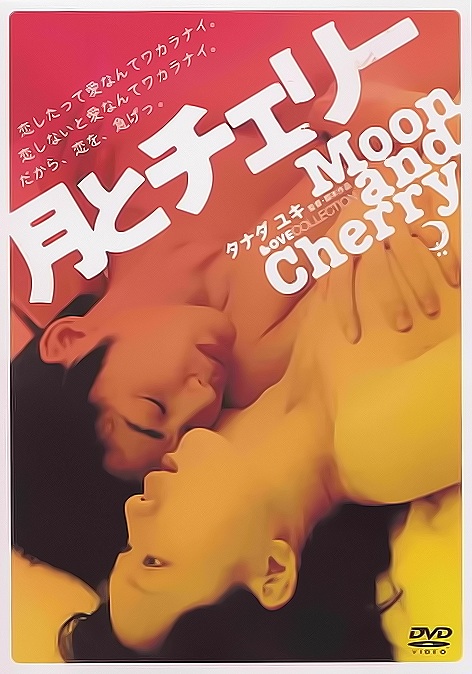
Moon and Cherry 月とチェリー (Tsuki to Cherry) aka Electric Button [2004] • Japan

Noriko Eguchi is one of my favorite actresses. She's had small parts in nearly fifty films in eight years. What's remarkable is that most of them have been reasonably high profile and critically well received, suggesting she has good intuition when it comes to selecting roles, and many of them are at the hands of Japan's best directors, suggesting they have good intuition when it comes to casting. She's not a box office draw, being much more a character actor than any idol-of-the-moment type, but she helps elevate every film she's in. Whenever she's onscreen she always appears smarter, stronger, deeper, and a little more enigmatic than everyone around her.

It's almost as if director Yuki Tanada wrote her first feature length film, Moon and Cherry, with Eguchi in mind. The film centers on the machinations of Mayama, played by Eguchi, as a member of a university erotic literature writing club. Mayama, its only female member, is the most talented and respected of the group because she's already been published, albeit under a male pseudonym. She's had sex with all but one of the other members of the group and uses the experiences as fodder for her writings. The film kicks into gear when a younger student, Tadokoro, joins the group. He immediately impresses the male members of the group with his knowledge of female anatomy, but just as he is swimming in their praise and accolades, Mayama walks in and says "Yeah, but you're a virgin." Experienced women can sense these things and Tadokoro is busted. Thus begins the intriguing gender role reversal story that is Moon and Cherry.

Mayama knows Tadokoro will make for good material so she takes him home to create some copy. The deflowering scene is controlled by Eguchi with aplomb, and in a moment of directorial panache, while Mayama is performing fellatio, we see Tadokoro biting his lip to the point of drawing blood. I don't need to spell out the brilliance of that metaphor. As soon as Mayama pops Tadokoro's cherry she jumps out of bed and starts writing. Tadokoro is befuddled but doesn't complain too much. As the relationship grows, Mayama sees Tadokoro's inexperience as an opportunity to try new things like sending an S&M dominatrix to his apartment and then demanding Tadokoro tell her all about it. She invites herself, followed by a pre-paid prostitute, to his place and then hides in his closet to watch the two of them go at it.

The only problem with completing this attempt at full on role reversal is the fact that Mayama is one of those women that men lose their minds over. There's no escaping that. Mayama has sex with Tadokoro in bed, on the floor, in the park, against a vending machine, but in between these events she disappears from his life. Tadokoro is torn but wants to make better use of his new found experience so he starts a relationship with a sweet and attractive co-worker, Akane, who serves as juxtaposition to Mayama. This sort of turns the film back on itself but I don't consider it a shortcoming at all.

Moon and Cherry is a very well-acted, creative and intelligent film that takes a different look at love, sex, and relationships. It's a low budget indie film shot on digital video as part of a Love Connections series of 2004 and it's a welcome opportunity to see the marvelous Noriko Eguchi star in a film. It's a smashing feature debut from writer/director Yuki Tanada who's gone on to script the female and visual extravaganza, Sakuran; write and direct Yû Aoi in One Million Yen and the Nigamushi Woman; and most recently write and direct the small masterpiece, Ain't No Tomorrows which I'll be reviewing soon.

A final shout out to newcomer Tasuku Nagaoka who plays Tadokoro with an awkwardly genuine sincerity. He's young and frail but never lets you think he won't make it, impressive in holding his own in scenes with the powerful Eguchi.

This could be a five star film but I don't think it wants to be. It wants to remain small and intimate. And independent. And even though it's one of the better films in recent memory, considered one of The Best of the Decade by a couple of the folks at Midnight Eye, I'm going to respect its wishes and give it four stars (with a stealth fifth star in the labels).

★★★★
Director: Yuki Tanada
Starring: Noriko Eguchi, Akira Emoto, Tasuku Nagaoka
Midnight Eye

Green Mind, Metal Bats 青春☆金属バット (Seishun kinzoku batto) [2006] • Japan

This is a hard film to describe except to say that it's deadpan funny, delightful and successful in it's earnest attempt to remain off-kilter. It's about two guys who are bummed out their dreams of becoming baseball stars didn't pan out, and a girl who loves baseball and baseball players. One of the guys was a pitcher, played with finely nuanced body language by Masanobu Ando, who's become a bicycle cop and hates everything except himself. He uses his position of authority to do things like get shoplifting housewives to show him the color of their underwear. The other guy is a batter (of unknown position), played by Pistol Takehara, who still wants to make it, practicing his swing a thousand times a day. He's a little numb in the noggin, having been beaned by the bicycle cop pitcher ten years ago and becomes an accomplice in love and illegal activities with a drunken, violent woman who shares his love of baseball. The show stealing woman is played way over the top by Maki Sakai, and now I'm sort of in love with her myself. I generally dislike watching actors play drunk, but with the exception of some of her stumbling, Sakai creates a believable and engaging character who's pushing forty, still hot, not so nice, but fun to have around. She had to wear prosthetics to round out her role as "the chick with a rack".

Green Mind, Metal Bats is a low-key, low budget absurd comedy with an edginess that keeps it unpredictable and unsettling. A bit part by Noriko Eguchi, as the pitcher's wife, gets this one a bonus point. Anything with Eguchi is better for it.

★★★★
Director: Kazuyoshi Kumakiri
Starring: Pistol Takehara, Masanobu Ando, Maki Sakai, Noriko Eguchi
IMDb
Asianmediawiki

One Million Yen and the Nigamushi Woman (Hyakuman-en to nigamushi onna) [2008] • Japan

This film will appeal to fans of Yû Aoi even though there isn't much range to her performance. What we get is exclusively the shy, sad, and awkward Yû Aoi with none of the radiant, confident, and smiling. She's on screen almost the entire two hour running time so the appeal may come from sheer quantity more than anything else, but she performs well and demonstrates she is capable of carrying a film on her own even if the value of that labor remains a question mark.

Yû Aoi's character has brought shame upon herself and her family by having a criminal record so she decides to run away, drift from town to town, staying in one place only long enough to earn one million yen and then move on. She wants to be anonymous, always one step ahead of any accusatory gaze that may be following her tortured soul. But what happens if she finds love? Will she reveal her ... true nature, that she's a criminal? No, that's not it. Her ... horrifying secret? No, that's not it either. The whole thing is kind of silly but I will grant the film some kudos for its final resolve even if it has little to do with illuminating its central conceit.

I'm no expert on Japanese culture but the basic premise of the film seems weak to me. Yû Aoi and a girlfriend agree to rent an apartment together so they can share costs and save money. They sign a lease and then Yû Aoi discovers that her girlfriend's boyfriend will be moving in as well. On move-in day only the boyfriend shows up and he informs Yû Aoi that his (and her!) girlfriend dumped him and will not be moving in. Fuck that. The guy turns out to be a total jerk, of course. Amongst many other idiotic attitudes, behaviors, and talking points, when Yû Aoi adopts a kitten and the guy doesn't like it, he throws it away, whatever that means, and we're gifted with a shot of a dead kitty on the road. In retaliation, Yû Aoi throws away every single piece of her roommate's property. The guy files charges and wins a criminal case against her, which she could have avoided by saying she had sex with the guy, even once, whether true or not, thereby making it a domestic issue and the police would've washed their hands of it. I'd proudly share that story at cocktail parties, but for Yû Aoi it's a scarlet letter.

The film's script has a number of weaknesses. One of them is Yû Aoi's little brother. He gets a subplot of being bullied by his peers. At first, he and Yû Aoi are at odds with one another. Then she leaves and massive love shows up. The little brother is only there to play on the heartstrings of unconditional blood love thriving in the face of a cruel world as it kicks brother and sister about. He's no good and his story is banal. Yû Aoi, and the film, would have been better served if she were cast out on her own, alone.

Yû Aoi's first stop in her search for anonymity finds her at a beach resort where everyone's hair is lighter than hers and their skin is darker. Oops. Her next stop is a rural mountain village where there are no young people left—let alone anyone as beautiful as Yû Aoi. Things get a little creepy and it's ironic that in this second stop the director achieves a nice symbiotic relationship between form and content but it only serves to bring the film to an unendurable lull. These rural village people are slow—in every way—and obstinate, and the film's pace follows suit.

Yû Aoi's final stop finds her in a semi-urban setting where she takes a job in a lawn and garden shop. This is where the "What if she finds love" card gets played, and we can only presume that deep down this is what Yû Aoi had been looking for all along because, even though she struggles against it at first, it's pretty hard to fathom any sane interest on her part in what she ends up with so she must be settling. The film does finish with a nice little kick, if not swift, and it's interesting that the reveal validates what you're hoping was the case, as unlikely as it may seem, but it promotes a dishonest sympathy through failure rather than disgust by virtue of assholeness. Had it gone any other way, though, the whole thing would have been a disaster.

All in all, a reasonably pleasant two hours spent with Yû Aoi as she weaves her way through a mostly mediocre film. There's nothing about the story which excites and other than Yû Aoi there are no characters worth paying attention to. The production values are good, though not remarkable in any way. If you are a fan of the actress, who does quite well in creating likable characters in the many smaller roles she takes on, One Million Yen and the Nigamushi Woman is worth seeing just to see her perform in a film that belongs entirely to her. But if you are a cinephile you'll probably walk away non-plussed.

★★★

Director: Yuki Tanada
Starring:Yu Aoi, Mirai Moriyama, Terunosuke Takezai

IMDb

Canary (Kanaria) [2005] • Japan

Another film by Akihiko Shiota, director of Harmful Insect. It had some moments but nothing special for me. I'm not sure what to think of Shiota at this point. I appreciate what he is trying to explore: disaffected, abused and neglected youth and all that, but I'm not convinced he's good at it yet. Harmful Insect would have been a lot less interesting without Aoi Miyazaki. I think Mitsuki Tanimura does a good job in Canary, Hoshi Ishida not so much but his character was the brooding, doesn't-say-much type, which is difficult for a teenager to pull off (unless you're Aoi Miyazaki).

I confess that many of the cultural pointers were lost on me ... so there's that, I mean, if they were supposed to be specific. Cultural historians and professional film critics (and Japanese folks) might enjoy this film more than I did. I liked the vibe, not sure about the story.

★★★

The Most Beautiful Night in the World (Sekai de ichiban utsukushii yoru) [2008] • Japan

It's all here. The reason for wars and other bad things is that people are not sexually satisfied. So, create a potion that will make everyone want to have sex all the time, all the unhealthy people will die from exhaustion, and then the world will be overrun with children. The march of civilization will stop but at least so will the wars and corruption. Interesting idea, but the acting and the storytelling in this nearly three hour film are so bad it can only work by virtue of a train wreck curiosity. It may become a cult classic. It's got full frontal nudity and a fifty persons naked orgy at the end. You can't take this film seriously but it does make a case for taking pity on it. It's bad, frighteningly bad, but it's shooting for being so bad it's good, hoping to create a pathetic charm. And it succeeds, to a degree. I admit to sorta liking this film after it was over but sitting through it had many difficult moments.

Michie Itô is great as the genius girl who breaks out in an allergic rash when she gets near stupid people, and who gives birth to a girl who has no bellybutton because she was born in an egg.

It's definitely not a pink film and I even hesitate to call it weird. It's more just earnestly underachieving. There's a wholesome quality to it too. It's strangeness isn't typical of Japanese weirdness, it's more like midnight-movie camp. It's structure is that of a fifteen year old girl (the one without a belly-button) narrating the secret of why her small community has such a high fertility rate: "It all started fourteen years ago when 'that man' came to our village", and then it takes its sweet time getting to the present. There isn't really an allure that something erotic might happen, although Michie Itô's character has a way of leading you to the edge every time she shows up, but there is a continuing implication that the story might unfold in an interesting and fulfilling way.

It's not Christopher Guest weird, where everyone seems to exist in their own orbit, and it's not Satoshi Miki witty weird, it's more like Godzilla ... with animated sequences from a third-grader thrown in. NYAFF Trailer @ YouTube

★★★

Josee, the Tiger and the Fish (Joze to tora to sakana tachi) [2003] • Japan

Big surprise. Comparatively speaking, this is a plain and simple love story from Japan. One of the participants has legs that don't work so her granny pushes her around in a baby carriage but it comes off as beside the point. She's suffered and she's not expecting love to be a part of her life. She's not looking for it but when it shows up, she gets it. She understands and appreciates it even though she knows with certainty that she will be lonely again. Chizuru Ikewaki brings a poetic depth to her role and Satoshi Tsumabuki is puppy dog cute as the boy who falls, surprisingly but so naturally, in love with her. This film could have been manipulative but it isn't, not in the least, and that's what is so refreshing about it. This is a bittersweet gem. If the ending surprises you, remember you saw it coming the whole time.

★★★★★

Loft (Rofuto) (2005) • Japan • Kiyoshi Kurosawa

It's not worth two hours time to sit through this, a deliberately poor movie, a weak self-parodying movie, to show the audience that even in the context of pointless nonsense, the director can still frame a shot well, or set a mood of dread filled (dreadful?) anticipation. I'm just not a big enough Kurosawa fanboy to try and make excuses for a film like this.

Is this film funny? Yes. And here's how it's funny: in one scene, after the presence of the J-Horror Goth Chick Ghost has been established, the director strings together a sequence of shots where the lovely Miki Nakatani spots said JHGC's feet in another room and inhales with a shudder as she runs into a corner. Miki doesn't do a good job of running away. She begins to creep anxiously closer to the ghoul again, and upon visual confirmation inhales with a shudder and runs to a different corner, and then creeps anxiously closer, shudder, corner, creeping, shudder, corner, creeping, shudder, a calm acceptance, CUT TO A NEW SCENE. Ha ha ha!

If you see this film think of it as taking a night class in Kiyoshi Kurosawa technique. You'll learn something.

★★