Showing posts with label Japan. Show all posts

Cafe Noir (Kape neuwareu) [2009] • South Korea

Cafe Noir is a linear quilt of set pieces and cinematic indulgences, vignette style. There are more than a half dozen scenes you could call music videos, gorgeous music videos with great music: Bach chorales, Korean indie funky dub, opera, Chinese avant-garde. The whole film is melancholy and these "music videos" barely raise its temperature. Except maybe the dance number near the end to the middle eastern grooves of Bill Laswell. Dance number?

The film is based on stories by Goethe and Dostoevsky. Most of the dialog is literary if not poetic. Beyond the inspirations and homages to great works of art, Cafe Noir is also steeped in gobs of religiosity ala Kim Ki-duk, and the academic musings on love of Hong Sang-soo, with plenty more nods to contemporary Korean cinema thrown in. There's a scene by the Han river where the uncle of the little girl who was killed in The Host talks about his feelings of loss. So Meta. The forlorn star of the second half is Hong regular Jung Yu-Mi. A scene where she says "fuck you, like you know it all!" will have Hong fans howling.

Viewers of the film familiar with Goethe, Dostoevsky and Classic Film auteurs will have a richer experience of the film than I did. Most of it was lost on me (except for some red balloons).

Cafe Noir is gorgeous.

Cafe Noir is pretentious. It's grandiose and overwhelming. It's punishingly thick and multi-layered. It's over three hours long and languidly paced. Characters in the film don't talk to one another the way normal people do, they deliver lines. Ten year old girls quote Goethe and pontificate about love with more wisdom than I'll ever possess.

Cafe Noir is the most amazing film experience I've had in years.

★★★★★

Director: Jung Sung-il
Starring: Ha-kyun Shin, Yumi Jung, Hye-na Kim, Jung-Hee Moon

IMDb
Asianmediawiki
HanCinema

M/Other [1999] • Japan

Suwa Nobuhiro's follow up to the marvelous 2/Duo. This is another mostly improvised, watching-paint-dry indie flick—although it's more mature in content and character. Makiko Watanabe is superb as Aki, a young woman who's shacked up with an older guy, Tetsuro, who brings his eight year old son to live with them while his wife recuperates from a car accident. At first Aki resents the idea, mainly because she wasn't consulted. She knows she will be tasked with most of the chores related to caring for the child, but soon comes to like her new role and is conflicted when it's coming to an end.

M/Other is a subtle film. Competing, confused emotions and transformation of character are observed, and executed, at a very high level.


★★★★★

Director: Nobuhiro Suwa
Starring: Tomokazu Miura, Makiko Watanabe, Ryudai Takahashi, Hiroo Fuseya

IMDb
Wikipedia
Asianmediawiki

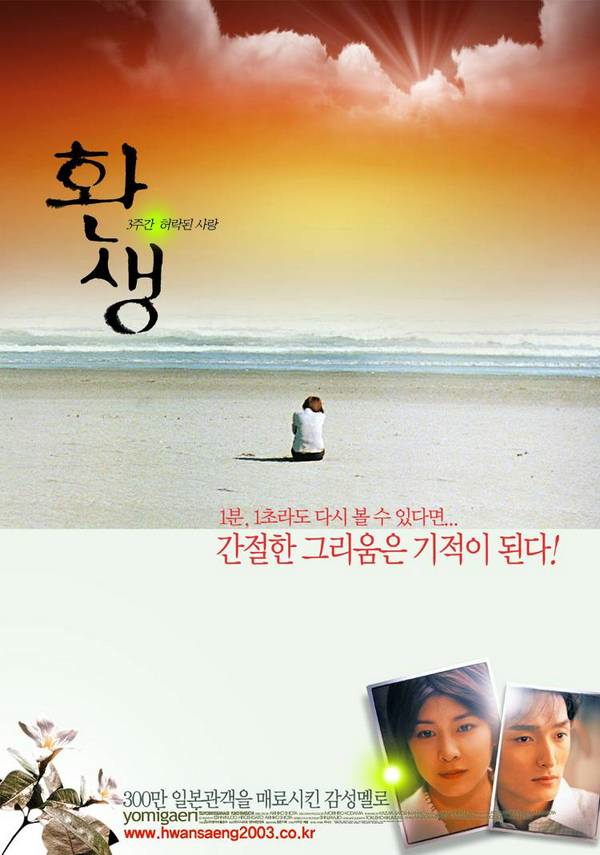
Resurrection 黄泉がえり (Yomigaeri) [2002] • Japan

It's hard to believe this is a Shiota Akihiko film; it's so mainstream sentimental. Compared to the two very independent flavored films about lost teenagers he made just before and after this one—the brutal Harmful Insect and the ennui filled Canary, not to mention his twisted psycho-sexual drama debut Moonlight WhispersResurrection is mall fodder. It's not bad as far as these things go. It just surprised me. The film stars adults instead of teenagers, but in the end it is very much a teen film.

People start returning from the dead. Children to parents, husbands to wives, wives to husbands, and so on. Each of these resurrections gets its own postcard-style short story and they are all meant to pull the heartstrings, nothing more. They have almost nothing to do with one another and they don't build to any big party for the dead. The film is a loosely knit series of vignettes held together by a government bureaucrat who returns to the little town where the events are happening, which also happens to be the town where he was born, to investigate the occurrences. Of course there is a girl there whom he pined for but lost contact with when he moved away. She serves as a love interest and sceptic. There's a twist and then you're supposed to cry.

It's all good. The film is so harmless it's hard to object to anything about it, except maybe the government bureaucrat's haircut. Tsuyoshi Kusanagi, as the bureaucrat, is an odd looking fellow. He'd been a member of the pop group SMAP, which lends more to the mall fodder aspect of the film, and he approaches the role with a sincere earnestness. He has a few well done moments of emotional outburst but is overall pretty flat, although not disagreeable, as an actor. Yuko Takeuchi is wonderful as the tomboyish love interest.

There is, actually, a big party for the dead at the end, but not really. It's a concert, which at first seems to serve only to highlight a couple songs, in their entirety, by pop singer Kou Shibasaki. Then you remember, "oh yeah, that's the girl from the beginning of the movie". It's not that this film is hard to follow, it's just structured in a way which favors feeling over narrative. The vignettes don't come together Altman style. They are all pretty much self-contained units.

This movie was a big hit in Japan when it came out, back when SMAP and Shibasaki were at the top of the charts, and was probably a lot more fun than it is now. What's interesting to me about it is seeing it in the context of Akihiko Shiota's other work. I haven't seen his two most recent films, Dororo and A Heartful of Love, but if this one is any indication, it suggests he is fully capable of making mainstream commercial films if he wants to. I don't know if that is good or bad.

★★★
Director: Akihiko Shiota
Starring: Tsuyoshi Kusanagi, Yuko Takeuchi, Yuriko Ishida, Sho Aikawa, Keiichi Yamamoto

IMDb
Asianmediawiki
Japan Times
Beyond Hollywood

Moonlight Whispers 月光の囁き (Gekkô no sasayaki) [1999] • Japan

One of those "only from Japan" psycho-sexual dramas which explores adult themes of desire, domination, and twisted mind-fuck games and perversion ... acted out by teenagers. No comment on this peculiar film tradition.

Boy with fetishes meets girl with Dom proclivities. At first the girl, played exquisitely by Tsugumi, thinks the boy's over-zealous displays of desire are perverted, but then she realizes his fetishistic personality gives her great power over him so she makes him do pretty much anything degrading she can think of, from licking her feet, nay, her entire leg clean, to locking him in a closet while she has sex with another guy. He goes along with all of it because he is also madly, sadly, and pathetically in love with her. It's a little harder to tell what her motivation is because, well, she's a girl. Depending on the viewer's orientation to things, the film might seem erotic, but no matter which way the wind blows there's no escaping the film's ominous, eerie, and sad emptiness (in an indie good way). This film just broods along beautifully.

This is Akihiko Shiota's directorial debut and probably his strongest film. The focus is clear and concise. The powerful but flawed Harmful Insect would have benefited from such focus. It was the first one of his films I had seen and it pissed me off for days. Then I saw Canary and wasn't sure what to think. There wasn't much new to it and it seemed less well done. Now that I've seen Moonlight Whispers I have to go back and watch those two films again, and I will be seeking out all of his films. Funny how that works.

★★★★★
Director: Akihiko Shiota
Starring: Kenji Mizuhashi, Tsugumi

IMDb
Wikipedia


Norwegian Wood ノルウェイの森 (Noruwei no mori) [2010] • Japan

I let myself get over-hyped about this one: Director Anh Hung Tran's The Vertical Ray of the Sun is one of the most beautiful films I've ever seen; Cinematographer Ping Bin Lee, one of my favorites; Jonny Greenwood doing the soundtrack. Almost every publicity blurb about this movie starts off with "Upon hearing the song "Norwegian Wood," Toru remembers back to his life in the 1960s ..."

Well ... that blurb may describe the book but it has nothing to do with this film. I'm not a Beatles fan but I do carry a bunch of love for that song and it does bring with it a great sense of nostalgia. Somebody paid somebody a bunch of money to play that song over the end credits, all for naught. There isn't any real sense of nostalgia in the film except for some of the fashion and the big telephones. I let myself be mislead.

Greenwood's soundtrack might be interesting to listen to by itself but in the film all the lilting strings manage to seem bombastic. I literally muted the film several times it annoyed me so much. I don't think this is Greenwood's issue, though. Tran has been known to over-saturate a film or two with torturing soundtracks (The Scent of Green Papaya). Ping Bin Lee did come through. There are many breathtakingly beautiful scenes in the film, a few of which played silently for me because of the aforementioned soundtrack's habit of shitting all over the film.

I do not like Rinko Kikuchi's acting. I've seen her in a handful of films and while she gets some moments right, she often brings too much of her blonding international star self to roles (even before she had it) and I struggle to see a character beyond her personality. She whispers a lot which is a phony way to be dramatic done by people, strangely, desirous of attention. If they have your attention a little bit they can force you to double it by whispering. Fortunately she is only half the focus of the film. Texas born Kiko Mizuhara is awesome as the main "other" girl, Midori, in Toru's life. She's cute, spunky, forward, sexually confident, and blunt, but comes off as merely an outline of a character. I wish the whole film were about her. Ken'ichi Matsuyama, as Toru, is serviceable as the supposedly nostalgic one but hardly awesome enough to be a guy that three different girls just have to fuck. Gorgeous Eriko Hatsune has a nearly film-stealing scene but that's about all we see of her.

The film contains some rather bold, and funny at the same time, sexual dialog, although it's a little sore-thumbish because the film is only punctuated with it. I loved it, and laughed, when Midori calls up Toru and says "My dad died. Will you take me to a porno film? The most perverse one." She also has a few moments describing to Toru how she'd like to be bedded by him which are entertaining. Kikuchi's Naoko, after letting Toru know that she's too crazy with despair to sleep with him asks him if it's torture to have an unserviced erection: "I can help with that", she then offers. There is a good bit of sadness and mixed up desire in the film but the characters and the story aren't developed enough to see it as more than immature angst.

I think this film will appeal to teenagers and twenty-somethings who've read the Haruki Murakami novel it's based upon because most of the holes in the film will be filled in and the sense of nostalgia might be there. Not that teenagers have a lot of nostalgia for the sixties but the film is about loss, and it is fairly good at presenting that—except the adolescent level of it is pretty thin. The film is NOT about the way things were—the last few wonderful lines of the film and a Beatles tune can't save it. It's just a young-love story which lacks the depth to appeal to those not feeling the same way, i.e., older folks. Young people experiencing the whirlwind of sexual awakening, and or those who've had a friend commit suicide, might love it.

Norwegian Wood is a great looking film but not well written or acted, and since it is also quite slow moving I don't think it will engage general audiences who haven't read the book. It's not sexy enough nor smart enough.

★★★
Director: Anh Hung Tran
Starring: Rinko Kikuchi, Ken'ichi Matsuyama, Tetsuji Tamayama, Kiko Mizuhara, Reika Kirishima, Eriko Hatsune

IMDb
Wikipedia
Asianmediawiki

Sweet Little Lies スイートリトルライズ (Suîto ritoru raizu) [2010] • Japan

There will be a lot of words written about how this film "makes you think"; how it makes you think about marriages which on the surface appear to be happy ones, and then how it (the film) proceeds to reveal the Sweet Little Lies that go on underneath in order to keep up that appearance. This will not be my approach. The idea has been Twin Peaksed to death. Nothing wrong with that. I'm just one who finds execution more engaging than idea.

Ruriko (Miki Nakatani) and Satoshi (Nao Omori) have been married for a few years and have been sexless for about the same. Satoshi, even though he's a little too grown up to be doing so, likes to sleep in and play video games. He doesn't appear to have any real love for his wife but also doesn't object to her much. It's Ruriko who demonstrates, though she may not necessarily have, all the love in the coupling. She's as dutiful as they come. She cooks breakfast, washes windows, and smiles sincerely. Both of them seem to float through life in a daze of WTF, sort of like the way folks taking a high daily dosage of Valium would. They are both stalked and then drawn into sexual affairs. Ruriko dives into hers the only way she knows how: with detached positivity. Satoshi remains lost in his cloud, but doesn't complain.

For a while I thought this film might fail. Miki Nakatani doesn't strike me as an actress with much range. She's good at contemplative WTF gazes off into space but not much more. Or so I thought. This role is perfect for her and she shines, and director Hitoshi Yazaki does a great job of capturing her in her strength. There are times when Nakatani brings the film into a surreal, Stepford Wives atmosphere with her robot-like gazing, and then she'll bust it wide open with a smile that makes you want to go crawling into her arms whimpering "mommy mommy", even though she exudes zero maternal aspects of personality.

Juichi Kobayashi, as Haruo, the man Ririko has an affair with, is a curiosity. He's a dancer, not an actor, so he's used to being adored but doesn't have any acting chops. Doesn't matter. He's a stalker so he's supposed to be creepy, if only mildly, and his role is to serve as an excuse for Nakatani to get emotional. There's great tension in sitting through the improbability of Ruriko actually falling in love with this guy, not just wanting to have sex with him, because, as unbelievable as it might seem, it's the only way Ruriko knows.

Nao Omori is a pleasure to behold as Satoshi. He's hard to figure out because he's so good at playing a man who doesn't have a clue. He's also lucky to have Chizuru Ikewaki cast as the young woman who innocently, but persistently pursues him. She elevates every film she's in and brings a controlled, mature naivete to her role that works wonderfully alongside Omori's clueless Satoshi. Both of these actors are great casting choices and in many ways, at least as a couple, they are more interesting than Haruo and Ruriko.

Sakura Ando rounds out the cast, in a small role, as Haruo's girlfriend. Yeah, Haruo is a cheater, too.

Hitoshi Yazaki directed one of my all-time favorite films, Strawberry Shortcakes, so I had pretty high hopes for this one. There were moments in the first act where I wasn't sure if things were going to work out but this is a much different film. It's slower paced and takes a while to bring you into its dreamlike world where appearances appear superficial. The brilliance of it is that when confronted with this obvious superficiality we assume it's masking a cauldron of repressed emotions, but there are no revealed emotions in this film. Nakatani's Ruriko appears to show some emotion, and she has a wonderfully teary-eyed "I Love You" scene, but it's not real. She's just executing the rituals she believes are associated with the set of circumstances. I was premature in thinking I would have to punt my suspension of disbelief at the idea of Ruriko falling in love with her stalker. It's not supposed to be believable. It's just another illusion Ruriko will play a role in.

If only Yazaki hadn't included the scene where Satoshi's sister stops Ruriko, as she attempts an abrupt exit from their afternoon tea to go meet Haruo, and says "Ruriko, you're glowing", my theories would make sense. As it stands, I am completely full of shit. Who cares?

Sweet Little Lies is shot in gorgeously austere and misty shades of gray. There are innumerable scenes in the film full of nuanced and subtle discomfort that will make you shiver. The script is smart, the performances are dazzling, and the film will make you think. Feel free to think about whatever you want.

★★★★★
Director: Hitoshi Yazaki
Starring: Miki Nakatani, Nao Omori, Chizuru Ikewaki, Sakura Andô, Juichi Kobayashi

IMDb
Asianmediawiki
Japan Times

Confessions 告白 (Kokuhaku) [2010] • Japan

When I made my top ten list for 2010 I wrote I was confident that if I had seen this it would have made the list. It's a little late, but now I've seen it and added it to the list.

As par usual, I'm not going to go through a plot synopsis. Click on one of the links at the end of this entry if you want that. 

Confessions is not perfect but it's pretty close. It's dark and gorgeous. It's unsettling. It's got Takako Matsu and Yoshino Kimura; Radiohead and Boris on the soundtrack. It gets crazy and goes by quickly at times (hard to catch all the subtitles), even though a good portion of the film is in slow motion. It's a testament to the skill of the director that everything makes an impression, even fluttering by. A few times, for a moment, it seems like it might lose steam and then whoosh! There it goes again. This is hands-on film making. An audio-visual package right up there with Myung-se Lee's M. It gets physical. And that's what I like about it. Nakashima gets how to manipulate sight, sound, and time moving through time that creates both a sense of being on a rollar coaster and being suspended in time. Like being in a dream or a car wreck.

It's creepy that most of the players in the film are 14 years old, talking about killing people and their mommy problems. The film gets most of its fuel from mommy problems. Shocking that it seems so believable that these kids understand what they are talking about. Tetsuya Nakashima makes these kids smart. It's very refreshing.

The first and last acts are both tours de force. I've seen three different English translations of the last line in the film. Don't google it until after you've seen it. What an ending! Some folks have written that Nakashima throws it all away with the last line but I think it depends on how you take it. I found it eerily ambiguous and evil.

Most commenters on the film will point out the film's "social commentary", i.e., that kids under fourteen years of age can't be punished by the law for anything. I'm not big on social commentary commentating but watching the film I couldn't help but think that any thirteen year old contemplating murder sort of gets a green lit idea. And the bit about the teacher giving the unpunishable kids HIV tainted milk, as part of her revenge, is chilling but it's more that she fills the kids with a fear of their own mortality than attempting murder of her own. You'll see what I mean when you watch the film. It's just one of the many questionable aspects of the script's believability that ....

If you over think this film it can fall apart. If you're the type that does that kind of thing you won't like it as much as I did. But unless you are also sensitive to slow motion or post rock emo soundtracks it's hard not to be overwhelmed by this masterfully crafted film.

★★★★★
Director: Tetsuya Nakashima
Starring: Takako Matsu, Masaki Okada, Yoshino Kimura, Masakazu Ato, Atsushi Ozawa

IMDb
Asianmediawiki
Japan Times
Beyond Hollywood

Cafe Isobe 純喫茶磯辺 (Jun kissa Isobe) [2008] • Japan

This is a funny film built on fine performances and skilled direction. Yujiro Isobe (Hiroyuki Miyasako) acts like a guy who has accidentally dropped his cards face-up on the poker table and thinks he can still bluff. Sometimes he's a little pitiful and some times a little creepy but he never goes over the edge—he just hints at it. He lives with his teenage daughter Sakiko (Riisa Naka). Mature beyond her years, Sakiko puts up with him but doesn't like him very much ... well, until the end when everything gets happy ... but she doesn't hate him. She treats him with the amount of respect he deserves, which is a cautious little. Sakiko's been abandoned by her mother but doesn't hate her either. Her mother didn't fight for her custody because, as she tells Sakiko, "It seemed like your father cared for you more than I did." Ouch!

Yujiro inherits some money and quits his job. After a bit of time doing nothing he decides to open a cafe. When he informs Sakiko of his plans she asks him if he has any service experience; or a business plan; or if he knows anything about food. He says he will work hard at it. Sakiko tells him, rightfully, that he doesn't even know what he's supposed to work hard at. His response is, "You're annoying. So annoying." He's going to bluff.

Yujiro opens the cafe and Sakiko agrees to help out part-time but she's so appalled by the decor her father has chosen she refuses to tell any of her friends where it is for fear they will come visit and laugh. Life at the cafe, and the father daughter relationship, gets complicated when an attractive young woman, Motoko (Kumiko Aso) begins working there. She wears a short-skirted uniform to attract customers, and Yujiro becomes attracted to her as well. Motoko is a strange character, with a lot of baggage. Sakiko is immediately suspicious and doesn't want her father to have anything to do with Motoko, professionally or personally. Yujiro begins dating Motoko and an emotional comedy of errors ensues.

Kumiko Aso is fabulous here. The three main characters are all good, really good actually, but Aso is a favorite actress of mine and she's wonderful in most everything she does, so I'm singling her out. She makes the film funny in a "funny-strange" way more than a "funny-haha" way, but there are many moments that will likely make you laugh out loud. A lot of the laughs are the result of the director's skill in editing for comic timing. This is a well put together film, and it has a heart, too. It's a comedy, and while it gets goofy from time to time, it brings itself together as a mildly touching, chuckle filled, human drama.

★★★★
Director: Keisuke Yoshida
Starring: Hiroyuki Miyasako, Riisa Naka, Kumiko Aso
IMDb
Asianmediawiki

Girlfriend • Someone Please Stop the World [2004] • Japan

More Ryuichi Hiroki. This one is love story between a young woman photographer, Kyoko, who gets an assignment to pick a woman off the street and take nude photos of her for a men's magazine, and the woman who turns up as the subject of that assignment, Miho. Kiyoko's professional ethos is one of getting to know her subject deeply, be it a fruit plate or a human being, and as she does this she finds her interest in this particular subject, Miho, turning into fondness. The feeling is mutual, but this isn't a gay-themed film per se. There are just no barriers in the way that might prevent these two wandering souls from exploring each other, trying to find a positive relationship in a world they feel disconnected from, saddened by. The two performances are good enough, but not great, while the underlying drama and psychological trauma seem less satisfying.

I'm never quite happy with films that explore a lesbian liaison by setting up one of the participants as frustrated by bad relationships with jerkball men. It doesn't have to be that way. In this case it's Kyoko, but she has the personality of being frustrated by more than her bad boyfriends. She's a bit frustrated with herself and is trying to find a comfortable compromise between photography as art and photography as commerce. She's idealistic and a bit peculiar. When she meets Miho, who is angry about her father who left her family years ago and hasn't been in contact since, she meets someone who's more bummed out with life than she is so she's able to feel a little bit better about herself, and seems genuinely interested in, listening to Miho's stories. It's not unusual to become attracted to someone that makes you feel better about yourself.

Miho agrees to pose nude for Kyoko partly, well, mostly, as a means of getting back at, and getting the attention of, her father. I'm not sure about that as a method or as a solution but she's hurt and angry and she wants her father's attention. Kyoko and Miho are both presented as empathetic outsiders. Following them is a reasonably enjoyable romp in indie ennui but it doesn't wrap itself up into a grand story.

Girlfriend is part of the Love Collection, a loose series of DV shot features from 2004 with the common theme of love. Other entries include Kihatsusei no onna (A Volatile Woman) by Kazuyoshi Kumakiri, OLDK by Masahiro Hara, Nejirin bou by Tadashi Tomioka, Moon and Cherry by Yuki Tanada and Kokoro to karada by Hiroshi Ando.

★★★

Director: Ryuichi Hiroki
Starring: Aoba Kawai, Tomorowo Taguchi, Kinuwo Yamada, Kazuhiro Suzuki, Jason Gray, Aya Sugimoto
IMDb
Asianmediawiki
cinephilia101

I Am an S+M Writer 不貞の季節 (Futei no kisetsu) [2000] • Japan

Ryuichi Hiroki released this film and Tokyo Trash Baby on the same weekend!

Kurosaki (Ren Osugi) is an erotic novelist who uses his editor and a hired model to act out scenarios in his living room he will use for inspiration in his writing. His wife Shizuko (Yôko Hoshi) calls him a pervert but we soon learn that what bothers her is that she feels her husband has intellectualized his carnal desires and she feels physically neglected. Shizuko tries to make him jealous, or simply goes after what she desires with someone else. At first she brings home an Caucasian English teacher but soon zeros in on her husband's editor after witnessing his accomplished S&M rope tying technique. Kurosaki's first response is anger, then forgiveness, then he decides to use the affair as inspiration for his current work in progress. He demands that his editor continue the affair and recount all the sordid details to him. He slaps his editor upside the head, then forgives him and offers him a drink each time before they get to work.

I don't think this would be funny if it were an English language film. Part of its charm is feeling like a foreigner watching a Japanese film. Much of the humor is surely lost in translation but some of the translations take on a humor of their own. Often it feels like the words are too blunt and some subtlety of language is being missed, while other times it seems words are forced together into strange combinations to try and convey different shades of something not literally translatable. "Go anal". It's all played very sincerely, if somewhat surreal. 

Speaking of surreal, one thing that puzzled me throughout this film was the house where most of the action takes place. The layout seems inscrutable, a labyrinth of hallways and doors. A character will walk down a hall, turn down another, and then open a sliding door to apparently go into a room. Then the camera is in the supposedly entered room but the door has hinges and no relation to a hallway. Kurosaki will serve his assistant a beer from one direction and then deliver a second one from a different location. There's one scene that appears to have no plot value where the maid exits a door, removes her shoes and plunges off the porch a couple feet to the ground, as if she expected a step of some kind to be present. I assume this scene is meant to convey that even the characters are a bit befuddled by the structure and layout of the house. Maybe I just missed something but this kind of scene does fit in with the overall strangeness of the film.

While this comes off as a small and amusing film, I think it was a big film for Ryuichi Hiroki, somewhat autobiographical, incorporating way more Japanese history and culture than I am privy to, and most importantly served as a great transition for him from a director of pinku films to more mainstream fare, albeit a little arthousey.

★★★★
Director: Ryuichi Hiroki
Starring: Ren Osugi, Yôko Hoshi, Jun Murakami, Eri Yamazaki, Kiriko Shimizu

IMDb
Asianmediawiki
Japan Times
Midnight Eye

Asako in Ruby Shoes 순애보 (Sunaebo) [2000] • South Korea, Japan

This one seems a bit of an art-house diversion for director Je-yong Lee. A mildly bizarre, slow moving film that's half Japanese and half Korean. It aims at just the right level and ends up as a nice compromise between indie indulgence and commercial fare.

On the Korean side, Lee Jung-Jae stars as U-in, a bored, anti-social civil servant who passes time surfing porn on the Internet and silently stalking a young punkish girl with fiery red hair. While playing around on the Internet U-in clicks on a link that asks him to describe his ideal woman. He describes the punky girl.

On the Japanese side Misato Tachibana stars as Aya, a young woman who has decided to commit suicide with a twist: she wants to confuse the date of her impending death by holding her breath and suffocating as she crosses the International Date Line. She also desperately wants a pair of Ruby colored shoes. One thing leads to another and Aya is contracted by Internet porn purveyors to play the punkish girl, as described by their client U-in, on one of their webcam sites. Thus the persona of Asako is born.

The two disparate lives meet and wind the film up in a somewhat unbelievable fairy-tale style ending but it's been a strange ride getting there so no giant complaints. It's interesting to see a film that is half in Japanese and half in Korean. Much of the film deals with the theme of belonging and it allows for stretching that theme to something larger than just one culture.

The performances are all pretty solid. Fashionista superstar Kim Min-hee plays the punky girl. It's a small role, as she serves only as the inspiration for Asako, but it's catchy. Lee Jung-jae is spot on as the nerdball stalker. This is a better role for him than the studly type he played in Je-yong Lee's debut film An Affair. He's much better at nerdy innocence with a sense of creepy just below the surface than as a macho guy who is supposed to drive girls wild. Misato Tachibana brings just the right amount of cuteness and individual longing to Aya/Asako. She doesn't seem to have pursued her acting career ambitiously after this film but did well here.

The film has a slow pace and treats some of the edgier elements with a gentle touch. It never becomes darkly uncomfortable and that's it's charm. It's got quirky characters and a subtle, light sense of humor. Not completely art-house fair but certainly not mainstream. Recommended for those who like films slightly off the beaten path.

★★
Director: Je-yong Lee
Starring: Misato Tachibana, Jung-Jae Lee, Urara Awata, Min-hie Kim, Ju-bong Gi
IMDb
Asianmediawiki

Glasses めがね (Megane) [2007] • Japan

Serenity now. This lovely gem can be dismissed as a new-age tourist brochure for Okinawa (although the locale remains unnamed in the film) if one is feeling rambunctious, or it can be consumed like one of the many bowls of magical shaved ice presented in the film, a spoonful at a time without surprises, savoring the moments that celebrate the simple in life.

The story that will unfold is obvious from the beginning. A harried young city dweller, Taeko, takes a much needed vacation to a remote island inn, meets a few laid back and strange locals which she at first tries to keep her distance from but eventually succumbs to the rhythm of the place and its people. Happiness is attained.

For a film like this to work it needs to look nice, have engaging characters, and not take itself too seriously. It's filmed on Yoron Island, Okinawa, Japan, so director Naoko Ogigami has the aesthetics of location covered. There are plenty of shots of crystal clear waters washing up on pristine beaches that look nice and help set the slow rolling pace of the film. Ogigami has written a witty and sparse script, which drifts along alternating between surreal and a Zen koan, and assembled a wonderful and talented cast to deliver it. Ken Mitsuishi, who's been in 136 films, plays the inn-keeper Yuji with such calm assurance you might think you're watching his biography. Ogigami also brings along two actresses who made an impression in her previous film, Kamome Shokudo (Seagull Diner). Masako Motai plays a mysterious visiting matriarch of the island, Sakura, who makes magical kaki-gori, a dessert made of shaved ice and syrup, and leads the locals in weird morning calisthenic exercises on the beach. Satomi Kobayashi plays Taeko, the vacationing visitor to the island. She seems well suited to Ogigami's style, having played a similar fish-out-of-water character in Kamome Shokudo, a Japanese woman who opens a restaurant serving rice balls in Helsinki. Her performance here shows a slow and subtle transformation that reflects the pace of life on the island. The cast is rounded out with celebrated young actors Mikako Ichikawa and Ryo Kase.

If you enjoy slow, amusing, meditative films with quirky characters this is a winner. If you're looking for slapstick, this is a loser. It's whimsical and slightly bizarre but thoroughly understated. Moments that might seem a little new age tree-huggerish aren't annoying because the tone is not preachy or precious. It's very light-hearted and doesn't take itself seriously.

★★★★★ 

Director: Naoko Ogigami
Starring: Satomi Kobayashi, Mikako Ichikawa, Ryo Kase, Ken Mitsuishi, Masako Motai
IMDb
Asianmediawiki
Japan Times
Time Out (an opposing view)


2/Duo (2/dyuo) 2 Duo [1997] • Japan

This is a rare gem. The feature film debut of director Nobuhiro Suwa. It's a no-budget, mostly improvised slice of emotionally repressed life which observes a young couple for a short period of time as they struggle to communicate. I wouldn't say things are going badly for them at this particular point in their lives, they seem very much in love, but the relationship is uncomfortable.

Kei (Nishijima) is a struggling actor, freeloading off Yu (Eri Yu) which makes him impulsive and insecure resulting in unpredictable behavior, fits of anger, and a proposal of marriage. Yu works in a boutique as a shop assistant and seems to be playing the archetype of the abused and unappreciated Japanese woman who tackles her fate with a Zen determinism. Her habit of laughing during the most tense and awkward moments makes her appear a little unstable but also very real, almost surreal.

Even without a handful of scenes where the characters (the actors?) are interviewed about their feelings by an off-screen voice, the film has a fly-on-the-wall documentary feel. 2 Duo is a quietly disturbing character study and the blurring of fiction with documentary might serve to enhance the impact but I'm not interested in critiquing the film from that angle. This is a film which lets us observe the surface interactions of a couple characters that clearly have immense depth. With its crisp vision, assured direction, and most of all its fine acting we really don't need any meta-narrative in order to be fully engaged. I'll leave it to film school students to comment on the ramifications of the documentary style interviews if such a critical look is needed.

This is a small, quiet film with characters that seem overflowing with histories right when we meet them. It's a little sad and painful but it's executed so well there's an uplifting quality to it. This is mostly due to the performance of Eri Yu, who went on to make a few more films but then seems to have disappeared from the industry. Nishijima's performance isn't quite the caliber of Yu's, or perhaps his character isn't as interesting. Being a jerk isn't as complex as being someone who bes with that jerk with their head held high, slightly wobbling.

★★★★★
Director: Nobuhiro Suwa
Starring: Eri Yu, Hidetoshi Nishijima, Makiko Watanabe

IMDb

Tokyo Trash Baby 東京ゴミ女 (Tokyo gomi onna) [2000] • Japan

Mami Nakamura's performance makes this one a big winner. She's engaging, endearing, amusing, and sympathetic from start to finish. That's what it takes for a small film like this to succeed, a film which says: "Here's an offbeat character, do you like her? Does she draw you into her life, entertain you, and invite you to wonder what will happen to her?" It takes a clever script and a good performance. Tokyo Trash Baby delivers on both accounts.

Miyuki (Nakamura) is a girl in love with her upstairs neighbor, a musician. Instead of trying to meet him she is content with stealing his garbage and foraging through it to find things that will give her insight into his personality. She collects many things, like empty cereal boxes, cigarette butts, love letters, discarded musical scores, and creates a shrine to her love in her apartment. She discards a used condom. The story falls a little flat after she does eventually meet him face to face, but Miyuki is still fun to spend time with. As are the few peripheral characters in the film.

Tomorowo Taguchi plays the manager at the cafe where Miyuki works and is typical Taguchi odd but doesn't have much impact on the story. Two other characters do, though: Kô Shibasaki plays co-worker, Kyoko, whose screen time is devoted almost exclusively to telling Miyuki stories of her sexual conquests, dreams, and dilemmas ... and bumming smokes. Masahiro Toda plays a customer trying desperately to get Miyuki to go out with him but he's too boring to make an impact on her. His attempts at realizing love are face to face but his loneliness prevents him from catching a clue. Both characters serve as juxtaposition to Miyuki and highlight my favorite theme of the film: loneliness. Kyoko has a very active social life but seems unfulfilled and lost. Miyuki (contrary to most observations on the film) doesn't seem lonely. She seems content and happy with her life. That's what makes her interesting. Director Hiroki gives her the respect she deserves.

Tokyo Trash Baby is part of the Love Cinema series of six straight-to-video releases which also includes Takashi Miike's Visitor Q. It's a low-budget affair shot on Digital Video. It's uses all natural lighting and sometimes the glare from an open window distracts but never gets in the way. It's testament to the strength of the story and performance that technical limitations do not derail the project at all.

★★★★★
Director: Ryuichi Hiroki
Starring: Mami Nakamura, Kazuma Suzuki, Kô Shibasaki, Sayuri Oyamada, Tomorowo Taguchi

IMDb
Asianmediawiki
MidnightEye

Island of Light ゴーヤーちゃんぷるー (Goya-champuru) [2006] • Japan

The least one can say about this film is that it won't hurt you. It's a bit thin, borderline trite, in it's I love the magic that is Okinawa message, but it's not offensive. There's this sixteen year old Tokyo girl whose mother abandoned her when she was two; her photographer father died mysteriously a month ago ("No body, so we prayed to his camera instead. That was quite weird to see"); she's bullied at school but jumps at the first chance to join the gang by targeting her best friend as the new scapegoat (she slaps her for no reason as an initiation rite); she quits school and secludes herself in her room because she can't relate to her guardian grandparents; she joins an online sort of hikikomori group, starts texting some guy (who befriends kids in the group because he feels superior to them) and tells him she wants to die. He says "might as well, it beats living ... but why don't you come visit me in Okinawa instead". All that's in the first ten minutes or so.

The girl isn't even off the ferry to the Island of Light before she is taken under the wing of a sweet old lady, the first of the fabulous Okinawans we'll meet as the film progresses. The old lady is a delivery driver which makes it convenient for quickly introducing the young girl to the community of wonderful people who will change her life. On one of their stops a man with terminal cancer has collapsed on his front porch so the girl gets a chance to be a hero by running to the clinic to fetch a doctor (on the way there she stops to ask directions of someone who is gardening and just happens to be the collapsed man's wife). She makes it to the clinic and delivers the message but collapses herself from all the running, and it just so happens that she collapses into the arms of a woman who, well ... if you haven't figured it out by now I won't spoil it.

Ordinarily a film like this would gross me out but this one gets a pass because it never gets melodramatic or histrionic. Most of the performers come off as non-actors (but most aren't) so maybe they lacked the chops to take it to that level. Even the coincidence heavy plot didn't roll my eyes too much because it unfolds in a "country" way, just like you'd expect on the Island of Light, not by building each scene to a crescendo, which is the "city" way. The scenery of Okinawa is soothing, too. In the end just remember: the film won't hurt you.

★★★
Director: Tetsuya Matsushima
Starring: Mikako Tabe, Jun Fubuki, Kôhei Takeda, Misako Ôshiro

IMDb
Asianmediawiki

Fine, Totally Fine 全然大丈夫 (完全没问题) (Zenzen daijobu) [2008] • Japan

This is a subtle, almost surreal comedy that wanders along at a slow pace, punctuated with bits of low-brow humor to keep it alive. It's also an odd little romance and a root-for-the-losers character drama, but there's never any high drama, as the film never gets out of lazy Sunday afternoon mode. The comedy and romance are spices in the mix of everyday people turning thirty, going nowhere fast, who end up going from not so good to not so bad after all. When the humor is subtle or sad it's great, but not so good when it resorts to the juvenile, like when a booger flies across the room and lands in someone's eye. Comedy is tough and everyone has a style that suits them. I could have done without the more broad-based physical bits but they do serve a purpose as little alarms for those who don't appreciate two hours of deadpan, no matter how funny it is. The director demonstrates a good amount of skill in using editing for comic timing, and he was wise to cast YosiYosi Arakawa as the guy to do the heavy lifting when it comes to the “Life’s more fun when you’re an idiot” bits.

I recommend this film to those who like slow comedies, but also to those who like whatever you call these uplifting films about everyday people who don't become rock stars or win the Olympics but just get along and find happiness in everyday life. I love the way the film ends and anti-resolves a love triangle we weren't sure was going to turn out to be much of a plot point. I wanted to reach through my screen and hug the crap out of Yoshino Kimura. Her performance really surprised me. What a pleasure to see her do comedy, albeit of the low-key and clumsy kind.

And even though her part is very small, any film with Noriko Eguchi gets points just for having her.

★★
Director: Yosuke Fujita
Starring: YosiYosi Arakawa, Yoshino Kimura, Yoshinori Okada, Noriko Eguchi, Shima Ise

IMDb
Asianmediawiki

Be Sure to Share ちゃんと伝え (Chanto tsutaeru) [2009] • Japan

"I love you, man".

Sion Sono has made some strange films. This is not one of them unless you consider it strange for him to make such a normal film. Be Sure to Share is a small, simple, and sentimental film, not typically Sono-esque. There's no blood and there's no running around with a handheld camera. There's plenty of emotional desperation but it's of the uplifting kind. The film is about a twenty-seven year old young man who wants to find a moment of bonding, a way of saying thank you, "I love you, man" to his dying father. The title says it all. It's not too mushy, though. The film works because of it's simplicity. There is the big scene that sort of stretches credulity but we could see it coming and Sono follows it up with one of the more hilarious uses of the line "didn't see that one coming" I've ever heard. It's off-camera and sort of eavesdropped upon and it made me laugh out loud.

The film is beautifully cast. Everyone is lovable. Idol-boy Akira does a very credible job playing a normal guy who all of a sudden must deal with mortality, in more ways than one. Ayumi Ito is adorable as his girlfriend and has one of the best crying scenes I've seen in a film. Keiko Takahash is pure mom incarnate, an immaculate performance. Eiji Okuda is good as the father when he's lovable and nice but he also has to play the predictably strict father who's tough to love, in flashbacks, so we get a sense of whatever it is that that film cliché gives us. That's the only weak part of the film but it's not enough to spoil it.

★★★★★
Director: Sion Sono
Starring: Akira, Eiji Okuda, Shogo Ueno, Ayumi Ito, Keiko Takahash

IMDb
Asianmediawiki

Yuriko's Aroma ユリ子のアロマ (Yuriko no aroma) [2010] • Japan

Oh, the expectations. Noriko Eguchi stars as aromatherapist Yuriko, who finds herself uncontrollably aroused by the sweaty scent of a seventeen year old boy. Oh, the possibilities. The boy happens to be the niece of the woman who owns the salon where Yuriko works. That's the story and pretty much the whole plot.

The film gives itself away early, letting on that it's going to be safe and good-humored. Oh, the let down. The moment things hint towards any tension, or that things might get sexy or erotic, the soundtrack rears its ugly head and plays goofy and light-hearted. And then the scene cuts away. The technique of cutting a scene before it finishes can be effective in moderation but here it's so overused it seems to reinforce a suspicion that the director doesn't know how to let a scene form its own conclusion. The film is sprinkled with innumerable scenes that have no beginning nor end, just a shallow, usually brief, middle period. Most of them add nothing and could have just been eliminated.

The film's runtime is only 79 minutes and it could have easily been shorter. It doesn't explore anything in any depth and there are a whole lot of scenes of "opening the door slowly, inch by inch" that could have been tightened up to make room for something else except there's nothing here. A couple off camera handjobs and an embarrassingly out of place scene with a topless air-head girl giving Yuriko a massage don't add any adult or erotic content.

I love Noriko Eguchi so I'm going to write off her Quaalude inspired performance as the result of bad direction. It's a gutsy role, in theory anyway, which calls for her to do a lot of aroused sniffing of a young boy's body and licking of his head. She does those parts very well. Few people could. Too bad they are the only interesting moments in the film.

★★
Director: Kôta Yoshida
Starring: Noriko Eguchi, Shota Sometani, Noriko Kijima, Jun Miho, Saori Hara

IMDb
Asianmediawiki
Midnight Eye
Official Site

There are snippets in this official trailer (which probably won't last long on YouTube because of the boobage) that aren't in the movie and the dialog is cut up and mismatched to create something that doesn't exist in the final product.

Maborosi 幻の光 (Maboroshi no hikari) Illusion [1995] • Japan

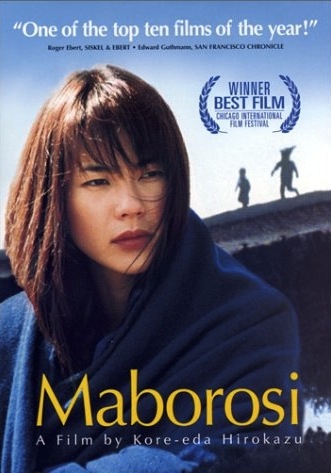
Continuing my exploration of Hirokazu Koreeda. This is another sad and gentle, lyrical film dealing with the themes of loss, death, and the soul. You have to be in the mood to let a film just float by, or wash over you in lilting waves to appreciate Maborosi. A couple of art house film techniques Koreeda employs might frustrate some viewers. One is the use of extremely long shots, in terms of time to a degree but mostly in terms of distance. His camera doesn't always foreground the focus of a scene but instead pulls back and observes it from afar. Sometimes very far. The second thing is that, with only a few exceptions, you never get a really good look at the faces of the actors, an aspect all the more remarkable given Koreeda's casting a fashion model in her film debut as the main protagonist. There is no vanity in this film. It's all bare naked emotion and gorgeous photography.

The film centers on Yumiko, played by Makiko Esumi the fashion model, whose husband apparently commits suicide by walking into an oncoming train three months after their first child is born. Koreeda establishes quickly, and beautifully, at the beginning of the film a very genuine and loving relationship between the couple so the viewer shares in Yumiko's confusion and pain in not knowing why he would kill himself. After a period of mourning Yumiko agrees to an arranged marriage and moves from Osaka with her son to a small fishing village where her new husband, a widower with a young daughter, has lived all his life. There are a few scenes which suggest Yumiko might have found happiness again but it doesn't last. The haunting inexplicability of her first husband's death is too strong for her to escape. The scene where Yumiko finally and completely breaks downs is framed and captured perfectly, but it's shot from about three hundred yards away.

The whole thing is more like a painting than a narrative film. The camera hardly ever moves. People don't say much and plot isn't really part of the equation. One thing I usually insist on when watching these slow-burn character studies with minimal dialog is access to the character's interior. What are they thinking and feeling? The most expressive entrance to someone's interior is their eyes, but as I've mentioned Koreeda shoots the film in such away we hardly know what the characters look like, let alone are we able to look into their eyes. Something else happens. We may not get a sense of what Yumiko is thinking or feeling but we have great sympathy for her. Her despair and inconsolable suffering are clearly shown.

Maborosi is the work of an artist, not someone with an interest in selling theater tickets. Koreeda's passion is exploring light and color and composition, and in exploring the themes of loss, death, and the nature of the soul. Yes, that's a polite way of saying a lot of people will find the film boring. So be warned. For those who like this kind of thing, and you know who you are, this is one of the good ones. It is so full of magnificently composed photography it will take your breath away.


Maboroshi is a Japanese term for illusion or mirage, and is often used in the tales of fishermen to describe a light that tempts them, without explanation, further out to sea. Maboroshi is the explanation given to Yumiko as to why her husband may have walked into the path of an oncoming train.

★★★★★
Director: Hirokazu Koreeda
Starring: Makiko Esumi, Takashi Naitô, Tadanobu Asano, Gohki Kashiyama, Naomi Watanabe

IMDb
Wikipedia
Asianmediawiki
Roger Ebert

Out of the Wind 風の外側 (Kaze no sotogawa) (2007) • Japan

This is Sakura Ando's feature film debut. It's written and directed by her father, Eiji Okuda. These are the facts. It's a confused film. It starts off being about a young girl, Mariko, who has a dream of becoming a diva in the world of opera. It's funny seeing Sakura Ando do that elongated mouth opera singing thing, but I digress. There has to be some conflict so a soft-spoken tough guy is introduced. He becomes Mariko's bodyguard and remains nameless for a while. This is a Japanese film. There are perverts targeting young girls in school uniforms.

The boy and girl enter into a typical movie relationship. It starts off distant and rocky but love slowly swirls. Then the focus of the film drifts to the guy who has a dream of becoming a big time Yakuza. Problem is, he's Korean, so he has to prove himself on his way up the ladder by doing all the icky jobs. One of which turns out to be killing a Korean businessman who ... drum-roll, please ... turns out to be Mariko's father. That would mean, you guessed it, Mariko is half Korean. Now the film drifts into an exploration of identity and we're given an excuse to up the ante in the love relationship between Mariko and her bodyguard. The life of Koreans and the discrimination they endure living in Japan is also explored.


It's not that a film can't grow and expand on the themes it explores but it has to be well-written and executed or it will fail. The amount of suspension of disbelief required to get from A to B to C in this film is huge. I didn't have the power to suspend my disbelief that a director would have his young daughter do a nude scene in her film debut, seems creepy, nor was I able to get through the scene where the bodyguard stumbles into the opera house and stabs Mariko's father while she watches the whole thing, albeit with a wrinkled forehead, but never stops singing.

This film is pretty awful, and it's too bad because Sakura Ando's performance is pretty good. It's a real sign of talent when you can be good in a bad film.

★★
Director: Eiji Okuda
Starring: Sakura Ando, Takao Sasaki, Kazu Andô, Yasuhiro Arai, Megumi Araki

IMDb
Asianmediawiki