Showing posts with label 2008. Show all posts

Red Cliff 赤壁 (Chi bi) [2008+2009] • China

A five hour holiday marathon. Period pieces, costume dramas, and films about fighting (physically or with weapons other than the heart) are a few of my least favorite film genres so I don't know how it happened but I loved every minute of this monster. If I had watched the condensed version I wouldn't have liked it. There are two 30 minute fight scenes, and since the cut version is aimed at Western audiences I doubt they would have suffered any loss, which would have then made them be half the movie and I would have been bored silly.

I love the Art of War, men of honor, tea ceremony languid pace of it which allows for fleshing out the characters and slowly developing the gravity of the situation. Sure, it's a little over-the-top at times—it's John Woo—but it's really easy to get into the film's depiction of historically important events and forgive a few personal excesses. The film is remarkably understated for the most part. All the performances are good. All the actors bring you into their world and make you care for them and their concerns. I even rooted for these guys when they went ONE against ONE THOUSAND ... something so silly I've never understood the prevalence nor appeal of it in film.

This film ignited an interest in Chinese historical epics I never thought I would develop. It prompted me to watch The Emperor and the Assassin, and that one is awesome. I've got a couple more in my queue. I think the key is picking the ones that are made for a Chinese rather than a Western audience. The long version of Red Cliff seems to be one of those films. It's slower and more poetic, which is what I like. If it's what you like and you've been keeping this one at bay for fear it's just another big, dumb Chinese historical videogame, give it a shot—and be sure to give it the long shot.

★★★★★
Director: John Woo
Starring: Tony Leung Chiu Wai, Takeshi Kaneshiro, Chen Chang, Wei Zhao, Fengyi Zhang, Shido Nakamura, Jun Hu, Yong You

IMDb
Wikipedia
Asianmediawiki

Cafe Isobe 純喫茶磯辺 (Jun kissa Isobe) [2008] • Japan

This is a funny film built on fine performances and skilled direction. Yujiro Isobe (Hiroyuki Miyasako) acts like a guy who has accidentally dropped his cards face-up on the poker table and thinks he can still bluff. Sometimes he's a little pitiful and some times a little creepy but he never goes over the edge—he just hints at it. He lives with his teenage daughter Sakiko (Riisa Naka). Mature beyond her years, Sakiko puts up with him but doesn't like him very much ... well, until the end when everything gets happy ... but she doesn't hate him. She treats him with the amount of respect he deserves, which is a cautious little. Sakiko's been abandoned by her mother but doesn't hate her either. Her mother didn't fight for her custody because, as she tells Sakiko, "It seemed like your father cared for you more than I did." Ouch!

Yujiro inherits some money and quits his job. After a bit of time doing nothing he decides to open a cafe. When he informs Sakiko of his plans she asks him if he has any service experience; or a business plan; or if he knows anything about food. He says he will work hard at it. Sakiko tells him, rightfully, that he doesn't even know what he's supposed to work hard at. His response is, "You're annoying. So annoying." He's going to bluff.

Yujiro opens the cafe and Sakiko agrees to help out part-time but she's so appalled by the decor her father has chosen she refuses to tell any of her friends where it is for fear they will come visit and laugh. Life at the cafe, and the father daughter relationship, gets complicated when an attractive young woman, Motoko (Kumiko Aso) begins working there. She wears a short-skirted uniform to attract customers, and Yujiro becomes attracted to her as well. Motoko is a strange character, with a lot of baggage. Sakiko is immediately suspicious and doesn't want her father to have anything to do with Motoko, professionally or personally. Yujiro begins dating Motoko and an emotional comedy of errors ensues.

Kumiko Aso is fabulous here. The three main characters are all good, really good actually, but Aso is a favorite actress of mine and she's wonderful in most everything she does, so I'm singling her out. She makes the film funny in a "funny-strange" way more than a "funny-haha" way, but there are many moments that will likely make you laugh out loud. A lot of the laughs are the result of the director's skill in editing for comic timing. This is a well put together film, and it has a heart, too. It's a comedy, and while it gets goofy from time to time, it brings itself together as a mildly touching, chuckle filled, human drama.

★★★★
Director: Keisuke Yoshida
Starring: Hiroyuki Miyasako, Riisa Naka, Kumiko Aso
IMDb
Asianmediawiki

Fine, Totally Fine 全然大丈夫 (完全没问题) (Zenzen daijobu) [2008] • Japan

This is a subtle, almost surreal comedy that wanders along at a slow pace, punctuated with bits of low-brow humor to keep it alive. It's also an odd little romance and a root-for-the-losers character drama, but there's never any high drama, as the film never gets out of lazy Sunday afternoon mode. The comedy and romance are spices in the mix of everyday people turning thirty, going nowhere fast, who end up going from not so good to not so bad after all. When the humor is subtle or sad it's great, but not so good when it resorts to the juvenile, like when a booger flies across the room and lands in someone's eye. Comedy is tough and everyone has a style that suits them. I could have done without the more broad-based physical bits but they do serve a purpose as little alarms for those who don't appreciate two hours of deadpan, no matter how funny it is. The director demonstrates a good amount of skill in using editing for comic timing, and he was wise to cast YosiYosi Arakawa as the guy to do the heavy lifting when it comes to the “Life’s more fun when you’re an idiot” bits.

I recommend this film to those who like slow comedies, but also to those who like whatever you call these uplifting films about everyday people who don't become rock stars or win the Olympics but just get along and find happiness in everyday life. I love the way the film ends and anti-resolves a love triangle we weren't sure was going to turn out to be much of a plot point. I wanted to reach through my screen and hug the crap out of Yoshino Kimura. Her performance really surprised me. What a pleasure to see her do comedy, albeit of the low-key and clumsy kind.

And even though her part is very small, any film with Noriko Eguchi gets points just for having her.

★★
Director: Yosuke Fujita
Starring: YosiYosi Arakawa, Yoshino Kimura, Yoshinori Okada, Noriko Eguchi, Shima Ise

IMDb
Asianmediawiki

My Dear Enemy 멋진 하루 (Meotjin haru) [2008] • South Korea

This film belongs to Jung-woo Ha. He is engaging and funny playing one of those guys who can spin even the worst of interactions into something that makes him seem likable. Seen in isolation, his character's charms might seem to not add up but the film manages to paint a convincing portrait of a guy you just can't say no to.

Do-yeon Jeon, in heavy eye make-up, pretty much pouts her way through the film playing an old girlfriend of his who wants to collect some money he owes her. She tracks him down and demands he repay her by day's end. She knows him well enough to know that promises of repaying her later will never be kept. He's vulnerable and in the dog-house but he's still in charge of things as he sets out to borrow money from a series of other old girlfriends and lovers in order to repay her. She follows him around while he does it. It's an interesting scenario which produces many storied and funny moments.

With lesser actors this film probably wouldn't work. It's a Yoon-ki Lee film—which means it's low-key, slice of life, simple story stuff. Don't expect high drama or excitement. What you'll get are two fine performances and, in typical Lee fashion, two characters who reveal themselves to one another not through mutual interaction but by observing the subtle interactions they have with other people.

★★★★
Director: Yoon-ki Lee
Starring: Do-yeon Jeon, Jung-woo Ha, Il-hwa Choi, Ju-bong Gi, Hyo-ju Han

IMDb
Asianmediawiki
HanCinema

Topless トップ (Toppuresu) [2008] • Japan

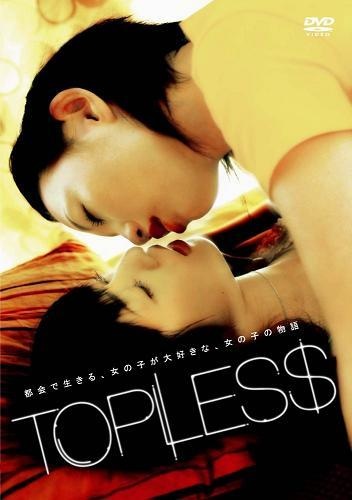
There's zero nudity in this very sweet film about being lesbian in contemporary Tokyo. Someone is going to argue that the title metaphorically refers to being emotionally topless, i.e., baring your soul, because the film takes the risky approach, like millions of films do, of being about being human. Even though the film focuses on the loves and lives of its central lesbian characters it really speaks a universal language that heterosexual viewers can relate to as well—like having to deny your identity for the sake of marrying a man for security. Uh-huh. No. This film is about being lesbian.

Topless is refreshing and all that. Its themes of love and fear and politics and sadness are universal. Some of its plot points are a little diversitiste though, like the young girl who comes to Tokyo with an anti-lesbian chip on her shoulder to look for her mother who abandoned her several years ago to be with a lesbian lover, meets the film's protagonist who helps her, comes to recognize that lesbians can be good people too. OK. Characters learn from other characters all the time in movies.

The film might appear a little fluffy when you stand back from it, but the journey through it is filled with a number of poignant moments. One is the film's only sex scene, a non-explicit one between the film's central lesbian character and her male roommate. She's lost her true love to a man, is full of turmoil and wants to see what sex with a man is like. The scene is done very well and handled delicately.

My take on the title and the poster depicting two young women about to engage in a passionate kiss is this: the opening moments of the film are a little warm. The two women, as depicted on the poster, are engaged in some very passionate kissing and roaming of hands. And then pop! The top, the attitude many viewers stereotypically enter with, and desire from, a film about lesbians—two chicks going at it will be hot—comes off. The scene makes an abrupt change in tone and direction. All of a sudden the film is about people with personalities and it never looks back. Yes, it keeps saying "my desire to love and be loved as a lesbian is just like yours (as a straight person) except it's a little complicated by all this societal buildup of crud." That's the point.

My biggest takeaway from the film is Mina Shimizu. She's one of those actresses like Noriko Eguchi, except she's very upbeat and not moody and darkish like Eguchi, who owns the screen and everyone else in it every time she appears. I predict big things ahead for her.

★★★★
Director: Eiji Uchida
Starring: Mina Shimizu, Ryûnosuke Kawai, Aya Ohyama, Erika Okuda, Aya Oomasa

IMDb
Asianmediawiki
isugoi

Still Walking 歩いても 歩いても (Aruitemo aruitemo) Even If You Walk and Walk [2008] • Japan

I liked Air Doll so much I decided to seek out more films made by its director Hirokazu Kore'eda. Imagine you have a new friend in life, someone you have a fondness and respect for, and they invite you along to meet the family of one of their best friends. You'll probably attend with an optimistic attitude, thinking the old adage "friends of yours are friends of mine." Such was my approach to seeing this film.

There is a rich tradition of the family drama in Japanese cinema and this is a worthy addition to it. Still Walking observes and reveals the humor, history, and hidden emotions of an extended family over the course of twenty-four hours. A brother and sister, their spouses and children, attend a yearly gathering at the home of their parents to commemorate the death of their older brother, the pride of the parents, who died accidentally fifteen years ago while attempting to save a young boy, a stranger, from drowning.

The film has a languid pace and a subtle sense of humor. There is a stereotypical grouchy and reserved father who has a stereotypically antagonistic relationship with his second son, a doting and good-humored mother, a loving and amiable sister. It seems like there may not be anything new here. There really isn't, and not much happens until another annual guest to the gathering shows up. He is the boy the older brother saved from drowning. He's an overweight, fidgety, perspiring loser. He is extremely uncomfortable and we can sense the parent's resentment that it was not him who died instead of their son.

There was something about Air Doll that bothered me. There is a scene where the Air Doll meets, literally, her maker. The man basically essays to her on the meaning of the film: aren't human beings just empty vessels too, desiring and needing to be filled up? I've come to think that Kore'eda didn't trust his audience, or perhaps himself, enough to let the film speak for itself. He felt the need to explain it. There is a similar scene in Still Walking. After the ill-at-ease boy leaves the family's home the son observes to his mother that it seems almost cruel to invite him as he seems so uncomfortable, almost tortured by it. The mother acknowledges this and says "That's why we invite him." The scene should have cut right there but Kore'eda has the mother discourse on the necessity of this sadism.

Even with that flaw, and the fact that Still Walking doesn't present an original scenario, I still loved it. I enjoyed meeting this family. Kore'eda and the cast bring a freshness to the family drama  staple of Japanese cinema. The photography is beautiful, the direction is fluid and accomplished, the performances superb, and there is a surprisingly good amount of subtle humor throughout the film. Highly recommended to those who enjoy the slow-paced and thoughtful.

★★★★
Director: Hirokazu Koreeda
Starring: Hiroshi Abe, Yui Natsukawa, You, Kazuya Takahashi, Shohei Tanaka, Kirin Kiki
 
IMDb
Asianmediawiki
MidnightEye
Ebert

Nobody to Watch Over Me 誰も守ってくれない (Dare mo mamotte kurenai) [2008] • Japan

This film starts with a title card message saying "In the event a minor commits a serious criminal offense police authorities may seek to shield the minor's family from excessive media scrutiny and public hostility. The protection is given to prevent members of the accused's family from taking their own lives in response to the trauma."

Some eighteen year boy is hauled off for allegedly killing two grade school children. The media is all over his house. The cops are too. One cop is assigned to protect the boy's fifteen year old sister. He made a mistake in the past and has a shaky hand. He's two days away from taking a vacation to save his marriage. Yawn. A reporter is gonna make his life hell. Stupid plot. Even stupider is when the reporter confronts the cop and tells him the fifteen year old girl should be killed as punishment for what her brother did. And then they show internet messages going around calling for the death of the little girl. Oh, and the mother kills herself in her bathroom while twenty cops sit around not protecting her. The cop protecting the little girl takes her to his shrink's house so we can get more scoop on his problems. He then goes back to the little girl's house to get her cell phone because she said she would be embarrassed if the cops read her email. Not like any of the twenty cops already there might have found it or thought it might be useful as evidence. The cop brings it back to the girl and one of her friends calls her up and says "Bummer your mom committed suicide, huh?"

This movie is so full of stupid I switched it off halfway through. People will claim that this is a side of Japanese culture westerners don't know about. I say prove it. The fact that everything else about this film is so dumb I have no reason to believe the part about the press and public calling for the death of the little girl to be representative of anything but nonsense and bad writing. The parents, maybe. But the little girl? I'm not buying it.

This was Japan's official entry to the Oscars. WTF?


IMDb

Crush and Blush (Misseu Hongdangmu) Miss Carrot 미쓰 홍당무 [2008] • South Korea

A career making performance from Kong Hyo-jin. This an intelligent Korean comedy, slightly risqué, that wins with wit, good acting, and an award winning screenplay filled with surprises. A number of times it will set you up to dare it to go somewhere, then it will go there and you'll applaud the way it's delicately handled. There is a lot of frank adult humor in the presence of a child so delicacy is warranted. Props to young actress Woo Seo for taking it all in stride, reminding us that kids are usually hip to many of the things adults think they should be protected from. Kong, a tiny woman who somehow makes herself look fat with facial expressions alone, and who's not afraid to look unattractive, is surprisingly accomplished in her comic timing. She plays a frumpy and unpopular high school teacher who blushes easily and is obsessed with one of her fellow teachers. The director seems to know all the cheap ways to make us laugh but instead of utilizing them she steps around them and shows us a sardonic wit behind the humor on the surface. This is both smart and funny. It's not a goof-ball comedy even though it might look like one from time to time.

Kong plays a teacher, Me-sook, with a mad crush on a married colleague, a crush that started when she was a student of his so now it's reached the level of obsession. She discovers he is having an affair with another woman so she forms an alliance with the man's daughter, Yoo-ri, an unpopular girl who attends the school where they teach, to sabotage the affair and, as far as Yoo-ri is concerned, save his marriage and keep the girl's family together. Of course Me-sook just wants the mistress out of the way so she can have the married man to herself. Things get complicated as Me-sook becomes friends with Yoo-ri and her true intention of destroying the affair and the marriage is found out. Me-sook is so delusional she thinks the man wants to be with her as much as she wants to be with him and she's doing him a favor by getting both the mistress and the wife out of the way. Amidst all the scheming a tender side of Me-sook's character's comes out in her budding relationship with Yoo-ri. The two outcasts find something in each other they weren't getting elsewhere and it makes for a nice, underdog-makes-good, uplifting thread as the film develops to its conclusion. 

Park Chan-wook (Oldboy, Thirst, Lady Vengeance) has a co-writing credit and might be responsible for the daring tendencies in some of the dialog but it's not just a well-written film. All of the performances are good and the direction is assured. This is a winner.

★★★
Director: Kyoung-mi Lee
Starring: Hyo-jin Kong, Eun-jin Bang, Woo-seul-hye Hwang, Jong-hyeok Lee, Woo Seo
IMDb
HanCinema
Beyond Hollywood

Non-Ko (Nonko 36-sai ノン子36歳 (家事手伝い) (kaji-tetsudai)) [2008] • Japan

Another nearly great film from director Kazuyoshi Kumakiri. The direction isn't as innovative as in Green Mind, Metal Bats, and the story isn't as novel either but Maki Sakai's performance carries the film more than enough for it to be engaging. I don't know why Saki isn't a bigger star. She seems like such an intelligent and courageous actress. Here she plays a thirty-something divorcee who used to be a popular movie actress starring in films with titles like Sexy Gambler and such. She has retreated to the countryside to live with her family who are caretakers of a Shinto shrine that is about to hold its annual celebration. Sakai's character isn't very likable, by viewers or by the other characters in the film, but somehow she makes her internal disappointment with life palpable and it brings you along for the ride. My only problem with the film is that I didn't like the one character who does like her, mostly because I couldn't understand why she comes to, momentarily at least, like him. He's a younger goofball of sorts who's come to set up a stall at the shrine celebration and ends up staying with Sakai's family. It's probably only his youthful ambition she finds attractive. The film is mostly bleak, punctuated with a few happy moments that seem a little out of place, and a couple sex scenes that require the infamous Japanese pixel blur.

Non-Ko is a successful portrait of a woman who feels anger, isolation, and disappointment in equal measure.


★★
Director: Kazuyoshi Kumakiri
Starring: Maki Sakai, Gen Hoshino, Shingo Tsurumi, Kanji Tsuda, Ryûto Kondô

IMDb
Asianmediawiki

Beast Stalker 证人 (Ching yan) [2008] • Hong Kong

There isn't one single monster in this (what's up with that?), although Nick Cheung looks pretty spooky with his fake eyeball and possesses some über-human qualities like always being out of the blue and into the right place always at the right time, moving at speeds faster than light, and getting bashed in the face with a rock and not bleeding. The (contrived and typical) story construction which explores the tug of war among duty, friendship, love, and responsibility is done well, and Nicholas Tse and Cheung both turn in top notch performances, as does the little girl. All the acting is pretty good when you can actually see what's going on. I had to stop frame and inch through a scene on a bridge/overpass where they hung the little girl over the edge. I wonder what the film could have been without being a stylized action pic.

Jingchu Zhang also stars but she seems to come up unremarkable in manly action movies like Overheard, Protégé and this one.

★★★
Director: Dante Lam
Starring: Nicholas Tse, Jingchu Zhang, Nick Cheung, Philip Keung, Esther Kwan
IMDb
Wikipedia

Hellcats (Ddeugeoun-geosi joh-a) aka I Like It Hot [2008] • South Korea

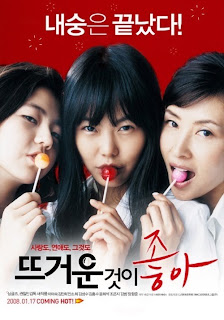
What a surprise this turned out to be. I couldn't get past the poster for the longest time. It's dumb and makes Hellcats look like a film I wouldn't want to see.

I recently watched An Affair (Jung sa), and although I didn't like the film at all I liked the performance by Lee Mi-Suk and wanted to see more of her. So this was it, a film about three stages of womanhood (high-school, twenty-something, just over-the-hill) and the angst of relationships.

The film owes most of its success to brilliant casting. The film's first casting coup, Lee Mi-Suk, turns in a solid performance as a forty-one year old (she's several years older than that in real life) stage designer confronted with 'early onset' menopause. As a result, or in conscious reaction to this news, she runs hot and cold in intelligent and honest ways with an actor working on the same production as her who's twelve years her junior. The guy is a bit of a playboy but seems earnest in his intentions and the fact that Lee is beautiful and still has the hot factor makes it a believable relationship.

The film's second casting coup was landing Ahn So-hee of the popular K-pop group, the Wonder Girls, to play Lee's teen-aged daughter. She's both precocious and naive and wants nothing more than to land a first kiss from her boyfriend of three years who seems more interested in motor bikes and video games than her. Many of the film's more bitingly humorous moments originate in the interactions she has with her mom and her aunt (played by Kim Min-hie, more on her later). The three women live together but it's Ahn who seems the mature one, suffering the emotional vicissitudes of her elders with aplomb. In her personal life, not sure how to get what she wants, she's helped along by the charming Brazilian born and exotic Jo Eun-ji. Their youth lends itself to a credible confusion between love and friendship, creating a relationship that's touching without being melodramatic.

Finally, the biggest and most welcome surprise is the performance of Twiggy model Kim Min-hie who anchors and narrates the film. She's a twenty-seven year old screenwriter, and younger sister to Lee, who ends up torn between pursuing her career (and her self, really), living the bohemian life with her never gonna make it dead-beat musician boyfriend, and marrying a successful, good-looking guy who seems to love her. Her performance is genuine, pulling off the impossible: acting drunk and shrill without losing any of her charm. She won't appeal to everyone, but for context let me state that I seldom, if ever ... in fact I almost always hate when actors play drunk, but Kim's performance worked for me. She's not drunk all the time. It's only a few scenes, but under normal circumstances this is enough to ruin a role, if not a film, for me.

Kim Min-hie burst into the limelight at a very young age with a very low body fat ratio as a model and fashionista. Her first few attempts at acting were met with chuckles and derision. She took six years off to study the craft of acting, including voice control and breathing techniques and, if her performance in Hellcats is any indication, it worked wonders. What's remarkable is that she doesn't seem to be acting at all, even in the drunk parts. She's just being filmed, being herself. I think that's the best kind of acting. She is also blessed with a facial structure (and I'm aware I'm being subjective here) that allows all kinds of different personalities to emerge, depending on camera angle, hair style, and internal motivation. I'll quit with the hyperbole now and just say she is a joy to watch in this film.

Hellcats isn't high brow art fluff nor mumblecore indie bullshit. It's an intelligent, mainstream feminist comedy. The male characters may not be much more than stereotypes but they aren't needed to be. They aren't belittled for being men and they are given enough substance to engage us, but this is a film about the women. Director Kwon Chil-in had success in 2003 with the hit Singles, which explored similar territory, and this is a worthy follow-up if you follow this kind of thing. I should give it five stars but I don't think many would believe it, so ....

★★★★

Director: Kwon Chil-in
Starring: Lee Mi-suk, Kim Min-hie, Ahn So-hee

IMDb
HanCinema
Asianmediawiki

One Million Yen and the Nigamushi Woman (Hyakuman-en to nigamushi onna) [2008] • Japan

This film will appeal to fans of Yû Aoi even though there isn't much range to her performance. What we get is exclusively the shy, sad, and awkward Yû Aoi with none of the radiant, confident, and smiling. She's on screen almost the entire two hour running time so the appeal may come from sheer quantity more than anything else, but she performs well and demonstrates she is capable of carrying a film on her own even if the value of that labor remains a question mark.

Yû Aoi's character has brought shame upon herself and her family by having a criminal record so she decides to run away, drift from town to town, staying in one place only long enough to earn one million yen and then move on. She wants to be anonymous, always one step ahead of any accusatory gaze that may be following her tortured soul. But what happens if she finds love? Will she reveal her ... true nature, that she's a criminal? No, that's not it. Her ... horrifying secret? No, that's not it either. The whole thing is kind of silly but I will grant the film some kudos for its final resolve even if it has little to do with illuminating its central conceit.

I'm no expert on Japanese culture but the basic premise of the film seems weak to me. Yû Aoi and a girlfriend agree to rent an apartment together so they can share costs and save money. They sign a lease and then Yû Aoi discovers that her girlfriend's boyfriend will be moving in as well. On move-in day only the boyfriend shows up and he informs Yû Aoi that his (and her!) girlfriend dumped him and will not be moving in. Fuck that. The guy turns out to be a total jerk, of course. Amongst many other idiotic attitudes, behaviors, and talking points, when Yû Aoi adopts a kitten and the guy doesn't like it, he throws it away, whatever that means, and we're gifted with a shot of a dead kitty on the road. In retaliation, Yû Aoi throws away every single piece of her roommate's property. The guy files charges and wins a criminal case against her, which she could have avoided by saying she had sex with the guy, even once, whether true or not, thereby making it a domestic issue and the police would've washed their hands of it. I'd proudly share that story at cocktail parties, but for Yû Aoi it's a scarlet letter.

The film's script has a number of weaknesses. One of them is Yû Aoi's little brother. He gets a subplot of being bullied by his peers. At first, he and Yû Aoi are at odds with one another. Then she leaves and massive love shows up. The little brother is only there to play on the heartstrings of unconditional blood love thriving in the face of a cruel world as it kicks brother and sister about. He's no good and his story is banal. Yû Aoi, and the film, would have been better served if she were cast out on her own, alone.

Yû Aoi's first stop in her search for anonymity finds her at a beach resort where everyone's hair is lighter than hers and their skin is darker. Oops. Her next stop is a rural mountain village where there are no young people left—let alone anyone as beautiful as Yû Aoi. Things get a little creepy and it's ironic that in this second stop the director achieves a nice symbiotic relationship between form and content but it only serves to bring the film to an unendurable lull. These rural village people are slow—in every way—and obstinate, and the film's pace follows suit.

Yû Aoi's final stop finds her in a semi-urban setting where she takes a job in a lawn and garden shop. This is where the "What if she finds love" card gets played, and we can only presume that deep down this is what Yû Aoi had been looking for all along because, even though she struggles against it at first, it's pretty hard to fathom any sane interest on her part in what she ends up with so she must be settling. The film does finish with a nice little kick, if not swift, and it's interesting that the reveal validates what you're hoping was the case, as unlikely as it may seem, but it promotes a dishonest sympathy through failure rather than disgust by virtue of assholeness. Had it gone any other way, though, the whole thing would have been a disaster.

All in all, a reasonably pleasant two hours spent with Yû Aoi as she weaves her way through a mostly mediocre film. There's nothing about the story which excites and other than Yû Aoi there are no characters worth paying attention to. The production values are good, though not remarkable in any way. If you are a fan of the actress, who does quite well in creating likable characters in the many smaller roles she takes on, One Million Yen and the Nigamushi Woman is worth seeing just to see her perform in a film that belongs entirely to her. But if you are a cinephile you'll probably walk away non-plussed.

★★★

Director: Yuki Tanada
Starring:Yu Aoi, Mirai Moriyama, Terunosuke Takezai

IMDb

My Wife got Married (A-nae-ga kyeol-hon-haet-da) [2008] • South Korea

I think it's a sign of real talent when a director can take an implausible scenario and stifle any objections to it simply by making it fun, not to mention plausible. This is a film, nominally, about bigamy with the added twist that the bigamist is a woman. But that's just the schtick. It's really just another film about a man's obsessive desire for a beautiful, care-free, intelligent, independent, quirky, sexually confident, and slightly crazy woman. Ritual, La Belle, Interview, Green Tea. The list of films like this, with variations on the theme, is endless. Every guy who didn't get and stay faithfully married at eighteen knows a woman like this and every woman knows this power. The setup doesn't require exposition, just a good actress. Son Ye-jin fills the role here admirably. She's a paradigm of contemporary Korean actresses: beautiful, sexy and seductive, successful, yet pure and nice, innocent and wholesome, almost virginal, all at once.

This isn't a deep or thoughtful film. It doesn't mine the character's motivations or history in search of discovery or enlightenment. It just plays things out. When the first husband asks Son's character how she can divide her love between two men she responds, "I don't think of it as dividing. It's doubling." How do you respond to that? You can't. Well you can, but you'd be out on the doorstep in no time if you did. When she declares to her first husband that there is another man in her life but she was afraid to tell him because she thought he would think she was crazy, she's telling the truth. She didn't want to upset a man she loves. Sure, the first husband is sort of a wimp but that's what happens when an angel drains your soul. He cries and tries to find strength, and it's funny watching him fail.

Don't go into this looking for social commentary or deep thoughts on the complicated nature of modern romance. It's just a Rom-Com with a delicious performance from Son Ye-jin. If you like her, and the broad theme doesn't morally prevent you from watching it, you should enjoy this film. It ultimately stays on the safe side of the road and only hints at being risqué, such as when Son Ye-jin fulfills her first husband's sexual fantasy of performing oral sex on him and keeping his penis in her mouth until he wakes up in the morning. Son Ye-jin!

★★★★

Director: Yun-su Jeon
Starring: Ye-jin Son, Ju-hyuk Kim, Sang-wook Joo, Seong-hun Cheon

IMDb


Gu Gu, the Cat (Gou-Gou datte neko de aru) [2008] • Japan

Major misfire. What on earth is Marty Friedman doing in this movie? First of all, this flick has very little to do with, and gives very little screen time to, cats. When the little felines do get a moment in the spotlight it is usually accompanied by some silly video game sound effects. To what end, I cannot fathom. Just like Marty Friedman. The ex-Megadeath guitarist plays an English teacher who has nothing to do with anything except looking like a cross between Kenny G and a beardless Harry Shearer as Derek Smalls in This is Spinal Tap. He acts as a narrator of sorts in the film and breaks the fourth wall when acting as a guide to various hot spots around the trendy Kichijoji neighborhood. Why he is doing any of this in the film, I don't know. Perhaps it is some sleight of hand trying to take our attention away from the three fat girls in the movie who serve no purpose except being the brunt of fat jokes. How lame is that?

There is one sort of take-your-breath-away moment in the film when Suzuka Ohgo, who played the blue-eyed little girl in Memoirs of a Geisha, shows up as the human incarnation of the main character's dead cat. She is sitting in the shadows at a table for quite some time as if, since she is playing a dead cat, we are not going to ever see who she is or what she looks like. When the camera finally acknowledges her face ... oh my, the girl is maturing nicely. Beautiful smile.

I like Kyôko Koizumi quite a bit, and she does her best, although sullenly so, as the main character who gets depressed when her cat Ca Va (the one later played by Suzuka Ohgo) dies. Juri Ueno's character is much more appealing. She actually gives the film hope as she tries to cheer up Koizumi and the movie. Koizumi finally gets a new cat, Gu Gu, but then she gets cancer and blah blah blah.

This film is a real dud. It felt like the only people who might remotely enjoy the silly set piece antics would be the people who made the film. It comes off as an inside joke we are on the outside of. I'm a cat person and had high hopes for this film after absolutely loving the director's Josee, the Tiger and the Fish. But, nope. There's nothing here.


Director: Isshin Inudou
Starring: Kyôko Koizumi, Denden, Juri Ueno, Marty Friedman, Naojirô Hayashi, Tatsuya Isaka, Ryo Kase, Suzuka Ohgo

IMDb

49 great films from the Oughts (the first decade of this century)

Just for kicks.

[Rec] (2007)
The 40-Year-Old Virgin (2005)
Adrift in Tokyo (2007) aka Tenten
Antichrist (2009)
The Aura (2005) aka El Aura
Babel (2006)
Battle Royale (2000) aka Batoru rowaiaru
Blind Mountain (2007) aka Mang shan
City of God (2002) aka Cidade de Deus
The Equation of Love and Death (2008) aka Li mi de cai xiang
Eternal Sunshine Of The Spotless Mind (2004)
Eureka (2000) aka Yurîka
Green Tea (2003) aka Lü cha
Hero (2002) aka Ying xiong
Himalaya With Michael Palin (2004)
In The Mood For Love (2000) aka Fa yeung nin wa
Irreversible (2002)
The Isle (2000) aka Seom
Joint Security Area (2000) aka Gongdong gyeongbi guyeok
Let the Right One In (2008) aka Låt den rätte komma in
Lost in Translation (2003)
Lost Indulgence (2008) aka Mi guo
Love Exposure (2008) aka Ai no mukidashi
M (2007)
Memento (2000)
Memories of Murder (2003) aka Salinui chueok
A Moment to Remember (2004) aka Nae meorisokui jiwoogae
Mother (2009) aka Madeo
Next Door (2005) aka Naboer
No Country for Old Men (2007)
Noriko's Dinner Table (2005) aka Noriko no shokutaku
Oasis (2002)
One Fine Spring Day (2001) aka Bomnaleun ganda
Planet Earth (2006)
Queenadreena: Live (2006)
Requiem for a Dream (2000)
Secret Sunshine (2007) aka Milyang
Sideways (2004)
Snatch (2000)
Spider Forest (2004) aka Geomi sup
Stranger Than Fiction (2006)
Strawberry Shortcakes (2006)
Suicide Club (2002) aka Jisatsu saakuru
Summer Palace (2006) aka Yihe yuan
Synecdoche, New York (2008)
This Charming Girl (2004) aka Yeoja, Jeong-hye
The Unknown Woman (2006) aka La Sconosciuta
Visitor Q (2001) aka Bijitâ Q
What Time Is It There? (2001) aka Ni na bian ji dian

Loft [2008] • Belgium

Most of the tension in this film is created by trying to keep the clichéd plot points fresh as they unravel and inevitably teeter on the edge of going over the top. It's done pretty well and it looks good. It's got a little Michael Mann steely look. The set design is minimal and trés modern, the cinematography mostly dark with touches of yellow and gray filters, the soundtrack nudges you along with obvious clues.

Five guys share a loft where they carry on their respective, perhaps, secret sexual affairs. Some are more committed to this scenario than others and all seems to be well until they discover a dead and very bloody girl in the bed. Who killed her, and why? Fingers start pointing and emotions run high. The story is presented through flashbacks and multiple interrogations so one is easily lead astray only to learn there's another side to the story as another deep dark secret is revealed. As soon as you think it's ho-hum, another shoe drops. The screenwriter must live in a Loft with a very big closet. The goodness of the twist factor here is achieved more through quantity than quality. This is not only a whodunit but a whodun-what. It just keeps going and going. It's formula stuff taken to the extreme.

★★★★

All About Women (Neui yan fau pui) [2008] • China

The main thread in this visual shenanigan belongs to the always lovely Zhou Xun. She's a frigid geeky scientist who invents a love potion, essentially extracting pheromones and then wearing them like a smoker's patch. The patches get tossed around among the three ladies and/or the objects of their desire. Kwai Lunmei is great as a punk rocker who eventually meets her imaginary boyfriend, and a pleasant surprise is Kitty Zhang Yuqi (from CJ7) who plays a high powered sexuality exuding executive who wants to market the patches. This is a goofy film full of sight gags, not to be taken seriously. An average film, flawed, but worth wasting time on just to watch three lovely ladies having fun.

★★★

Hurt Locker [2008] • USA

I don't understand all the love for this film. Kathryn Bigelow is a fine director and all, but the script for this is terrible. It's cliché from top to bottom. There's nothing here that isn't predictable macho nonsense. Given that it is purported to be written by someone embedded with real access to these army guys, I couldn't believe how unbelievable it all is. Team players don't turn off radio contact and do things the other players don't know about unless they're dumb movie characters. Generals don't then praise them for doing it, either. Of course butch boy befriends Iraqi boy for cheap shot at character depth and I call bullshit. This film is insufferably boring unless you get a rush from fantasy testosterone games. The narrative barely rises above the limits of a Powerpoint presentation.

★ ★

Brass Knuckle Boys (Shonen merikensakku) The Shonen Merikensack [2008] • Japan

I'll watch anything with Aoi Miyazaki in it but it was extremely tough this time. She's fabulous, of course, and the film starts off with a refreshingly bizarre sense of humor, but it quickly devolves into toilet humor. Miyazaki plays a record company office worker who discovers a punk rock band on the Internet, thinks they are the next big thing, and decides to represent them on behalf of her company. What she doesn't know, at first, is that the band's web site and videos are 25 years old, so she must follow through promoting a group of middle-aged punk rockers because contracts have been signed and jobs are on the line. I can't imagine who this movie is aimed at. Young people (who are into punk) will recognize it as fake and older people (who may have been punks) will too. Brass Knuckle Boys confuses punk with childishness and fails to create characters that anyone will care about. For every quick and funny moment that works, and there's a bunch of them, there's umpteen that don't. And the sibling rivalry family drama subplot is painfully uninteresting. I'm a huge Aoi Miyazaki fan but a two hour fart joke is a bad vehicle for her.

Love Exposure (Ai no mukidashi) [2008] • Japan • Sono Sion

Director Sono Sion is a also a street poet and musician. There is a guerilla-art quality to this film. One gets the impression it's being made up on the spot, while you are watching it, yet there isn't the slightest hint of improvisation, and the film betrays an intricate construction. Contradictions abound. There's a mature adolescence in heady ideas about original sin and up-skirt, "peek-a-panty" photography. I hesitate to call this a weird film because it's not, even though I smiled through most of it thinking This can't be serious. I was amazed by the entire cast's chameleon like ability to move convincingly among different levels of sanity. Everyone in the film is so earnestly bizarre. If you like Sono's work you will not be disappointed by this. If you haven't seen anything by him, why not start with a four hour movie? The music is great.

★★★★★

Trailer: