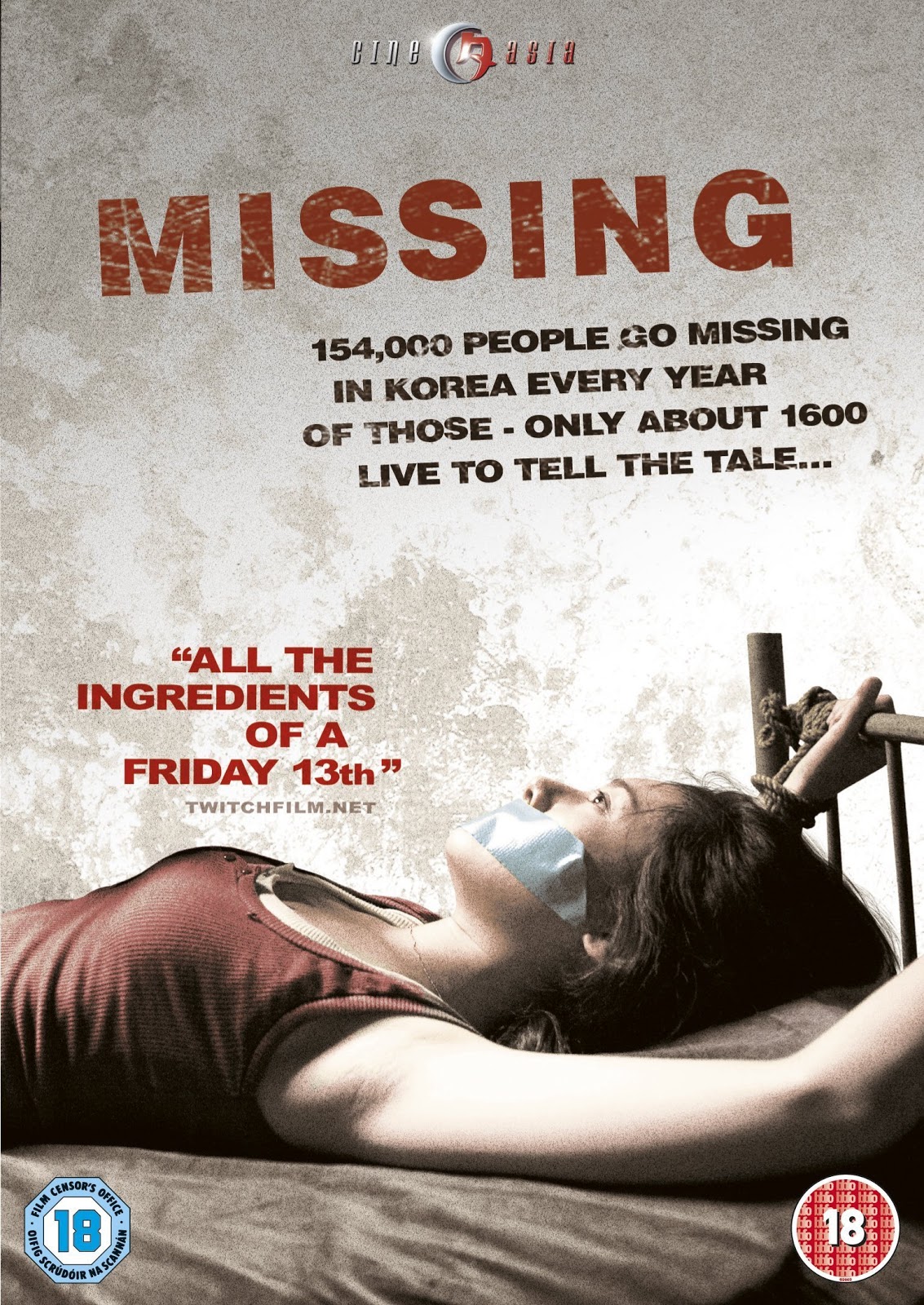
Missing (Sil Jong) [2009] • South Korea

The crucial part of a scene where an axe is planted into someone’s head is not how it goes in but how it comes out. This is where a director lets you in on what they’re doing, what kind of film they’re making and how good their chops are. You might think just based on the fact that we have an axe planted in someone’s head that it tells you all you need to know about what kind of movie we’re talking about, and you’d be right, up to a point. Billed as a serial killer thriller, this year’s Missing (Sil Jong [literally, The Disappeared]), by Korean director Kim Sung-Hong—not to be confused with Hark Tsui’s Missing (Sam hoi tsam yan) from last year—is a slasher movie, but it’s not. It’s got all the ingredients of a Friday the 13th—not a Hostel—style gorefest but seems to be targeting an older, if not wiser, demographic. I’m a bit surprised to read that this film has done reasonably well at the box office bringing in three and a half million since it’s debut March 19.

Missing is based on a true story. In August and September of 2007, a seventy year old South Korean fisherman killed four women in Bosung, South Jeolla Province, South Korea. All the publicity for the film lets us know that it’s been fictionalized but I don’t know if that is referring to the axe implantations, and other acts of that ilk, or the fact that the killer in the film is a sixty year old ex-restauranteur cum chicken farmer. Wikipedia doesn’t have an entry for the guy so we’ll have to wait to find out the facts.

South Korea’s done pretty well with serial killer films based on true events. Memories of Murder and The Chaser come to mind. Missing isn’t up to the caliber of those films, but it doesn’t try to be like them either. It’s not played from the point of view of a cop, or ex-cop’s, investigation. It’s a bit more simply voyeuristic. The first act observes the plight of one of the victims along with some collateral damage. It’s got a gratuitous up-skirt shot, cameras that pan out from a girl’s behind, a “Women in Prison” style shower scene, something somewhere between Deliverance and Last Tango in Paris, and an attempt at some Lorena Bobbitt flavored revenge. When you add all that up you should get something a lot less than what Missing ends up being. There is nothing remarkable about the style of the film but the production values are what you’d expect from a mainstream South Korean offering. It gives us exploitation within a mainstream frame.

Along with the cheap thrills of a crap horror movie we also get many more earmarks of the genre: an almost discovery that comes too early in the film; a freak accident that kicks the film into third gear; cops who refuse to help because there’s insufficient evidence to do so; and above all, characters who don’t act the way they should, like not running away or successfully killing the bad guy when it seems they have the chance, not to mention an ending that’s tackily tacked on in order to have a sequel. (I don’t think it’s just a nod to the real thing)

Missing is the most un-Korean Korean film I think I’ve seen. It’s like a Hollywood film, only better. Watching it, I wasn’t thinking it would be ripe for a Hollywood remake. I was trying to figure out what Hollywood movie it was a remake of. So much of it is so familiar. It doesn’t reach for the epic proportions of a Se7en or a Silence of the Lambs, nor does it have any of the new wave stylings of the French extremists, but it also doesn’t sink to the depths of a standard Hollywood slasher. It’s not a great film, maybe not even a good one, but it’s pretty good at being unlike what it seems to be. It should mildly satisfy gore hounds and horror enthusiasts while not completely turning off those who, if you were to mention something like a Fargo moment, might be prone to immediate dismissal.

The film is well cast too. Veteran actor Moon Seong-geun (Virgin Stripped Bare by Her Bachelors, Green Fish) plays the old man killer as utterly normal and utterly evil. Jeon Se-hong (Temptation of Eve) is sufficiently bodacious as the younger sister and first victim put through the grinder, so to speak, and Chu Ja-hyeon (Portrait of Beauty, Bloody Tie) plays the older sister who goes looking for her with enough intelligence and good looks to keep us on board for the duration. And there’s motorbike riding coffee delivery girls in hot pants. But don’t think you have this film figured out. It might surprise you. There will be blood.

★★★★

Josee, the Tiger and the Fish (Joze to tora to sakana tachi) [2003] • Japan

Big surprise. Comparatively speaking, this is a plain and simple love story from Japan. One of the participants has legs that don't work so her granny pushes her around in a baby carriage but it comes off as beside the point. She's suffered and she's not expecting love to be a part of her life. She's not looking for it but when it shows up, she gets it. She understands and appreciates it even though she knows with certainty that she will be lonely again. Chizuru Ikewaki brings a poetic depth to her role and Satoshi Tsumabuki is puppy dog cute as the boy who falls, surprisingly but so naturally, in love with her. This film could have been manipulative but it isn't, not in the least, and that's what is so refreshing about it. This is a bittersweet gem. If the ending surprises you, remember you saw it coming the whole time.

★★★★★

Nanayo (Nanayomachi) [2008] • Japan

I’m not exactly sure what director Naomi Kawase set out to accomplish in her latest film, Nanayo, but there is something both strangely compelling and very frustrating about it. It seems like an intelligently crafted work that took a big, well ... not really a big swing, but a swing nonetheless, and missed. The film starts off well enough. Ayako (Kyoko Hasegawa, Three Extremes, Female) arrives in Thailand, for reasons unknown and never explained, sweaty, braless in a tank top, and improvises her way around for a bit, deals with language issues and tries to get help in locating her hotel. She’s very engaging and the milieu is rich.

I point out that she is sweaty, braless, and wearing a tank top, because the way the director films this woman and plays with sensuality throughout the film is a constant but I’m not sure as to what ends. And I point out improvising because this film is clearly half improvised and half scripted; the former being quite good and the latter somewhat of a preposterous mess. That’s my initial judgement, anyway. Kyoko Hasegawa exudes a confident and charming strength and sexiness while she is improvising but gets lower marks for the scenes where she is called upon to act.

After the steamy introduction we witness Ayako witnessing a Thai girl and white guy getting out of a taxi. The white guy is angry and screaming at the driver: “You are shit, I should kick your ass!” Ayako decides, against my better judgement but apparently not hers, to ask this cab driver to take her to her hotel, if he knows where it is. The driver seems uninterested but waves her in. She has to open the trunk of the cab and put her big, heavy suitcase in there by herself. We’re getting some pretty good character development of this taxi driver guy right away.

After getting in the cab, Ayako asks the driver if he knows where her hotel is. The driver doesn’t seem to understand but they drive away. Ayako rubs some lotion on her chest in a rather sensual manner coming precariously close to her breasts (I’m just sayin’) and notices the driver eyeing her in the rearview. More character development on that guy. She puts on her sunglasses and falls asleep. When she wakes up they appear to be in the woods. The driver opens one of the rear doors and signals for Ayako to get out. She fears she is about to be robbed, or worse, and crawls out the other side. The driver chases after her along some wooded trail as Ayako throws things at him and eventually gets away. The cab driver has a scary movie limp so it wasn’t difficult but she’s left all her belongings either in the taxi or on the trail.

Ayako runs further into the woods, where we see some monks walking about, and eventually into the arms, literally, of some guy who turns out to be French. She cries on his chest while he strokes her hair. Strange and creepy. He takes her to the home where he is staying and studying the fine art of Thai massage from the matriarch of the place. I’m not making this up.

They all drink some tea, the French guy behaving way too touchy-feely with Ayako for my taste, and then the taxi driver walks up. Turns out he is the brother of the massage teacher. Oops.

Before you know it, taxi man is lying there getting a massage from his sister and Ayako is instructed to lie down beside him so the French guy can practice on her. All of a sudden Ayako is on top of the French guy, massaging him but she digs her fingernails into him so he throws her off and she lands with her head on the taxi guy—and just lays there for a very uncomfortable moment. Uncomfortable for me, at least, because we have not had the character development turn-around where we’re supposed to think we’ve misjudged taxi man’s behavior and he’s really a nice guy. That comes later. As does one of those “I have no idea what you are saying but I understand you” moments where the French guy tells Ayako he’s homosexual. Presumably, we are to reassess our first impressions of the French guy’s behavior.

(Is this supposed to be some didactic multicultural essay? I think it’s a bit more akin to Rachel Getting Married in that it’s more of a celebration of diversity than a manifesto. )

Pretty soon everyone is having fun together, shopping, eating, dancing, and etc., until the massage teacher’s little boy comes up missing. Big loud cross-language arguments ensue. The French guy’s been just chillin’ in Thailand to center himself, practicing yoga. We’ve seen him do a headstand and child’s pose. So I can’t for the life of me understand why he hauls off and whacks Ayako during this argument.

Ayako heads out into the woods to find the little boy. She gets stuck in some kind of boggish swamp and we can see through her muddy and damp sweat pants she’s wearing a sexy thong. (I’m not looking for this stuff). This struggle tires her out so she naps against a tree and dreams about this other unknown, unexplained character who gets to play the massage game with a clearly naked but not revealing Ayako in a few of the films momentarily erotic and cinematically sensual scenes.

Ayako wakes up and finds the boy. Everybody sings and dances, there’s some family drama about sending the boy to temple or not, and a couple ducks fly up a river. Roll credits.

There are some incredibly sensuous moments throughout this film, from landscapes to facial expressions. Kyoko Hasegawa is engaging when she appears to be winging it but gets lower grades when called upon to act. Grégoire Colin is french as the French Guy. I don’t get Thai acting. It all seems way over the top, but Thailand and its people are beautiful.

★★★


Harmful Insect (Gaichu) [2001] • Japan

Aoi Miyazaki plays a thirteen year old girl whose mother attempts suicide after her father abandons the family. Her classmates gossip in the bathrooms about a supposed affair she had with her sixth grade teacher. She skips school and her only friend is killed by a gang. Her mother’s new boyfriend attempts to rape her. It’s seems awful to take such a cute and accomplished young actress and punish her for ninety minutes and call it a film, but it's the strength of Miyazaki's performance that makes Harmful Insect a powerful and haunting experience.

I was furious and hated this movie five minutes after it was over. It had seemed slow and unfocused and the ending, awful. I still think it’s an unpolished film, not that attractive to sit through, but I have a better appreciation for the vision of it after being unable to not think about it for a while. I won’t say exactly what the ending is, but it has to do with the sixth grade teacher who leaves the school and goes to work in a nuclear power plant amidst the rumors of a relationship with Miyazaki’s character. The film is punctuated throughout with screens of written correspondence between the teacher and Miyazaki. It’s not definitive that there was a sexual relationship and the ambiguity is important. That the two of them actually correspond is telling.

One of the best scenes in the film is when Miyazaki’s character is talking with a classmate she has started going out with. We’ve seen them innocently kiss and we see this as a first step, perhaps, in her trying to re-assimilate into a normal middle school life. The two characters are in an classroom, empty of people but full of desks. The boy inquires about the rumors surrounding her relationship with the teacher. Miyazaki, without hesitation, gently pulls one of the desks from the back of the room to the front, knocking it into rows of desks and chairs as she exits. It’s an outstanding scene and really highlights how well this sixteen year old actor is able to internalize her character’s angst and scream it out loud without making a sound.

I can’t say enough about how good Miyazaki’s performance is. I’ve mentioned how relentlessly her character is punished throughout the film. The amazing thing is how quietly and resigned, how maturely and almost positively, she responds to all of it. Her alienation is palpable and yet she wanders through the film with such strength of character it’s mesmerizing.

I still don’t think the film is assembled very well. If it weren’t for Miyazaki’s performance it would be difficult to engage. The lack of a traditional flow of ideas seems crass, too challenging for its own good. The exaggerated level of her abuse, coupled with her transcendent response to it, still makes me question the director's choice for the ending. It comes off like another slap in the face, a misguided attempt to inflict more pain in the viewer’s heart when something, anything, would have been more appropriate for the character. Ultimately, however, I guess it is the organic summation of the vision that the director set out to explore: bad things happen to good people and the alienation of youth is a train wreck of self-multiplying disasters that once begun is impossible to stop. It’s a shame that redemption is withheld from a character so deserving of it.

If you are a fan of Aoi Miyazaki you need to see this film just to see what she was capable of at age sixteen. It’s pretty powerful.
★★★★


Heavenly Forest (Tada, kimi wo aishiteru) [2006] • Japan

I was a bit surprised by the sometimes frank and honest dialog coming from Aoi Miyazaki's character in what for the most part is a very family friendly bit of Japanese young love/first love cinema. But it is appropriate for her character, a set-to-mature-at-any-moment young woman deficient in some necessary growth hormones needed to push her over the edge (that when triggered by a first kiss could ultimately be her ... undoing) and seems trapped in young adolescence. It's a very cute and cute-funny, and really sad, sad, film. Miyazaki teeters the edge between coy and seductive so well it made me dizzy ... with delight.

The film is beautifully photographed. The 'heavenly' forest is fairy-tale gorgeous, as are the three young actors we spend time with. The story is engaging too, clearly a novel-adapted one.

★★★★★

What Time Is It There? (Ni na bian ji dian) [2001] • Taiwan, France • Ming-liang Tsai

This is the best plotless film where nothing happens I've ever seen. The film focuses on three characters, their loss and loneliness. If there is a story arc it's that each of them finally reaches out to make a connection, a sexual connection, with varying degrees of success. Throughout the film we simply observe them doing, well ... not much of anything, but practically every scene is cut so that you wish you could stay with it for at least a moment longer, to be with that person in that situation for just a bit more time. You can't make a film like this without masterful execution of the crafts of acting, cinematography, and direction. Check, check, and check. I was stunned by this film ... even without considering its many symbolisms and allegories.

★★★★★

More Than Blue (Seulpeumboda Deo Seulpeun Iyagi) [2009] • South Korea

More Than Blue (Seulpeumboda Deo Seulpeun Iyagi) (aka A Story Sadder Than Sadness) is in the same league as A Moment to Remember ... if you like this kind of stuff. It uses pretty much the standard terminal disease of the week Korean melodrama template: the first half is fun and lighthearted (to set context and set up the sadness); in the first two-thirds of the second half, we watch the knife go in; and in the final third of the second half, the knife is unmercifully twisted.

Honestly, the first act of this film isn’t very good. Instead of focusing on the couple that are going to face the agony, the director let’s other characters tell their story. Problem is, these other characters aren’t that good while the two leads in this film are likable beyond belief and should have been all over the place in our face. Instead there’s the wacky guy with a wacky girl, music industry politics, and a sad, second tier guy who knows, and tells, the story of K who has terminal cancer and is in love with his best friend Cream but since he’s dying he doesn’t tell her. The Korean Times observed, correctly, I think, that while the theme is familiar it “feels more classic than cliched”.

After getting all that plot out of the way of the story the director zeroes in on what he really knows: the poetry of sadness and love. When he gets to this point the direction becomes quite inspired, the acting improves, the soundtrack comes alive, and the whole visual experience elevates a notch or two. There’s a scene in a church the director takes to Godfatheresque operatic proportions without shame.
Sang-Woo Kwon (Once Up on a Time in High School, Volcano High), as K, pulls out the wounded puppy dog eyes to great effect. But we also see that he is full of love. We can see clearly the range and dynamics of his hope and despair. He delivers with great subtlety.

Lee Bo-Young (A Dirty Carnival) as Cream, is a Korean actress home run. Beautiful and natural. I was mesmerized by her (performance). Maybe this movie really stinks and I just fell in love with another Korean actress. I don’t think so. She wears several different hairstyles in the film. Up, down, all around. They create different shades of her character and don’t look like different hair-dos; they look like she’s just wearing her hair differently. She seems very at home in her role. She plays lovably, attractively, confidently high-maintenance. And she cries well. She’s seductive and childish. She’s my everything.

Lee Beom-Su (Singles) plays the good man who K tries to fix up with Cream. K wants Cream to have someone who will care for her after he’s dead. (Story) Jeong Ae-Yeon plays the good man’s fiancé. She’s a hot and sexy photographer and she smokes a lot. (Cigarettes and toothbrushes play major thematic roles) She brings more plot to the film. K has to get her to call off the marriage so the good man will be free to marry Cream. She agrees on the condition that K let her photograph him as he is dying. She’s intense (she smokes, remember?), and begins to question K’s resolve to die without telling Cream how he feels. She calls him a fake and says “When you’re hungry, you eat. When you’re hurting, you cry. When you’re having fun, you laugh. Not hold it in like you. Do you want to Die like this?” When K responds “No. I don’t want to die like this” we really feel the knife twisting.

Strange thing though. The film didn’t make me cry. I found myself thrusting my fists in the air, in a very sports-like manner, at how well directed, and how well acted were the scenes that were supposed to make me cry. Once this film reaches the second half and leaves the detritus behind it’s like floating on a cloud. The director takes a few chances, but he’s getting us high so we give him all the slack he wants. He incorporates twists, some in story and some in the telling of it. The film becomes very poetic on many levels. If you think the twists work they’ll seem brilliant. If you don’t, you may frown upon the whole thing. I’m, of course, not going to say what they are, except to say I think they work and give the film a unique spot amongst the ranks of Korean high-art melodrama.

★★★★★


Su-ki-da [2005] • Japan

I felt Hiroshi Ishikawa's previous film, Tokyo.Sora, set out to make boring an accomplishment so I wasn't interested in seeing this until I discovered Hiromi Nagasaku in Don't Laugh at My Romance and then Funuke Show Some Love, You Losers! She's a versatile actress who elevates every film she's in and brings the necessary talent to make this low-key character study work. The script and story here aren't much--secret love, disease, recognition, love, death--typical melodrama, but Nagasaku and her younger self counterpart played by Aoi Miyazaki are truly engaging and look remarkably like they could be the same person ten years apart. I could literally see their thought and emotional processes. If you are going to leave the camera on an actor for minutes at a time without any dialog, you better have good actors. The director's signature long shots and pale, landscapey photography compliment well here. This is not for the Harlequin crowd, it's an art-house film with a capital A. Lovely and meditative. Su-ki-da means I love you.

★★★★


Ex Drummer [2007] • Belgium

The dialog in the film is so quick-witted sometimes I could barely keep up with the subtitles. It's dark and nihilistic and spares nothing in its onslaught. It's offensive, very funny at times, punk and truly bizarre. There's a subtle structural game going on as well that's all but lost amidst the barrage of hate and humor. Based on the semi-autobiographical cult novel by controversial Belgian writer Herman Brusselmans, Ex Dummer tells the story of Dries, a famous writer living the good life with his beautiful wife in their beautiful apartment, who is approached one day by three losers who want him to join their band as the drummer. He accepts the invitation as an opportunity for source material. As the film unfolds Dries is sometimes seen as reporting on the events that he experiences and at other times he seems to be inventing them. It's not important to the film one way or the other and appears to be just one of innumerable filmic techniques employed by the director of this punk stew.

Each member of the band must have a handicap. The singer has a lisp and lives on the ceiling of his apartment. The lisp was lost on me as I don't speak the language, but it is apparently so bad it's reached the level of a handicap. The bass player has a debilitating mother complex, keeps his father in a straight jacket strapped to a bed in his attic, and he's got a stiff right arm. The guitar player is deaf and addicted to crack. The drummer's handicap is that he can't play drums ... but he's writing the story so he lies about it.

The band is only going to play one gig, a battle of the bands, and then breakup. There isn't much of a story to follow. We're simply treated to the machinations of this motley crew as they prepare for the concert and their lives crumble around them. The soundtrack is magnificent and the acting is all spot on. If you like punk, real punk without eyeliner, you should see this.

★★★★