Happy Times 幸福时光 (Xingfu shiguang) [2000] • China

I love Zhang Yimou when he does these common-people flicks. This one is funny, touching and real. A fifty-something guy, who so desperately wants to get married and have someone to snuggle with at night, ends up housing and employing the beautiful eighteen year old blind step-daughter of some really unattractive and overweight woman as a sign of his commitment. The fat woman doesn't want the girl because she is a hassle to take care of and the girl was abandoned and dumped on her by some previous loser dude anyway.

As part of his marriage scheme the man lies to the woman, telling her he is the manager of a hotel. But the hotel is nothing more than an abandoned bus in a park that a friend of his had convinced him to slap a coat of paint on and charge young couples to sit inside it and make out. The man had at first hired the daughter to clean up the bus between customers, but when the city hauls the bus away as part of a beautifying the parks campaign the guy is forced to find other means to employ the girl who possesses nothing but cleaning and massage skills. Him and several of his retired friends construct a massage parlor room inside an old warehouse and then take turns getting massages from the girl. He has to pay his friends to get the massages, and they in turn give the money to the girl for tips. The farce can't go on forever, as the guy doesn't have much money to begin with, and it doesn't.

There is some disagreement about how this film should have or could have ended. Suffice to say it's pretty sad, and left rather unresolved. So you just have to accept it and be kind of bummed out (but in a good way if you go for that kind of thing). Dong Jie turns in a sweet and convincing performance as the young blind girl. There is nothing creepy about the film at all. Ebert doesn't get it.

★★★★
Director: Zhang Yimou
Starring: Benshan Zhao, Jie Dong, Lifan Dong, Biao Fu, Xuejian Li
IMDb 7.4/10 (2,306 votes)
Wikipedia

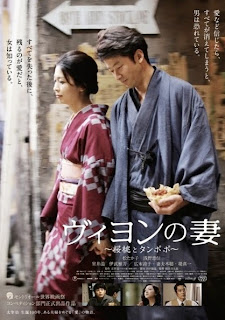
Villon's Wife ヴィヨンの妻 〜桜桃とタンポポ〜 (Viyon no tsuma) [2009] • Japan

This film made me crazy. It's a good film, very well acted with some poetic dialog sprinkled throughout, but it's also some of the worst Orientalist horror imaginable. But that's weird because it's a Japanese film, by a Japanese director, based on a short story by a Japanese writer. "Villon's Wife" is the name of the story the film is based upon, and the film is about a wife but there's nobody named Villon in it. If you run the Japanese sub-title, 〜桜桃とタンポポ〜, through Google translation it returns "Cherry and dandelion", which might seem a little abstract but it has a lot more to do with the movie than "Villon's Wife" and actually takes a bit of the sting out of what comes off as the debatable center of attention and refocuses it on what really matters. 

On the surface this is a film of questionable merit about a long-suffering and loyal wife, named Sachi, to a cheating, thieving, alcoholic husband named Otani. They have a two year old child. Otani is a writer and an attempt is made to give his awful ways a pass by portraying them as self-destructive in that poetic way only artists can be, and be loved. He characterizes the owners of a local pub, where Sachi is working to pay off his debt, as "mercenaries" who feed him liquor so they can profit off him. That's the twisted logic of a drunk. He says things like "Distant yet close, are man and woman", and "Women know neither joy nor grief ... men know only grief. They are always fighting fear". Goodness.

Which brings us to cherries and dandelions. Otani has written a dandelion story about "a dandelion's sincerity". The story moved a young factory worker named Okada so deeply he begins stalking Otani but meets and falls in love with Sachi instead, quickly sussing Otani's ill-treatment of her. Over drinks with this would be suitor to his wife Otani, as a self-reflective woe-is-me justification for his abuse of Sachi, says "I can't even love a dandelion the way I should. I want to pluck its petals, scrunch it in my fist ... stick it in my mouth..." Otani is suspicious of the relationship between his wife and the factory worker and, feeling like a cuckold, meets with one of his lovers, portrayed as equally self-destructive (somehow, as a woman she is able to feel grief too, I guess), and they attempt suicide together. They fail. Sachi dutifully hires a lawyer, an old flame who is still in love with her, to defend Otani who is charged with the attempted murder of the girl. Sachi doesn't have any money and might have slept with the lawyer as payment.

The film ends with Sachi trying to mend things with Otani who is eating cherries that were given to him to give to his son. He acknowledges he is a terrible father. Sachi eats one of the cherries, says they are good and tells her husband that "Being a monster is fine. As long as at least we're alive, it's just fine." I wanted to pull my hair out.

Japanese sexism may not be peculiar but it is certainly intense and complex. On first blush, Villon's Wife seems to be one big stereotype celebrating the loyal, subservient, and beautiful Japanese woman. And props must be given to Takako Matsu who plays Sachi. She is beautiful, beaming that stereotype loud and clear. Everyone in the film is portrayed as loving her. She is so radiant it might be hard to take your eyes off her and see what else is going on in the film. Villon's Wife is a period piece set in the late 1940s and all the characters seem self-destructive. The Japanese have lost the war and GI Joe is everywhere. When Sachi goes to meet with the lawyer who helped her husband, she first approaches a woman on the street who is applying red lipstick to entice GI Joe, and says "Please sell me your lipstick". The woman replies "A Yankee gave it to me. It's American." Sachi makes the woman an offer she can't refuse, applies the lipstick and goes in to see the lawyer. When she comes out, her hair ever so slightly disheveled, she sees the lipstick woman in the back of a Jeep with a few other women and a bunch of GI Joes. The woman is waving and saying "Good bye. Good bye". At first Sachi seems confused, but eventually smiles and returns the "Good bye". She sets the lipstick down in the grass and, with an apparent sense of shame (or empowerment?), wipes her hand across her lips.

I don't really know for sure if this film is that smart and subtle, but if it's not, it's awful. I can't even say for sure what exactly the film is exploring or trying to say. It would help if I were Japanese, I think, and had read the source material but that kind of movie going is for college students. I can say that Villon's Wife presents itself as being a whole lot more than a simple character study of an abused but loyal wife. I blame the chosen English title for throwing me off. All of the performances are outstanding. Takako Matsu is brilliant and beautiful as Sachi. Asano Tadanobu was born to play the role of Otani and Ryoko Hirosue is wonderful in her bit part as his partner in the attempted Love-Suicide. All the characters are good and the film looks great. I'm not so creeped out any more, but be warned: watching this film at face value is a little troubling. If you don't look for deeper meaning it might not appeal.

★★★★
Director: Kichitaro Negishi
Starring: Takako Matsu, Asano Tadanobu, Ryoko Hirosue, Shigeru Muroi, Masatô Ibu
IMDb 7.7 (58 votes)

Non-Ko (Nonko 36-sai ノン子36歳 (家事手伝い) (kaji-tetsudai)) [2008] • Japan

Another nearly great film from director Kazuyoshi Kumakiri. The direction isn't as innovative as in Green Mind, Metal Bats, and the story isn't as novel either but Maki Sakai's performance carries the film more than enough for it to be engaging. I don't know why Saki isn't a bigger star. She seems like such an intelligent and courageous actress. Here she plays a thirty-something divorcee who used to be a popular movie actress starring in films with titles like Sexy Gambler and such. She has retreated to the countryside to live with her family who are caretakers of a Shinto shrine that is about to hold its annual celebration. Sakai's character isn't very likable, by viewers or by the other characters in the film, but somehow she makes her internal disappointment with life palpable and it brings you along for the ride. My only problem with the film is that I didn't like the one character who does like her, mostly because I couldn't understand why she comes to, momentarily at least, like him. He's a younger goofball of sorts who's come to set up a stall at the shrine celebration and ends up staying with Sakai's family. It's probably only his youthful ambition she finds attractive. The film is mostly bleak, punctuated with a few happy moments that seem a little out of place, and a couple sex scenes that require the infamous Japanese pixel blur.

Non-Ko is a successful portrait of a woman who feels anger, isolation, and disappointment in equal measure.


★★★★★
Director: Kazuyoshi Kumakiri
Starring: Maki Sakai, Gen Hoshino, Shingo Tsurumi, Kanji Tsuda, Ryûto Kondô

IMDb
Asianmediawiki

Beast Stalker 证人 (Ching yan) [2008] • Hong Kong

There isn't one single monster in this (what's up with that?), although Nick Cheung looks pretty spooky with his fake eyeball and possesses some über-human qualities like always being out of the blue and into the right place always at the right time, moving at speeds faster than light, and getting bashed in the face with a rock and not bleeding. The (contrived and typical) story construction which explores the tug of war among duty, friendship, love, and responsibility is done well, and Nicholas Tse and Cheung both turn in top notch performances, as does the little girl. All the acting is pretty good when you can actually see what's going on. I had to stop frame and inch through a scene on a bridge/overpass where they hung the little girl over the edge. I wonder what the film could have been without being a stylized action pic.

Jingchu Zhang also stars but she seems to come up unremarkable in manly action movies like Overheard, Protégé and this one.

★★★
Director: Dante Lam
Starring: Nicholas Tse, Jingchu Zhang, Nick Cheung, Philip Keung, Esther Kwan
IMDb
Wikipedia

Green Mind, Metal Bats 青春☆金属バット (Seishun kinzoku batto) [2006] • Japan

This is a hard film to describe except to say that it's deadpan funny, delightful and successful in it's earnest attempt to remain off-kilter. It's about two guys who are bummed out their dreams of becoming baseball stars didn't pan out, and a girl who loves baseball and baseball players. One of the guys was a pitcher, played with finely nuanced body language by Masanobu Ando, who's become a bicycle cop and hates everything except himself. He uses his position of authority to do things like get shoplifting housewives to show him the color of their underwear. The other guy is a batter (of unknown position), played by Pistol Takehara, who still wants to make it, practicing his swing a thousand times a day. He's a little numb in the noggin, having been beaned by the bicycle cop pitcher ten years ago and becomes an accomplice in love and illegal activities with a drunken, violent woman who shares his love of baseball. The show stealing woman is played way over the top by Maki Sakai, and now I'm sort of in love with her myself. I generally dislike watching actors play drunk, but with the exception of some of her stumbling, Sakai creates a believable and engaging character who's pushing forty, still hot, not so nice, but fun to have around. She had to wear prosthetics to round out her role as "the chick with a rack".

Green Mind, Metal Bats is a low-key, low budget absurd comedy with an edginess that keeps it unpredictable and unsettling. A bit part by Noriko Eguchi, as the pitcher's wife, gets this one a bonus point. Anything with Eguchi is better for it.

★★★★
Director: Kazuyoshi Kumakiri
Starring: Pistol Takehara, Masanobu Ando, Maki Sakai, Noriko Eguchi
IMDb
Asianmediawiki

Crossing Hennessy (Yue man xuan ni shi) [2010] • Hong Kong

A gigantic disappointment for Lust, Caution star Tang Wei's return to the big screen. She's woefully under-used, pouting a little bit here and there or acting obviously phony as her character tries to pretend that Jacky Cheung's character is interesting or funny. I've seen 5th graders act better than Cheung does in this film. It's almost as if he mistakenly wandered onto the set of the wrong movie. He's out of sync and irritating the whole way through. And not funny at all. The suspension of disbelief factor has to be in full force to accept that Tang Wei's character might fall for this guy. Of the many supporting characters in the film, his extended family verges on being likable but they whined so much it became annoying. Cantonese is not a pleasant sounding language for that kind of communication. The film does show a seldom seen side of everyday Hong Kong which is refreshing but beyond that the film's pretty much a train wreck without chemistry, comedy, or cuteness.

★★
Director: Ivy Ho
Starring: Jacky Cheung, Wei Tang, Maggie Cheung, Danny Lee, Lowell Lo
IMDb
Wikipedia

Red River (Hong he) [2009] • China

Another film starring Jingchu Zhang. This woman is surprising me. I have seen, and liked, her bit parts in Overheard and Protégé, a couple manly pictures where the female roles amount to no more than looking good, which she does very well, and assisting the story arc of the manly men moving forward, which she does very well. I didn't imagine her being capable of so much more than that. Ann Hui gave her a starring role in a film I recently reviewed, Night and Fog, and Zhang owned that film. So here comes Red River, another starring role.

The film didn't make a big splash and seems to have gotten lost in the shuffle of the many films that were produced to commemorate the 60th anniversary of Communist China. I'm not entirely sure of what connection this film has to that celebration because many of the cultural particulars were lost on me. The film is set near the Red River at the border of China's Yunnan Province and Vietnam. Problem is, Zhang is a Mainland Chinese woman playing a young Vietnamese girl and the other three stars are Hong Kong actors. The dialog seems to drift between some Mandarin dialect and broken Vietnamese—phonetically spoken by the Hong Kong actors—and I couldn't keep a firm grip on who was supposed to be Chinese and who was supposed to be Vietnamese or when things were supposed to be happening in China, or in Vietnam. Things become clearer as the film goes on but while I was working through it, I was confused.

Setting all that aside, Red River is also a rather sweet gender-swapped Oedipal love story interrupted by gangsters. The story starts off with a brief prologue set in the Vietnam war era seventies. A little girl, Ah Tao, witnesses her father being blown to bits by a land mine when they're flying a kite together. Big Bummer, that. It then jumps to the nineties with Zhang playing Ah Tao, all grown up but suffering mentally from the trauma. She's working as a cleaner in a massage parlor (in China) owned by her aunt who has a friend, Ah Ha (Cheung), who happens to look a lot like Ah Tao's father. Ah Ha discovers Ah Tao has a marketable singing voice so he's nice to her while trying to make money off her by charging people a couple dollars to Karaoke with her. The aunt also has a wealthy and cruel gangster client who's pissed off because he had a leg blown off in the Vietnam War, and he takes an interest in ah Tao because, since she's mentally challenged, she doesn't know enough to avoid him. Ah Tao's affection is for Ah Ha, because he's nice to her and he doesn't kill people for a living—and the other thing—so she runs off with him. This angers the gangster who chases after them to get her back. Tragedy and trouble ensue. Things end sadly.

So much for the story. I really like Zhang's performance. Playing a mentally challenged person is a tough role. More often than not actors resort to obnoxiousness and slobbering to get the point across. Zhang plays it sweet and clean. A Variety reviewer calls Zhang's performance too "one-dimensionally wide-eyed" to be convincing. She is wide-eyed, to be sure, and she may be one dimensional, but her dimension comes off as childlike freedom, unencumbered by the nuances of modern bullshit living that clobber any hope for happiness. That's the beauty of the way Zhang plays it. Her handicap is a freedom to approach the world in a state of honest and hopeful wonderment. She's seems happy scrubbing floors and singing for people, and Zhang does a fantastic job bringing that to life.

I may object on principle to the film business habit of having drop-dead gorgeous women with perfect skin, hair, teeth, and nails playing mentally retarded Vietnamese refugees scrubbing floors in massage parlors—but not in practice. Zhang is both beautiful and talented. She's pleasant to look at and she does a good job.

★★★★
Director: Jiarui Zhang
Starring: Jingchu Zhang, Loletta Lee, Nick Cheung, Danny Lee
IMDb
Wikipedia
Asianmediawiki

Nuan [2003] • China

This is very good looking film. It's a fairly typical Chinese story about a village boy who goes to the city for university and returns ten years later for a quick visit and runs into the girl who was his first love, and to whom he promised he would return to after university. Liar! The woman gave up waiting for the guy and married the village idiot who is also mute.

It's a Chinese film, but Japanese actor Teruyuki Kagawa plays the mute guy and it's the first of the many roles I've seen him in that I haven't liked. He pretty much killed the film for me. He won awards for his performance, it's just that I dislike characters who act like ill-mannered assholes, so your mileage may vary.

The whole film is a little slow on the uptake with all kinds of flashbacks going on to show the young lovers. The back and forth from present to past has an odd rhythm. And the big moral of the story comes up wimpy sealing the deal: "I'm a liar but the girl I lied to seems happy, so that's good. I guess I'm a loser". Or something like that. Excepting the beautiful cinematography, the film feels like it was put together by folks with good intentions lacking a mature vision beyond simply capturing a place in time. Some times that works and some times it doesn't. I liked the early love birds and the scenery but the film kept frustrating me in its execution.

★★★
Director: Huo Jianqi
Starring: Xiaodong Guo, Teruyuki Kagawa, Jia Li
IMDb
Wikipedia

Night and Fog (Tin shui wai dik ye yu mo) [2009] • Hong Kong

Stories of domestic abuse are often so unreal or surreal, if/when they are made into movies they often come off as unbelievable or too melodramatic, leaving the facts of the case alone to provide the emotional impact. The aesthetics of the film itself seem less of a priority. The acting and direction of Night and Fog are so pitch perfect, that even though the story starts at the end so we know the result and it's unraveled through flashbacks and police interrogations, it plays out like a mystery. It's not the what of what happened but the how of what happened that compels. And don't write off Jingchu Zhang as just another pretty face. She nails the part of an ambitious peasant girl from the heartland, in this case Sichuan, who appears to have made it to the top by marrying a Hong Kong man. Her sisters made it only halfway, marrying men from the industrial Shenzhen. This is the ladder of success many young women from the disadvantaged rural areas attempt to climb. No matter that many of the men they pursue, especially the ones from Hong Kong, might already have a wife.

Director Ann Hui places the micro of domestic abuse into a wider macro social context with such honesty it's scary. The film reveals a plight of a segment of the Chinese population it hurts to know about. Hui pushes hard on the social buttons of an issue that many would like to ignore, but that's what gives the film its power. This is one of the more painfully sad films I've seen in a long time. I put it on when it was already way past my bed time, thinking I'd just get a feel for it and fall asleep. Well, a feel for it I got, and ended up staring at it, bug-eyed, the entire two hour runtime.

★★★★★
Director: Ann Hui
Starring: Jingchu Zhang, Simon Yam
IMDb 7.2 (24 votes)

Trailer: