The Most Distant Course 最遥远的距离 (Zui yao yuan de ju li) (2007) • Taiwan

This is one of those slow and dreamy ones. The story of three different people, each on their own journey, whose lives overlap may be a familiar one but this version has its own unique angles  and just enough depth of character to keep the viewer engaged. All three characters are wonderfully portrayed.

Tang (Tz-yi Mo) is on a road trip capturing sounds and recording them onto cassette tapes from all the places he had hoped to visit with his girlfriend before she broke up with him. He sends the tapes to the last known address he has for her but she has already moved on. Xiaoyun (Lunmei Kwai) now lives at the address and receives the mysterious and unidentified tapes. Unhappy with her present conditions in life, Xiaoyun sets out to find and visit all the places the sounds are coming from with the outside hope of maybe meeting the guy who is sending them.

Tang meets up on his travels with a psychiatrist, played charismatically, if a bit larger than the rest of the film's characters, by Siao-guo Jia, who is also suffering a broken heart and doing some soul searching of his own. The two of them share some odd experiences and some moments of sad humor while Xiaoyun's parallel journey is filled with many beautiful sights along the Taiwan countryside. Everything comes together in a very bittersweet ending that's neither happy nor sad but wide open to possibility.

★★★★
Director: Jing-Jie Lin
Starring: Tz-yi Mo, Siao-guo Jia, Lunmei Kwai

IMDb
Asianmediawiki
Love HK Film
Taipei Times

A Good Rain Knows 호우시절 (Ho woo shi jul) aka Season of Good Rain [2009] • South Korea, China

It would be a spoiler if I were to state one of the main reasons I love this movie. I can say, however, that the film is very much about a Chinese experience, and the fact that it is directed by a Korean is what makes it interesting. There are other good things about the movie so I'll work with them and save the spoiler.

A Good Rain Knows is nice to look at. It's photographed in crisp and bright colors and makes great use of it's locale, Chengdu, the capital city of Sichuan Province. It's got dancing in a downtown square, bamboo groves, even a scene with a panda bear. Gao Yuanyuan as Mei, a tourist guide in a Chengdu park, has never looked more radiant. Jung Woo-sung is a South Korean heartthrob but his acting ability is curious. He always seems nervous. He plays an architect, Dongha, who travels to Chengdu on assignment and runs into Mei, an old and dear friend. There is no plot to speak of, just the unfolding of their past and present relationship that gives the film its purpose.

Dongha, a Korean, and Mei, a Chinese, communicate almost exclusively in English. Since their relationship is presented as fragile and tentative, and since Jung is a nervous actor anyway, having them communicate in broken but understandable English is a stroke of genius from director Hur. If you're bothered or unmoved by the stilted verbiage the film won't work.

In typical Hur fashion, and this film sees him in perfect stride, not much happens. We're presented with a couple characters testing the water to see if, when, and how love will factor into their relationship. The lens slowly gets closer, revealing inner layers, until a small explosion occurs. And in typical Hur fashion this explosion takes place far beneath the surface. We know it's a big one but all we see are the rippling aftershocks (hint) on the surface.

Hur is a fascinating director. In some ways his films are just cheesy romances with questionable soundtracks, but he possesses an emotional intelligence and an eye for subtle soul-searching details that make his films powerful when he gets it right. He gets it right this time. A good rain knows when to fall.

★★★★★
Director: Jin-ho Hur
Starring: Woo-sung Jung, Yuanyuan Gao, Byung-seo Kim

IMDb
Asianmediawiki
HanCinema
Beyond Hollywood

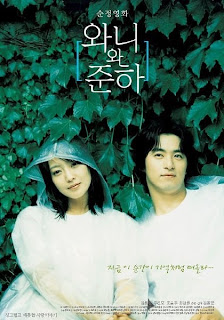
Wanee and Junah 와니와 준하 (Wanee wa Junah) [2001] • Korea

In an angsty romance there's got to be something in the way. Koreans usually toss in a terminal disease as roadblock. Wanee and Junah employs something different. Let me get the accolades out of the way before I spoil the hell out of the movie so you can stop reading when it's appropriate for your needs.

Hee-seon Kim, as Wanee, is fabulous. I'm not familiar with her work outside Wanee and Junah but apparently this "first beauty of South Korea" hadn't received many high marks in the thespian department before this. She is a natural and simple beauty but that's not important. She brings an incredible amount of restraint and depth to the role here, and when it comes time to cry she does it just right. Jin-mo Ju, also a looker, as Junah, is very sympathetic and brings more to his role than just being a kind and supportive puppy dog.

These two very genuine performances allow for Wanee and Junah to reach some peaks of emotional sadness on the level of One Fine Spring Day—one of the best films ever made about love evaporating for no reason (or for so many reasons it's too complicated to parse), just like it does in real life. This is the kind of sadness that doesn't make you cry, it makes you mad. It makes you want to rebel against it because it seems so unfair, so not right. So with all this goodness going for it why don't I love this film? Maybe I do. Maybe I'll come around to accepting it, warts and all. One thing I love about it is that it has stayed with me and scrambled my brain for days after watching it.

The director uses a handful of jump edits in the first act of the film. This technique is often utilized to let ten seconds of screen time signify a much greater span of real time. I thought they were unnecessary and gave it an amateurish feel. The film jumps back and forth in time, from the present day to Wanee's high school days, so there is an inherent non-linearity to it. Since the film is about Wanee coming to terms with her past, and Junah discovering it, this is necessary. All of the transitions between time zones are expertly and creatively done but the substance of them often feels oblique, like the director is toying with the viewer's ability to file each of them away for later explanation. This is the kind of thing film snobs champion, saying "The film makes you think!". But good films should make you think about their content not their structural deployment.

Here come the ***SPOILERS***

It ends happily. In a way it comes as relief because ten minutes before it ends you're likely to be coiled up in disbelief at the level of sadness. But something about a happy ending makes for a less powerful film. It becomes just a movie at that point. Wanee and Junah is not just another movie, though. The roadblock to romance is Wanee's first love. A love left unconsummated and full of prickly details, one of which is that it kills her mother's husband, who is the father of said first love, which makes the guy her half-brother, not to mention also her best friend's first true love. At first, all of this thorniness seemed cheap to me, especially the way it is not made clear from the beginning. I felt deliberately mislead even though I knew from the overall wholesome tone of the film it wasn't going to go very far into dark places. It could have. And it could have chopped off the happy ending and it would have been killer. And I would have criticized the film for being unrealistic and exploiting taboos for the sake of making me unnecessarily unhappy. End ***SPOILERS***

Wanee and Junah is a pretty remarkable film. Good performances, good cinematography and score compliment the ambitious, if not always successful, directorial choices in both structure and content. I was frustrated many times along the way but not too many films can tie your guts up into a knot the way this one does. Color me impressed with that.


I'm posting this one with four stars, which is a compromise between Your Mileage May Vary and A Great Success. I've given it three, four, and five stars in the tags because I really can't decide. Wanee and Junah, like the aforementioned One Fine Spring Day, is a film that depends a lot on what you bring to it, what your own experiences are, and where you sit with regards to some of the delicate circumstances it operates in.
★★
Director: Yong-gyun Kim
Starring: Hee-seon Kim, Jin-mo Ju, Seung-woo Cho, Kang-hee Choi

IMDb
Asianmediawiki
HanCinema
Love HK Film
Koreanfilm.org

One Day (You yi tian) [2010] aka As I Walked Out One Evening • Taiwan

This is a strange one, in a good way, for the most part. It's a lovely and meditative story of blossoming and innocent young love that jumps back and forth in time and in and out of dreams. It gets a little weird, then a little confusing, and then almost shoots itself in the foot by hinting at some plot to get in the way of the story. I'm not sure that it happened but it seems to have, and it appears to relate to the melodramatic question a young woman asks her mother: "If you could go back to the past and meet dad again, would you still marry him ... but you know that he would have an accident later?"

Nikki Hsin-Ying Hsieh, looking a lot like Zhou Xun from certain angles, plays the young woman with the beautiful name, Singing. She works on a ferry that shuttles recruits between the port of Kaohsiung and the military base of Kinmen Island. One night during the trip all the lights go out on the ferry and Singing appears to be alone. Then an Indian man with an axe, screaming without subtitles, chases her. She's rescued by a young soldier and the loopy dream logic begins. The soldier tells her that they are not in the real world. A horse walks by. Singing's hair is shorter and she's in a study hall in Taipei sitting next to the soldier only now he's a student. They fall in love but keep waking up together, or falling asleep and dreaming together, on the ferry. The future, the past, what's a dream and what's reality blur to the point that it doesn't matter. Until that little plot point rears it's head. There's a little crying and some running, two things that suggest melodrama, but this is a mood piece much more than a drama. The dreamlike quality is emphasized by the fact that almost all the scenes take place on or near the water. The cinematography is often muted and the soundtrack mostly noodling piano.

I think it's a mistake to try and discover meaning in a film like this, as the director or as a viewer, even though it's filled with innumerable possible symbolisms. This is not a commercial love story. It's far too down tempo and poetic. But it is a love story and these kinds of films require a nice couple for us to love, and the two leads provide that here, with extra credit given to the ever watchable Nikki Hsin-Ying Hsieh in her film debut.

The beautiful theme song that plays as the end credits roll is sung by Tarcy Su, a singer and actress I just discovered in the remarkable film Blue Cha Cha.

★★★★
Director: Chi-Jan Hou
Starring: Bryan Shu-Hao Chang, Nikki Hsin-Ying Hsieh, Gwen Yao

IMDb
Asianmediawiki

The Last Lioness [2009] • National Geographic

I'm always suspicious about how much of the "story" is manufactured in some of these animal documentaries. This one focuses on a single lioness, Lady Liuwa, who is the sole survivor after massive poaching wiped out most of the wildlife in Zambia's Liuwa Plain, a 3,000 square mile reserve. Cameraman Herbert Brauer goes there to photograph hyenas and becomes the object of Lady Liuwa's affection. The lioness hangs out by his jeep and does playful ktty-rolls, sleeps close to his tent at night, follows him around like a well trained dog and rips the seat of his jeep to shreds trying to get at a little of his man smell (I guess).

Lady Liuwa has been alone for five years. The African Parks Conservation team hatches a plan to bring in a male lion to give Lady Liuwa some companionship and the possibility of mating and creating a new pride of lions in the park. The first male they bring in chokes to death on his own vomit after waking up from the ten hour sedation needed to transport him to Liuwa from wherever he used to live. They don't show that part, though, and don't really explain why it's so difficult to find and translocate some stud, or even some other girl lions, for Lady Liuwa to play with.

Eight months later the African Parks Conservation team finds a couple lion brothers and translocates them to Liuwa. Five days later they are hanging out with Lady Liuwa and she's doing kitty-rolls for them.

There better be a sequel.

★★★★

Starring: Lady Liuwa the Lioness

NatGeoTV site

Fine, Totally Fine 全然大丈夫 (完全没问题) (Zenzen daijobu) [2008] • Japan

This is a subtle, almost surreal comedy that wanders along at a slow pace, punctuated with bits of low-brow humor to keep it alive. It's also an odd little romance and a root-for-the-losers character drama, but there's never any high drama, as the film never gets out of lazy Sunday afternoon mode. The comedy and romance are spices in the mix of everyday people turning thirty, going nowhere fast, who end up going from not so good to not so bad after all. When the humor is subtle or sad it's great, but not so good when it resorts to the juvenile, like when a booger flies across the room and lands in someone's eye. Comedy is tough and everyone has a style that suits them. I could have done without the more broad-based physical bits but they do serve a purpose as little alarms for those who don't appreciate two hours of deadpan, no matter how funny it is. The director demonstrates a good amount of skill in using editing for comic timing, and he was wise to cast YosiYosi Arakawa as the guy to do the heavy lifting when it comes to the “Life’s more fun when you’re an idiot” bits.

I recommend this film to those who like slow comedies, but also to those who like whatever you call these uplifting films about everyday people who don't become rock stars or win the Olympics but just get along and find happiness in everyday life. I love the way the film ends and anti-resolves a love triangle we weren't sure was going to turn out to be much of a plot point. I wanted to reach through my screen and hug the crap out of Yoshino Kimura. Her performance really surprised me. What a pleasure to see her do comedy, albeit of the low-key and clumsy kind.

And even though her part is very small, any film with Noriko Eguchi gets points just for having her.

★★
Director: Yosuke Fujita
Starring: YosiYosi Arakawa, Yoshino Kimura, Yoshinori Okada, Noriko Eguchi, Shima Ise

IMDb
Asianmediawiki

Be Sure to Share ちゃんと伝え (Chanto tsutaeru) [2009] • Japan

"I love you, man".

Sion Sono has made some strange films. This is not one of them unless you consider it strange for him to make such a normal film. Be Sure to Share is a small, simple, and sentimental film, not typically Sono-esque. There's no blood and there's no running around with a handheld camera. There's plenty of emotional desperation but it's of the uplifting kind. The film is about a twenty-seven year old young man who wants to find a moment of bonding, a way of saying thank you, "I love you, man" to his dying father. The title says it all. It's not too mushy, though. The film works because of it's simplicity. There is the big scene that sort of stretches credulity but we could see it coming and Sono follows it up with one of the more hilarious uses of the line "didn't see that one coming" I've ever heard. It's off-camera and sort of eavesdropped upon and it made me laugh out loud.

The film is beautifully cast. Everyone is lovable. Idol-boy Akira does a very credible job playing a normal guy who all of a sudden must deal with mortality, in more ways than one. Ayumi Ito is adorable as his girlfriend and has one of the best crying scenes I've seen in a film. Keiko Takahash is pure mom incarnate, an immaculate performance. Eiji Okuda is good as the father when he's lovable and nice but he also has to play the predictably strict father who's tough to love, in flashbacks, so we get a sense of whatever it is that that film cliché gives us. That's the only weak part of the film but it's not enough to spoil it.

★★★★★
Director: Sion Sono
Starring: Akira, Eiji Okuda, Shogo Ueno, Ayumi Ito, Keiko Takahash

IMDb
Asianmediawiki

Secret Reunion (Ui-hyeong-je) [2010] • South Korea

This is a Hollywood style cat and mouse buddy flick with good action sequences, good acting, and a thick plot with international intrigue which ends happily ever after. It stars a couple of South Korea's top box office attractions in Kang-ho Song and Dong-won Kang. Song plays his usual bumbling yet lovable and competent self, and Kang ups his acting ante from stud muffin to scary good hit-man. They have great chemistry together. It's gritty and bloody and, because it seems to follow Song wherever he goes, it's sprinkled with bits of humor throughout.

So what went wrong? Nothing, really, until the deus ex machina at the end. It's probably never been more true than it is with Secret Reunion that a bad ending can ruin a film (for some people). It seems to have bothered critics more than audiences, as Secret Reunion is South Korea's highest grossing film of the year so far. But it also seems to have disappointed one of its actors. As Song put it in an interview "If I were the director, I would have chosen an ending for "Secret Reunion" in which the pain lasts longer". In other words, no living happily ever after. South Korea has a tradition of ending films a little differently than most Hollywood films. People usually die instead of flying off into the sunset. I say it's no big deal and there is a lot f fun to be had with Secret Reunion. Just close your eyes, stop the DVD Player, or walk out a few minutes early f you don't want any cheese in your omelet.

★★★★
Director: Hun Jang
Starring: Kang-ho Song, Dong-won Kang, Kyeong-min Go, Seung-do Han, Su-ho Ha

IMDb
Wikipedia
Asianmediawiki
HanCinema

Yuriko's Aroma ユリ子のアロマ (Yuriko no aroma) [2010] • Japan

Oh, the expectations. Noriko Eguchi stars as aromatherapist Yuriko, who finds herself uncontrollably aroused by the sweaty scent of a seventeen year old boy. Oh, the possibilities. The boy happens to be the niece of the woman who owns the salon where Yuriko works. That's the story and pretty much the whole plot.

The film gives itself away early, letting on that it's going to be safe and good-humored. Oh, the let down. The moment things hint towards any tension, or that things might get sexy or erotic, the soundtrack rears its ugly head and plays goofy and light-hearted. And then the scene cuts away. The technique of cutting a scene before it finishes can be effective in moderation but here it's so overused it seems to reinforce a suspicion that the director doesn't know how to let a scene form its own conclusion. The film is sprinkled with innumerable scenes that have no beginning nor end, just a shallow, usually brief, middle period. Most of them add nothing and could have just been eliminated.

The film's runtime is only 79 minutes and it could have easily been shorter. It doesn't explore anything in any depth and there are a whole lot of scenes of "opening the door slowly, inch by inch" that could have been tightened up to make room for something else except there's nothing here. A couple off camera handjobs and an embarrassingly out of place scene with a topless air-head girl giving Yuriko a massage don't add any adult or erotic content.

I love Noriko Eguchi so I'm going to write off her Quaalude inspired performance as the result of bad direction. It's a gutsy role, in theory anyway, which calls for her to do a lot of aroused sniffing of a young boy's body and licking of his head. She does those parts very well. Few people could. Too bad they are the only interesting moments in the film.

★★
Director: Kôta Yoshida
Starring: Noriko Eguchi, Shota Sometani, Noriko Kijima, Jun Miho, Saori Hara

IMDb
Asianmediawiki
Midnight Eye
Official Site

There are snippets in this official trailer (which probably won't last long on YouTube because of the boobage) that aren't in the movie and the dialog is cut up and mismatched to create something that doesn't exist in the final product.