In Love We Trust (Zuo you) [2007] • China

Check this scenario: a divorced couple learns that the only way to save the life of their little daughter Hehe (that's her name, I'm not inserting a chuckle), who suffers from a blood disease, is to have another child. But both of them have remarried. Do they do it? Do they do it in secret? Can they do it?

No surprise to learn director Xiaoshuai Wang studied painting before becoming a director. This is a marvelously composed film. The screenplay is brutal sharp with one large unnecessary gimmick toward the end. I'm glad this theme was done art-house and not commercial melodrama, which it could easily be. The four main performers are solid and compelling, with lots of shots of faces on bodies doing nothing but carrying burden within. And they all pull it off. You'll have lots to talk about after watching this.

★★★★★

Director: Xiaoshuai Wang
Starring: Jia-yi Zhang, Nan Yu, Taisheng Chen, Yuan Tian, Yuanyuan Gao

IMDb
Wikipedia
shanghaiist.com
Screen International

Canary (Kanaria) [2005] • Japan

Another film by Akihiko Shiota, director of Harmful Insect. It had some moments but nothing special for me. I'm not sure what to think of Shiota at this point. I appreciate what he is trying to explore: disaffected, abused and neglected youth and all that, but I'm not convinced he's good at it yet. Harmful Insect would have been a lot less interesting without Aoi Miyazaki. I think Mitsuki Tanimura does a good job in Canary, Hoshi Ishida not so much but his character was the brooding, doesn't-say-much type, which is difficult for a teenager to pull off (unless you're Aoi Miyazaki).

I confess that many of the cultural pointers were lost on me ... so there's that, I mean, if they were supposed to be specific. Cultural historians and professional film critics (and Japanese folks) might enjoy this film more than I did. I liked the vibe, not sure about the story.

★★★

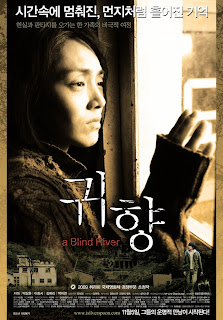
A Blind River (Kwihyang) [2009] • South Korea

Everything about this film is perfect ... except that it doesn't lend itself to slick and easy summation. It's beautifully shot, powerfully acted, skillfully directed, and the soundtrack, while used very sparingly, when called upon to augment the emotion of a scene, is executed with flair.

OK. That's some hyperbolic praise. This film blew me away. The funny thing is, though, I'm not sure I really got it, or got all of it. In a nutshell the film is about a thirty years young Korean man in search of his biological mother. With extras.

This film touches on many of the related topics of child abandonment, identity, adoption, loss, and being young and pregnant and alone (not to mention some very pointed exposition on Korean nurseries and clinics) in very powerful ways but it's not a message film nor an after-school special level catharsis. It's way weirder, and more literary, and much more poetic. The film is more like a visual narrative than a story. The second act is pretty much a riff on Albert Camus' Le Malentendu. And what a second act it is. It reaches Shakespearean levels of emotional intensity that are downright scary, getting jiggy with some twisted Oedipal sidewinder concoction. I wouldn't call this an art-house film, though. It doesn't come off as pretentious or intentionally vague even though parts of it might seem random and inexplicable.

So what is it I didn't get? The film opens abruptly with a scene, likely to cause you to recoil in your seat, of young girl in somewhat primitive circumstances having an abortion. It's not explicit, more fly-on-the-wall view, but it's potent. And I think it's an abortion. Could be she is going to deliver the baby and sell it. Given the stage of her pregnancy the latter is more likely, and the film seems to want to ask if there is a difference. [UPDATE: upon a second viewing, it's clearly option #2, but I'm leaving my error because I'm in favor of letting this represent my initial reaction] Either way, she is in full traumatized mode. The confusing part is that this girl continues to appear in the film, pregnant, with ambiguous results in a parallel storyline. I'm not sure if she is to represent the boy's mother or simply another scenario. I'm not sure at what level this film plays with time, reality, representation, or dreams but only my left brain wants to know. There's nothing frustrating or loose-endy about it if you just let it be.

After the first scene the film settles into more standard drama for a bit, with a little cultural essaying and identity politics as it introduces us to the young man who will be our protagonist. He is with his girlfriend who wants to support him but also proposes to him and suggests it might be better if the two of them start their own family instead. The young man says he's not ready for that and abandons her to go find his mother.

The young man was raised in Australia and speaks English. His Korean is broken at best and this adds to the difficult dreamlike second act when he returns to Korea and ends up at a broken down hotel run by two widows, one of whom may or may not be his mother. I'm not even going to begin to try and dissect the second act. Suffice to say, the ambiguity of this film is precise and remarkable. As is the performance of Park Ji-a as the younger of the two women inn-keepers.

Park Ji-a, apparently going by simply ZIA now, is the only person associated with this film that I know anything about. She's been in a few Kim ki-duk films, most notably the lead in Breath (Soom), and I've always liked her peculiar beauty and thin but extremely muscular frame. It's not surprising to see her here as she has always seemed at home in Kim's dreamy structures. A Kim ki-duk directorial comparison is apt here but I can't tell you a thing about the person who directed this movie, Ahn Seon-kyeong.

Park Sang-hun is very good as the young Korean man, and I guess I do know about Park Ji-Yeon who plays his girlfriend. Her role is minimal but she does a fine job. I'm not sure who plays the young pregnant girl (Kim Ye-ri?) but her performance is amazing. She practically steals the show and you will feel very strongly for her.

Things wrap up with a mildly melodramatic resolve but I didn't really care one way or the other about it. The film had to stop at some point. I can't imagine that even if you hate the ending that it would spoil the preceding journey. This is a film that should be seen by anyone interested in good and/or powerful film making. It's not about the story or the message. It's about the colors and the brush strokes. And the meter.

★★★★★ 

49 great films from the Oughts (the first decade of this century)

Just for kicks.

[Rec] (2007)
The 40-Year-Old Virgin (2005)
Adrift in Tokyo (2007) aka Tenten
Antichrist (2009)
The Aura (2005) aka El Aura
Babel (2006)
Battle Royale (2000) aka Batoru rowaiaru
Blind Mountain (2007) aka Mang shan
City of God (2002) aka Cidade de Deus
The Equation of Love and Death (2008) aka Li mi de cai xiang
Eternal Sunshine Of The Spotless Mind (2004)
Eureka (2000) aka Yurîka
Green Tea (2003) aka Lü cha
Hero (2002) aka Ying xiong
Himalaya With Michael Palin (2004)
In The Mood For Love (2000) aka Fa yeung nin wa
Irreversible (2002)
The Isle (2000) aka Seom
Joint Security Area (2000) aka Gongdong gyeongbi guyeok
Let the Right One In (2008) aka Låt den rätte komma in
Lost in Translation (2003)
Lost Indulgence (2008) aka Mi guo
Love Exposure (2008) aka Ai no mukidashi
M (2007)
Memento (2000)
Memories of Murder (2003) aka Salinui chueok
A Moment to Remember (2004) aka Nae meorisokui jiwoogae
Mother (2009) aka Madeo
Next Door (2005) aka Naboer
No Country for Old Men (2007)
Noriko's Dinner Table (2005) aka Noriko no shokutaku
Oasis (2002)
One Fine Spring Day (2001) aka Bomnaleun ganda
Planet Earth (2006)
Queenadreena: Live (2006)
Requiem for a Dream (2000)
Secret Sunshine (2007) aka Milyang
Sideways (2004)
Snatch (2000)
Spider Forest (2004) aka Geomi sup
Stranger Than Fiction (2006)
Strawberry Shortcakes (2006)
Suicide Club (2002) aka Jisatsu saakuru
Summer Palace (2006) aka Yihe yuan
Synecdoche, New York (2008)
This Charming Girl (2004) aka Yeoja, Jeong-hye
The Unknown Woman (2006) aka La Sconosciuta
Visitor Q (2001) aka Bijitâ Q
What Time Is It There? (2001) aka Ni na bian ji dian

Bounce Ko Gals (Baunsu ko gaurusu) [1997] (aka Leaving) • Japan

This movie was a great big surprise. A film about the world of compensated dating in Japan, made in Japan, could easily be exploitatively cheap or cheaply titillating, but Bounce Ko Gals is neither, and much to many people's chagrin, considering its subject matter, it turns out to be a sweet, sort of melodramatic film about friendship. There is no sex or nudity in the film but it is pretty insightful and blunt about such things. It's not a kids film by any means and as much as some adults might like to think its subject matter inappropriate for teens, it's pretty spot on in its portrayal of youth culture, particularly that of contemporary Tokyo.

The three teenage girls who play the leads are fantastic—all feature film debut performances. Hitomi Satô, as the tough and cynical one, owns the film every moment she's on screen. She's a leader who blasts her clients with a stun gun and robs them instead of sleeping with them. She banks on the fact that no one will ever report to the police they were robbed by an underage, would-be prostitute. Yasue Satô (no relation) is the free spirit, setting up “dates” for high school friends but never going on them herself. She street dances and suffers from "straight-line-itis", becoming nauseous if she ever finds herself walking a straight line in life, literally or figuratively. It's a hilarious schtick. And finally, Yukiko Okamoto plays the innocent one who stumbles into the world of ko girls because of a dire need to finance her education in America. She assists the film in a half-hearted attempt at finding a moral center and eventually brings things to a touching resolve.

The great Kôji Yakusho joins the three girls in the film and offers some old school perspective, adding color to the film's main theme. He plays a veteran sex trade yakusa boss who sees the teenage girls as a threat to his business but he can't help admiring their resourcefulness so a tenuous friendship ensues. He threatens the girls, because his position demands it, but he also assists them when they target the wrong people and get into trouble.

Bounce Ko Gals is a hip, fun, frank, and furious look at the, some would say uniquely Japanese, phenomenon of teenage girls who have discovered their sexual power and find very little reason not to use it even though the endgame of designer handbags and other assorted accessories might seem superficial—not to mention mind-boggling to those of a more mature bent. A straightforward approach to this subject matter results from the director's documentary style of filming, and it's got a great soundtrack. Highly recommended.

★★★★★

Loft [2008] • Belgium

Most of the tension in this film is created by trying to keep the clichéd plot points fresh as they unravel and inevitably teeter on the edge of going over the top. It's done pretty well and it looks good. It's got a little Michael Mann steely look. The set design is minimal and trés modern, the cinematography mostly dark with touches of yellow and gray filters, the soundtrack nudges you along with obvious clues.

Five guys share a loft where they carry on their respective, perhaps, secret sexual affairs. Some are more committed to this scenario than others and all seems to be well until they discover a dead and very bloody girl in the bed. Who killed her, and why? Fingers start pointing and emotions run high. The story is presented through flashbacks and multiple interrogations so one is easily lead astray only to learn there's another side to the story as another deep dark secret is revealed. As soon as you think it's ho-hum, another shoe drops. The screenwriter must live in a Loft with a very big closet. The goodness of the twist factor here is achieved more through quantity than quality. This is not only a whodunit but a whodun-what. It just keeps going and going. It's formula stuff taken to the extreme.

★★★★

City of Life and Death (Nanjing! Nanjing!) [2009] • China, Hong Kong

Maybe the color palette confines itself to a too small range of gray but it is effective. Maybe a few scenes are overly dramatized for effect but I can hardly imagine anything comparing to the real events that transpired. This isn't a documentary and it's not a perfect film but it is an incredibly moving one. There was a bit of an uproar in China over this film, claiming it did not demonize the Japanese enough. A member of the Politburo intervened on behalf of the film to keep it in theaters. There's that to chew on. I honestly can't separate recommending the film from recommending being aware of this ugly bit of history. You could just read a wikipedia entry on the Rape of Nanjing but you could also just watch Dr. Phil or Oprah instead of ever going to the movies. It's like that.

★★★★★

Oto-na-ri [2009] • Japan

This is worth a rental to watch with someone just to discuss the ending. It's one of those "Love was right under your nose the whole time" stories that doesn't have a lot of gas in the tank but it finds a reasonable parking place at the end, an ending which is at first frustrating, then appealing. Then it's back and forth in your mind leaving you unsure if it's a cop out or something inspired. I found it to be acceptable and ultimately enjoyed its resolve, with all its implied storyline.

Oto-na-ri is about two lonely souls, early thirties and, of course, attractive but somehow alone in life. They live next door to one another in an apartment building with paper thin walls and take in elements of each other's life through the sounds and conversations each of them produce. But they never see each other. It's clear that the movie is about these two people but it's not real clear it's going to be about them getting together (or not).

Kumiko Aso plays the girl. She works in a flower shop and is studying to become a professional florist. She will be leaving for France in the very near future—so throw in a "Time is of the essence" plot line for tension. Junichi Okada plays the boy, a professional photographer who may or may not be leaving for Canada in the very near future to take landscape pictures. They are two artistic souls, as characters, to lend a little of the poetic to the proceedings but they're not overly emo.

It's a standard formula to follow the lives of two separate yet somehow implicitly connected people and make us feel that if these two folks would just meet they'd fall in love and all would be well in the world. I wasn't particularly intrigued with either of the two individual stories, a fault of a not very mature script, but I did like the characters, probably because Kumiko Aso is a wonderful and skilled actress who doesn't have a bad moment in the film, and Junichi Okada, a matriculated boy band idol, isn't bad either.

The direction isn't very inspiring, though. There were a number of edits where a scene would just stop and stumble into the next one, and while the film overall seems littered with good intentions it is clearly not the work of a master craftsman. Oto-na-ri riffs on the theme of sound without sight and in one of the films weaker scenes, involving one of the side characters in Aso's singular life, the theme is explicitly spelled out for us in case we didn't get it—a case where the director loses confidence in the old adage of "Show us, don't tell us".

All in all, while it's got a number of less than inspired elements, Oto-na-ri  is a pleasant experience made worthwhile by Kumiko Aso's performance and an ending that will most likely prompt you to groan out loud or applaud it's effort. I liked it.

★★★

A Perfect Getaway [2009] • USA

Some day Timothy Olyphant will land a role in a good movie and the world will ask "Where has this guy been hiding?"

I don't enjoy writing negative reviews and generally reserve the endeavor for films that feel insulting rather than simply failing to excite. Generally these are either art-house films which are too arty or selfish for their own good, or more mainstream films that use standard formulas as if we've never seen them before. A Perfect Getaway falls in the latter category.

I'm going to get spoilery here because there is no way to talk about why I didn't like this film without telling what happens, how it gets there. I will also add that I went into this film knowing nothing about it except for the title which does give some notion of the genre it is aiming for.

In a nutshell we have three couples in this film, one of them a murderous one. The first couple is Steve Zahn and Milla Jovovich. They are presented, very clearly, as nerdy, naive, and wimpy. They embark on their honeymoon to some far off and secluded place in Hawaii. They hear about another newlywed couple that was murdered by another couple and so we are all set to weather the storm of how they will getaway from being murdered. The second couple is presented very early on, and very stereotypically, as most likely the killers. Right here we have the first insult. This couple, couple number 2, is insinuated into the plot in a lame attempt to take your eye off the ball. It's cheap. We know right away they are not going to turn out to be the killers, and yet we also know we are still going to have to sit through a handful of phony attempts to convince us that maybe we are wrong about that obvious conclusion.

The third couple is Timothy Olyphant. He's got a girlfriend but he is the only one important to the character development of the couple. He is mysterious. He has a badass history, carries a knife, kills an animal, and has a steel plate in his head. But he is also a nice, thoughtful guy. It's the back and forth of his mysterious goodness and badness that creates the only interesting tension in this film. And since Olyphant is a good actor his character makes for the only enjoyable aspect of the film—besides some beautiful photography of Hawaii.

To cut a long story short, it turns out that the first couple are the killers (or the first couple is the killer couple). It's a big twist! But it's completely unfeasible. So unfeasible that the film spends thirty minutes of inexplicably black and white night visioned flashback recreations to try and make the case anyway. I immediately called bullshit, stopped caring at all, and just wanted the film to be over because nothing about it mattered any more. Twists should be over with quickly. If a film has to spend an inordinate amount of time defending a twist, it's not a very good twist. I felt completely disrespected by the script. Insulted. Thrillers with twists are supposed to be somewhat mysterious throughout. This one deliberately misleads its audience in a patronizing manner, and only attempts such nonsense because it thinks its audience is gullible and stupid. Well ... right back at ya, Perfect. Getaway from me.

★